


11th Grade Exponents Quizzes
Test your mastery of exponents with this comprehensive Grade 11 mathematics quiz designed to assess your understanding of exponential rules, properties, and calculations. Practice challenging questions with instant feedback to strengthen your skills in working with powers, roots, and exponential expressions at a self-paced level.
Recommended topics for you

14 questions
Recall: Properties of Exponents!

Quiz
•
11th Grade

15 questions
Properties of Exponents
Quiz
•
11th Grade

20 questions
Properties of Exponents
Quiz
•
11th Grade

32 questions
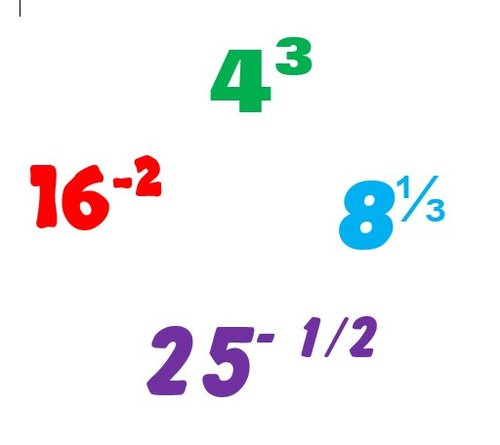
Negative and fractional indices
Quiz
•
11th Grade
25 questions
Negative and fractional Indices
Quiz
•
10th - 11th Grade

15 questions
Power to a Power
Quiz
•
9th - 12th Grade
12 questions
Multiplying Dividing and Power to a Power
Quiz
•
8th - 11th Grade
12 questions
Properties of Exponents
Quiz
•
9th - 12th Grade
27 questions
Multiplication Law of Indices, The Product of Powers
Quiz
•
9th - 12th Grade
15 questions
Laws of Exponents
Quiz
•
9th - 12th Grade
20 questions
Exponents Mixed Practice
Quiz
•
9th - 12th Grade
20 questions
CW 5.1_Review Exponents
Quiz
•
9th - 12th Grade
Explore 11th Grade Exponents Quizzes
Exponents form a critical foundation in Grade 11 mathematics, representing one of the most essential algebraic concepts students must master before advancing to higher-level mathematical studies. Through Wayground's comprehensive collection of exponent quizzes, students engage with targeted practice questions that systematically build their understanding of exponential rules, properties, and applications. These carefully designed assessment tools provide immediate feedback on key skills including simplifying exponential expressions, applying the laws of exponents, working with negative and fractional exponents, and solving exponential equations. The interactive practice questions challenge students to demonstrate their mastery of exponential notation while reinforcing the conceptual understanding necessary for success in advanced algebra, precalculus, and calculus courses. Wayground supports mathematics educators with an extensive library of millions of teacher-created exponent quizzes, offering robust search and filtering capabilities that allow instructors to locate resources precisely aligned with curriculum standards and learning objectives. The platform's differentiation tools enable teachers to customize quiz content, adjust difficulty levels, and modify question types to meet diverse student needs, supporting both remediation for struggling learners and enrichment opportunities for advanced students. These digital-first quiz collections integrate seamlessly into classroom instruction, homework assignments, and review sessions, while comprehensive analytics help educators identify knowledge gaps and track student progress over time. The flexible delivery formats accommodate various teaching styles and learning environments, empowering teachers to reinforce exponential concepts through targeted skill practice, formative assessment, and structured review activities that strengthen mathematical reasoning and procedural fluency.
FAQs
How should I teach exponents and logarithms in Grade 11?
Present logarithms as the inverse of exponentiation: if bˣ = y, then log base b of y equals x. Move between exponential and logarithmic forms regularly, then apply the relationship to equations, growth and decay models, and compound interest.
What exercises help Grade 11 students practice advanced exponents?
Combine rational-exponent simplification with exponential equations and function applications. A strong set includes one equation solved by rewriting with a common base, one requiring logarithms, and one model in which students interpret the growth or decay factor.
What mistakes do Grade 11 students commonly make with exponential equations?
Students often apply exponent properties across addition, take a logarithm of only part of an equation, or confuse a growth rate with the growth factor. In compound-interest problems, they may also mismatch the compounding frequency and exponent.
How can I use a Grade 11 exponents quiz for practice or assessment?
The same quiz can be hosted as a digital quiz on Wayground or assigned as a printable PDF. Every version includes a complete answer key, and teachers can grade paper submissions by scanning or capturing them with the Wayground for Teachers app.
How do Grade 11 exponents fit into the Common Core high school progression?
Common Core high school mathematics connects rational exponents to radicals, then develops exponential functions and their logarithmic inverses. Students use that foundation to solve exponential equations and model situations such as compound interest or continuous growth and decay.
How can I differentiate Grade 11 exponential-function practice?
Offer an extended-time digital version for students who need to manage several algebraic steps, and use reduced answer choices when interpreting parameters in a model is the target skill. A translated quiz version can support multilingual learners while preserving the same equations and data.
What exponent topics are usually covered in Grade 11?
Grade 11 courses commonly address rational and negative exponents, exponential equations, logarithmic relationships, and exponential functions. Applications often include compound interest and growth or decay models.

Accessibility
Features
Wayground Super
School & District
Wayground for Business
Create a quiz
Create a presentation
Wayground AI
Subjects
Mathematics
Social Studies
Science
Physics
Chemistry
Biology
About
Our Story
Wayground Blog
Media Kit
Careers
Support
F.A.Q.
Help & Support
Privacy Policy
Terms of Service
Teacher Resources
2026 Wayground


Get our app

