


3rd Grade Fractions As Parts of a Set Quizzes
Help your Grade 3 students assess their understanding of fractions as parts of a set with this interactive quiz. Students will practice identifying and representing fractional parts within groups of objects through self-paced questions with instant feedback.

19 questions
Fraction as a Set

Quiz
•
3rd Grade

20 questions
Fraction Pieces
Quiz
•
3rd Grade

20 questions
Quiz on Fractions on a Number Line
Quiz
•
3rd Grade
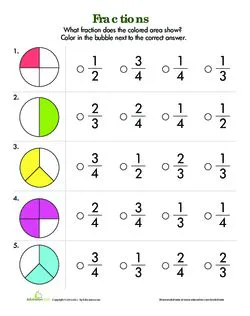
20 questions
Fractions as a Whole
Quiz
•
3rd Grade

20 questions
Fractions of a Part
Quiz
•
3rd Grade

14 questions
Fractions Practice
Quiz
•
3rd Grade
16 questions
Math: Unit 3 Assessment (Fractions)
Quiz
•
3rd Grade
20 questions
Fractions as Numbers
Quiz
•
3rd Grade
16 questions
Lesson 21: Fractions on Number Lines
Quiz
•
3rd Grade
20 questions
Identify Fractions on a Number Line
Quiz
•
3rd Grade
10 questions
Fraction Quiz ( Unit 5 Lesson 8)
Quiz
•
3rd Grade
13 questions
Lesson 2: Fractions as Parts of a Whole
Quiz
•
1st - 5th Grade
Explore 3rd Grade Fractions As Parts of a Set Quizzes
Fractions as parts of a set represent a fundamental mathematical concept that Grade 3 students must master to build a strong foundation in fractional understanding. Through comprehensive assessment and practice questions available on Wayground, students develop critical skills in identifying how fractional parts relate to whole groups or collections of objects. These carefully designed quizzes provide targeted feedback that helps young learners visualize fractions beyond traditional pie charts and number lines, instead focusing on discrete collections where students must determine what fraction of a set meets specific criteria. The practice questions systematically build understanding of how fractions represent relationships between parts and wholes in real-world contexts, enabling students to recognize that three out of five apples represents the same fractional relationship as three-fifths in abstract form. Wayground's extensive collection of teacher-created resources provides educators with millions of standards-aligned materials specifically designed to support fraction instruction at the elementary level. The platform's robust search and filtering capabilities allow teachers to quickly locate assessment materials that target fractions as parts of a set, while differentiation tools enable customization based on individual student needs and learning objectives. These digital-first quiz formats support flexible delivery methods that accommodate various classroom environments, from individual practice sessions to whole-group instruction, making them invaluable for both initial instruction and remediation efforts. Teachers can leverage these resources for comprehensive planning that addresses diverse learning styles, provides enrichment opportunities for advanced students, and offers additional skill reinforcement for those requiring extra support in understanding how fractional concepts apply to grouped objects and collections.
FAQs
What are the expectations for fractions as parts of a set in Grade 3?
Third grade is a critical year for fractions. Students are expected to understand fractions as numbers and work with non-unit fractions (e.g., 2/3, 3/4) as parts of a set. They move beyond just finding one part (1/3) to finding multiple parts (2/3).
How does this topic align with Grade 3 Common Core standards?
This concept is central to the Grade 3 Common Core standards, which define a fraction a/b as 'a' parts of size 1/b. Understanding 3/4 of a set of 12 items as three groups of three is a direct application of this standard and builds the foundation for fraction equivalence and comparison.
How do I teach non-unit fractions (like 3/4) as parts of a set?
Use a two-step process. First, have students find the unit fraction (1/4 of the set). Once they've identified the size of one part, ask them to find the number of items in three of those parts. For example, with 12 objects, first find 1/4 (which is 3), then find 3/4 (which is 3 groups of 3, or 9).
What kinds of problems help third graders master this?
The most effective problems require students to work with numerators greater than one. This quiz includes exercises like, "There are 10 circles. 4/5 of them are shaded. How many are shaded?" This forces students to first determine the value of 1/5 (2 circles) and then multiply by the numerator (4 x 2 = 8).
What is the most common mistake students make with this concept in Grade 3?
A frequent error is misinterpreting the numerator and denominator. For example, when asked to find 2/3 of 9, a student might correctly partition the set into 3 groups of 3, but then only circle 2 items instead of 2 *groups* of items. This shows a confusion between the number of items and the number of groups.
How can I use this Grade 3 fraction quiz?
This quiz can be assigned as a digital quiz on the Wayground platform for instant feedback or downloaded as a printable PDF for offline paper-and-pencil practice. An answer key is included with every quiz to make grading simple and efficient.

Accessibility
Features
Wayground Super
School & District
Wayground for Business
Create a quiz
Create a presentation
Wayground AI
Subjects
Mathematics
Social Studies
Science
Physics
Chemistry
Biology
About
Our Story
Wayground Blog
Media Kit
Careers
Support
F.A.Q.
Help & Support
Privacy Policy
Terms of Service
Teacher Resources
2026 Wayground


Get our app

