


Imperative Sentences Quizzes
Test your knowledge of imperative sentences with this interactive quiz designed to assess understanding of command and request structures in English grammar. Practice identifying and constructing imperative sentences through self-paced assessment questions with instant feedback.

20 questions
Imperative Sentences

Quiz
•
4th - 6th Grade

8 questions
IMPERATIVE SENTENCES
Quiz
•
5th Grade

15 questions
Imperative Sentences
Quiz
•
3rd Grade
20 questions
IMPERATIVE SENTENCES
Quiz
•
1st - 6th Grade

10 questions
Imperative Sentences
Quiz
•
1st Grade

10 questions
Imperative sentences & "What's this?"
Quiz
•
KG - 1st Grade
10 questions
Year 3 Imperative sentences
Quiz
•
3rd Grade
20 questions
English Year 1: Imperative Sentences
Quiz
•
1st Grade
10 questions
Imperative Sentences Quiz
Quiz
•
3rd Grade
25 questions
IMPERATIVE SENTENCES
Quiz
•
3rd Grade
13 questions
Imperative Sentences
Quiz
•
1st Grade
8 questions
Imperative Sentences
Quiz
•
2nd Grade
Explore Imperative Sentences Quizzes
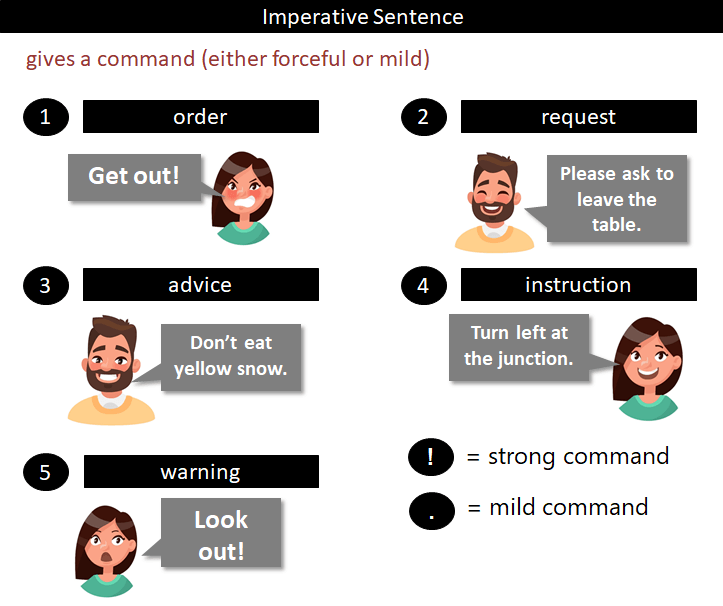
Imperative sentences serve as commands, requests, or instructions that directly address the reader or listener, making them essential components of effective communication in English grammar. These specialized sentence structures typically omit the subject "you" while maintaining clear directive meaning, and mastering their proper formation and usage represents a critical milestone in grammatical development. Through comprehensive quiz collections available on Wayground, students engage with targeted assessment activities that strengthen their understanding of imperative sentence construction, punctuation patterns, and contextual applications. These practice questions provide immediate feedback on student comprehension while developing essential skills in recognizing imperative mood, distinguishing between polite requests and direct commands, and understanding how imperative sentences function across different writing contexts from technical instructions to creative dialogue. Wayground's extensive library contains millions of teacher-created quiz resources specifically designed to support educators in delivering effective imperative sentence instruction and assessment. The platform's robust search and filtering capabilities enable teachers to locate materials aligned with specific grammatical standards while accommodating diverse learning needs through customizable question sets and difficulty levels. Digital delivery formats allow for immediate scoring and detailed analytics that inform instructional planning, helping educators identify students requiring additional practice with imperative sentence recognition or construction. Teachers can differentiate instruction by selecting from various question types and complexity levels, supporting both remediation efforts for struggling learners and enrichment opportunities for advanced students, while the platform's flexible assignment features enable seamless integration into grammar units focused on sentence types and communication effectiveness.
FAQs
How do I teach imperative sentences to students?
Start by contrasting imperative sentences with declarative ones so students can feel the difference in purpose and tone. Emphasize that imperative sentences use a second-person implied subject ('you') that is never written, which is often the trickiest concept for learners to grasp. Use real-world examples like recipe instructions, classroom directions, and safety signs to ground the concept before moving into written practice.
What exercises help students practice imperative sentences?
Effective practice exercises include identifying imperative sentences within mixed sentence-type passages, converting declarative sentences into imperative form, and punctuating commands and requests correctly using periods or exclamation points. Tasks that ask students to write their own instructions for a familiar process, such as making a sandwich or playing a game, help reinforce command structure in a meaningful context.
What are common mistakes students make with imperative sentences?
The most frequent error is confusing the implied subject with a missing subject, leading students to mark imperative sentences as incomplete or incorrect. Students also commonly overpunctuate, placing exclamation points after every command rather than reserving them for urgent or emphatic imperatives. Another recurring issue is mixing imperative and declarative structures within a single sentence, particularly when students attempt to write multi-step instructions.
How do I differentiate imperative sentence instruction for struggling learners?
For students who need additional support, reduce cognitive load by focusing first on a single imperative type, such as direct commands, before introducing polite requests or negative imperatives. On Wayground, teachers can enable reduced answer choices for individual students to make identification exercises more accessible, and the Read Aloud feature can help students who benefit from hearing sentence structures before analyzing them in writing.
How do I use Wayground's imperative sentences quizzes in my classroom?
Wayground's imperative sentences quizzes are available as printable PDFs for traditional classroom use and in digital formats for technology-integrated learning environments, including the option to host them as a quiz directly on Wayground. Teachers can use the platform's search and filtering tools to find quizzes aligned to specific learning objectives, then assign them for independent practice, small group work, or whole-class instruction. Each quiz includes a complete answer key, which supports both self-paced student review and efficient teacher grading.
How is an imperative sentence different from a declarative sentence?
A declarative sentence makes a statement and includes an explicit subject, while an imperative sentence gives a command, request, or instruction and omits the subject because it is implied to be 'you.' For example, 'You should close the door' is declarative, whereas 'Close the door' is imperative. Understanding this distinction helps students correctly identify sentence types and apply appropriate punctuation.

Accessibility
Features
Wayground Super
School & District
Wayground for Business
Create a quiz
Create a presentation
Wayground AI
Subjects
Mathematics
Social Studies
Science
Physics
Chemistry
Biology
About
Our Story
Wayground Blog
Media Kit
Careers
Support
F.A.Q.
Help & Support
Privacy Policy
Terms of Service
Teacher Resources
2026 Wayground


Get our app

