


Interval Notation Quizzes
Master interval notation with comprehensive quizzes designed to assess your understanding of mathematical intervals, inequalities, and set representation. Practice essential interval notation concepts through self-paced assessments that provide instant feedback on writing intervals using brackets, parentheses, and inequality symbols.

18 questions
Using Interval Notation

Quiz
•
10th Grade
15 questions
Interval Notation
Quiz
•
10th - 12th Grade

10 questions
Interval Notation for Beginners BW
Quiz
•
9th - 12th Grade

16 questions
Interval Notation Review MY
Quiz
•
9th Grade

15 questions
Linear Equations, Interval Notation, Domain, Range
Quiz
•
11th Grade

45 questions
Interval Notation and Compound Inequalities
Quiz
•
9th Grade
20 questions
Interval Notation
Quiz
•
9th - 12th Grade
20 questions
Inequalities Set Builder Notation and Interval Notation
Quiz
•
11th Grade
22 questions
Interval Notation
Quiz
•
9th Grade
20 questions
Behavior of Graphs Interval Notation
Quiz
•
10th Grade
16 questions
Interval Notation 1-3
Quiz
•
10th - 12th Grade
15 questions
Interval Notation
Quiz
•
9th - 12th Grade
Browse by grade
Explore Interval Notation Quizzes
Interval notation serves as a fundamental mathematical language for expressing sets of real numbers and solution sets in algebra. These comprehensive quizzes available through Wayground provide students with targeted practice questions that build fluency in reading, writing, and interpreting interval notation across various mathematical contexts. Through systematic assessment and immediate feedback, students develop essential skills in translating between inequality statements and interval form, understanding bracket versus parenthesis usage, and applying notation rules to represent domains, ranges, and solution sets. The practice questions progressively challenge learners to work with bounded and unbounded intervals, union and intersection operations, and real-world applications where interval notation provides precise mathematical communication. Wayground supports mathematics educators with an extensive collection of teacher-created interval notation quizzes drawn from millions of educational resources that align with algebra curriculum standards. The platform's robust search and filtering capabilities enable teachers to locate assessments that match specific learning objectives, from introductory bracket and parenthesis concepts to advanced compound inequality representations. Customization tools allow educators to differentiate instruction by adjusting question difficulty, modifying time limits, and selecting appropriate problem types for individual student needs. These flexible digital delivery formats facilitate seamless integration into lesson planning, targeted remediation for students struggling with notation conventions, and enrichment opportunities for advanced learners ready to explore complex interval relationships and set theory applications.
FAQs
How do I teach interval notation for the first time?
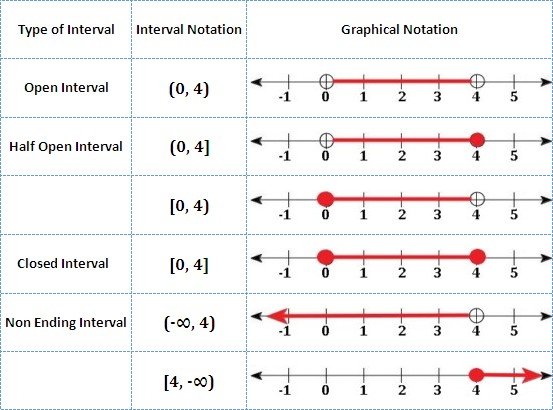
Start by connecting interval notation to concepts students already know, like inequalities and number lines. First, have students graph an inequality (e.g., x > 2) on a number line. Then, introduce the corresponding interval (2, ∞), explaining that parentheses mean 'not including' and brackets mean 'including'. Emphasize that infinity always uses a parenthesis.
What kind of exercises help students practice interval notation?
The most effective practice involves translation. These quizzes provide exercises that require students to convert back and forth between three forms: inequality notation (e.g., -1 ≤ x < 4), a number line graph, and interval notation (e.g., [-1, 4)). This reinforces that all three representations describe the same set of numbers.
What are the most common mistakes students make with interval notation?
The most frequent error is confusing parentheses `()` for exclusive endpoints with brackets `[]` for inclusive endpoints. Students also commonly try to use a bracket with infinity or negative infinity. A more advanced error is mixing up the union `∪` and intersection `∩` symbols when working with compound inequalities.
How can I use this interval notation quiz in my classroom?
This quiz is available as a printable PDF and in a digital format. You can host it as an interactive quiz on Wayground for immediate feedback or print the PDF for students to complete on paper. For paper submissions, you can use the Wayground for Teachers app to quickly scan and grade the completed work using the provided answer key.
Where does interval notation fit in the math curriculum?
In a curriculum aligned with Common Core, interval notation is a key concept in high school algebra. It builds directly on students' prior work with solving and graphing inequalities. Mastery of interval notation is essential for future topics, as it becomes the standard language for describing the domain and range of functions in Algebra 2 and Pre-calculus.
How can I support students who struggle with the symbols in interval notation?
For students who find the notation challenging, use Wayground's differentiation tools. When assigning a digital quiz, you can enable 'Reduced answer choices' to help them focus on the correct structure. For printable versions, you can apply a dyslexia-friendly font or increase the font size and spacing to improve readability and reduce visual clutter.

Accessibility
Features
Wayground Super
School & District
Wayground for Business
Create a quiz
Create a presentation
Wayground AI
Subjects
Mathematics
Social Studies
Science
Physics
Chemistry
Biology
About
Our Story
Wayground Blog
Media Kit
Careers
Support
F.A.Q.
Help & Support
Privacy Policy
Terms of Service
Teacher Resources
2026 Wayground


Get our app

