

11th Grade Law of Syllogism Quizzes
Test your understanding of the Law of Syllogism with this comprehensive Grade 11 quiz designed to assess your logical reasoning skills. Practice applying syllogistic principles through carefully crafted questions that provide instant feedback to strengthen your mathematical logic foundation.

16 questions
Law of Detachment & Law of Syllogism

Quiz
•
9th - 12th Grade

10 questions
Check on Learning_Law of Detachment/Syllogism
Quiz
•
9th - 12th Grade
21 questions
Law of Syllogism/ Detachment
Quiz
•
9th - 12th Grade

11 questions
Law Of Syllogism
Quiz
•
9th - 12th Grade

21 questions
law of syllogism and detachment quiz
Quiz
•
9th - 12th Grade

26 questions
Logic Test Review (Conditional Statements, Laws, & Venn Diagram)
Quiz
•
9th - 12th Grade
Browse by grade
Explore 11th Grade Law of Syllogism Quizzes
Law of Syllogism forms a cornerstone of logical reasoning in Grade 11 mathematics, requiring students to understand how conclusions can be drawn from interconnected conditional statements. These comprehensive quizzes available through Wayground provide systematic assessment opportunities for students to master this fundamental principle of deductive reasoning. The practice questions challenge learners to identify valid syllogistic arguments, distinguish between correct and incorrect logical chains, and apply the transitive property of conditional statements in mathematical contexts. Through immediate feedback and varied problem types, students develop critical thinking skills essential for advanced mathematical proofs and logical argumentation, building confidence in their ability to construct and evaluate chains of reasoning. Wayground supports mathematics educators with an extensive collection of teacher-created quiz resources specifically designed for Law of Syllogism instruction at the Grade 11 level. The platform's robust search and filtering capabilities enable teachers to quickly locate quizzes aligned with curriculum standards and specific learning objectives, while customization tools allow for differentiation based on individual student needs and ability levels. Digital delivery formats facilitate both classroom instruction and independent practice, making these resources ideal for initial concept introduction, ongoing skill reinforcement, targeted remediation, and enrichment activities. Teachers can seamlessly integrate these quiz collections into their lesson planning workflow, using the adaptive features to address diverse learning styles and provide personalized feedback that guides students toward mastery of logical reasoning principles.
FAQs
How should I teach the Law of Syllogism in Grade 11?
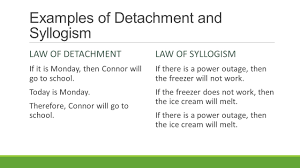
Model the structure symbolically first: if p implies q and q implies r, then p implies r. Next, ask students to annotate the shared element in written arguments and defend whether each conclusion is logically valid.
What quiz activities build fluency with the Law of Syllogism?
Mix three types of practice: completing missing premises or conclusions, sorting valid and invalid syllogisms, and constructing a logical chain from several conditional statements. Finish with a few problems that require students to justify why the law does or does not apply.
Why do students get Law of Syllogism problems wrong?
A common error is treating any repeated idea as a valid link. The connecting statement must serve as the conclusion of one conditional and the hypothesis of the next; otherwise, the proposed conclusion is unsupported.
How do I assign this Grade 11 Law of Syllogism quiz?
The quiz can be hosted as a digital quiz on Wayground or assigned as a printable PDF. A complete answer key is included, and teachers using paper can capture student work and grade it through the Wayground for Teachers app.
How can I support students who need help with multi-step logical arguments?
Use reduced answer choices while students learn to distinguish valid forms, then remove that support as accuracy improves. Extended time and wider quiz spacing can also help students follow each premise without losing the shared condition.
Is the Law of Syllogism a Grade 11 math topic?
It is appropriate for Grade 11 logic and reasoning instruction because students are ready to move beyond recognizing conditional statements and begin constructing and evaluating more complex deductive arguments.

Accessibility
Features
Wayground Super
School & District
Wayground for Business
Create a quiz
Create a presentation
Wayground AI
Subjects
Mathematics
Social Studies
Science
Physics
Chemistry
Biology
About
Our Story
Wayground Blog
Media Kit
Careers
Support
F.A.Q.
Help & Support
Privacy Policy
Terms of Service
Teacher Resources
2026 Wayground


Get our app

