

9th Grade Law of Syllogism Quizzes
Test your Grade 9 understanding of the Law of Syllogism with this comprehensive mathematics quiz designed to assess your logical reasoning skills. Practice applying syllogistic principles through targeted questions that provide instant feedback to strengthen your deductive reasoning abilities.

7 questions
Warm UP Law of Detachment & Law of Syllogism

Quiz
•
9th Grade

11 questions
Law of Detachment and Law of Syllogism Quick check
Quiz
•
9th - 10th Grade

16 questions
Law of Detachment & Law of Syllogism
Quiz
•
9th - 12th Grade

10 questions
Check on Learning_Law of Detachment/Syllogism
Quiz
•
9th - 12th Grade
21 questions
Law of Syllogism/ Detachment
Quiz
•
9th - 12th Grade

21 questions
law of syllogism and detachment quiz
Quiz
•
9th - 12th Grade
Browse by grade
Explore 9th Grade Law of Syllogism Quizzes
The Law of Syllogism represents a fundamental principle in Grade 9 logic and reasoning that enables students to draw valid conclusions from conditional statements through transitive reasoning. Wayground's comprehensive quiz collection provides targeted assessment opportunities that help students master this critical logical concept, offering practice questions that challenge learners to identify when the conclusion of one conditional statement matches the hypothesis of another, thereby forming a valid chain of reasoning. These carefully designed quizzes develop essential analytical skills by presenting students with varied scenarios requiring them to apply syllogistic reasoning, while immediate feedback mechanisms ensure students understand both correct applications and common logical fallacies that can undermine valid reasoning processes. Wayground's extensive library contains millions of teacher-created quiz resources specifically designed to support Grade 9 mathematics instruction in logic and reasoning concepts like the Law of Syllogism. Teachers can efficiently locate high-quality assessment materials through robust search and filtering capabilities that align with curriculum standards, while customization tools enable educators to modify existing quizzes or create differentiated versions that meet diverse student needs. The platform's flexible digital delivery system allows teachers to deploy these logic-focused assessments for formative evaluation, remedial instruction, or enrichment activities, supporting comprehensive lesson planning that reinforces syllogistic reasoning skills through varied practice opportunities that can be adapted for individual students, small groups, or whole-class instruction.
FAQs
Why is the Law of Syllogism important in 9th-grade math?
It is a foundational tool for writing two-column proofs in Geometry. In 9th grade, students transition from informal logic to using formal laws, like the Law of Syllogism, as a valid reason to justify steps in a deductive argument.
How do I teach the Law of Syllogism in the context of geometric proofs?
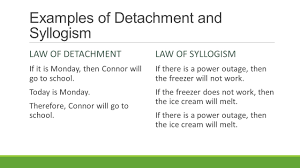
Model its use directly within a simple proof. For example: "If two angles are vertical angles, then they are congruent. If two angles are congruent, then they have equal measures. Therefore, by the Law of Syllogism, if two angles are vertical angles, then they have equal measures." This explicitly connects the law to the structure of a proof.
What practice problems prepare 9th graders for using the Law of Syllogism in proofs?
Effective practice problems should mix symbolic logic (e.g., `p → q`, `q → r`) with actual geometric statements. This requires students to translate between the abstract language of logic and the concrete language of geometry, which is a key skill for constructing proofs.
What mistake indicates a 9th grader hasn't mastered the Law of Syllogism for proofs?
A common error is misapplying it within a proof. For instance, a student might cite the Law of Syllogism as a reason when the logical step actually demonstrates the Law of Detachment, indicating they can't yet differentiate between the two distinct logical structures in a formal context.
How can I use this quiz to prepare my 9th graders for proofs?
Use the digital version on Wayground for interactive practice that provides immediate feedback on logical errors. Alternatively, print the PDF for students to work on in pairs, forcing them to articulate and defend their reasoning as they prepare for the demands of writing proofs. A full answer key is always included.
How does the Law of Syllogism fit into the high school geometry curriculum?
It is a core component of the introductory unit on logic and proofs. Aligned with Common Core standards on deductive reasoning, it is one of the first formal logic principles students apply to justify steps in a geometric proof. This moves them from making informal arguments to building structured, valid reasoning.

Accessibility
Features
Wayground Super
School & District
Wayground for Business
Create a quiz
Create a presentation
Wayground AI
Subjects
Mathematics
Social Studies
Science
Physics
Chemistry
Biology
About
Our Story
Wayground Blog
Media Kit
Careers
Support
F.A.Q.
Help & Support
Privacy Policy
Terms of Service
Teacher Resources
2026 Wayground


Get our app

