
Filters
Resource Type


Mutually Exclusive Events Quizzes
Test your understanding of mutually exclusive events with this interactive mathematics quiz designed to assess your probability and statistics knowledge. Practice identifying when events cannot occur simultaneously and receive instant feedback to strengthen your problem-solving skills.

15 questions
Mutually Exclusive Events Review

Quiz
•
9th - 12th Grade

15 questions
Mutually & Non-Mutually Exclusive & Complementary Events
Quiz
•
6th - 8th Grade

20 questions
Probability Mutually Exclusive Events
Quiz
•
10th Grade
20 questions
Mutually and Not Mutually Exclusive Events
Quiz
•
10th Grade

20 questions
Determine Mutually Exclusive Events
Quiz
•
10th Grade

20 questions
Probabilities of Mutually Exclusive Events
Quiz
•
10th Grade
20 questions
Probability of Mutually Exclusive Events and Inclusive Events
Quiz
•
10th Grade
20 questions
Mutually Exclusive and Not Mutually Exclusive Events
Quiz
•
10th Grade
20 questions
Mutually Exclusive Events
Quiz
•
9th - 12th Grade
20 questions
Probability of Mutually Exclusive Events
Quiz
•
10th Grade
27 questions
Addition Rule for Mutually Exclusive Events
Quiz
•
7th - 12th Grade
20 questions
Mutually Exclusive Events
Quiz
•
10th Grade
Explore Mutually Exclusive Events Quizzes
Mutually exclusive events represent a fundamental concept in probability theory where two or more events cannot occur simultaneously, making their intersection empty and their combined probability equal to the sum of their individual probabilities. Mathematics educators utilize comprehensive quiz collections through Wayground to deliver targeted assessment opportunities that strengthen students' understanding of this critical statistical principle. These practice questions systematically guide learners through identifying mutually exclusive scenarios, calculating probabilities using the addition rule, and distinguishing between mutually exclusive and independent events. The structured feedback provided through these quizzes enables students to recognize common misconceptions, such as confusing mutual exclusivity with independence, while building confidence in applying probability formulas to real-world situations involving non-overlapping outcomes. Wayground's extensive library of millions of teacher-created quiz resources empowers mathematics educators to deliver precisely targeted instruction on mutually exclusive events through robust search and filtering capabilities that align with state and national mathematics standards. Teachers can seamlessly customize existing assessments or create new practice questions that address specific learning gaps, whether students need remediation on basic probability concepts or enrichment through complex multi-event scenarios. The platform's flexible digital delivery formats support both immediate classroom assessment and extended practice sessions, while differentiation tools allow educators to modify question difficulty and provide scaffolded support for diverse learning needs. These comprehensive quiz collections enable teachers to systematically reinforce probability concepts, monitor student progress through detailed analytics, and ensure mastery of mutually exclusive events as a foundation for advanced statistical reasoning.
FAQs
What's a good way to introduce mutually exclusive events?
Start with simple, physical examples. Ask students if they can roll a 2 and a 5 on a single die at the same time, or draw one card that is both a heart and a spade. When they say no, explain that these are mutually exclusive events because they cannot happen together. This concrete starting point helps build the abstract definition.
What types of problems help students practice mutually exclusive events?
Effective practice moves from identification to application. Start with "yes/no" questions where students determine if two events are mutually exclusive (e.g., "drawing a king" and "drawing a queen"). Then, introduce calculation problems using the addition rule, like finding the probability of rolling a 1 or a 6.
What is a common mistake students make with mutually exclusive events?
A frequent error is confusing mutually exclusive events with independent events. Students may also incorrectly apply the simple addition rule to events that are not mutually exclusive, forgetting to subtract the probability of the overlap. For example, when finding the probability of drawing a king or a spade, they might add P(King) + P(Spade) and forget to subtract P(King of Spades).
How can I use this mutually exclusive events quiz with my students?
This quiz is available as a printable PDF for hands-on practice or as an interactive digital quiz you can host on Wayground. For paper assignments, you can use the Wayground for Teachers app to quickly scan and grade student work. Every quiz, regardless of format, includes a full answer key.
How do mutually exclusive events fit into the math curriculum?
Aligned with Common Core State Standards, the concept of mutually exclusive events is a key part of developing statistical understanding, typically introduced in middle school. It builds on basic probability and prepares students for more complex compound probability rules, such as those for non-mutually exclusive and independent events, which are critical for high school math.
How can I support struggling learners with this topic?
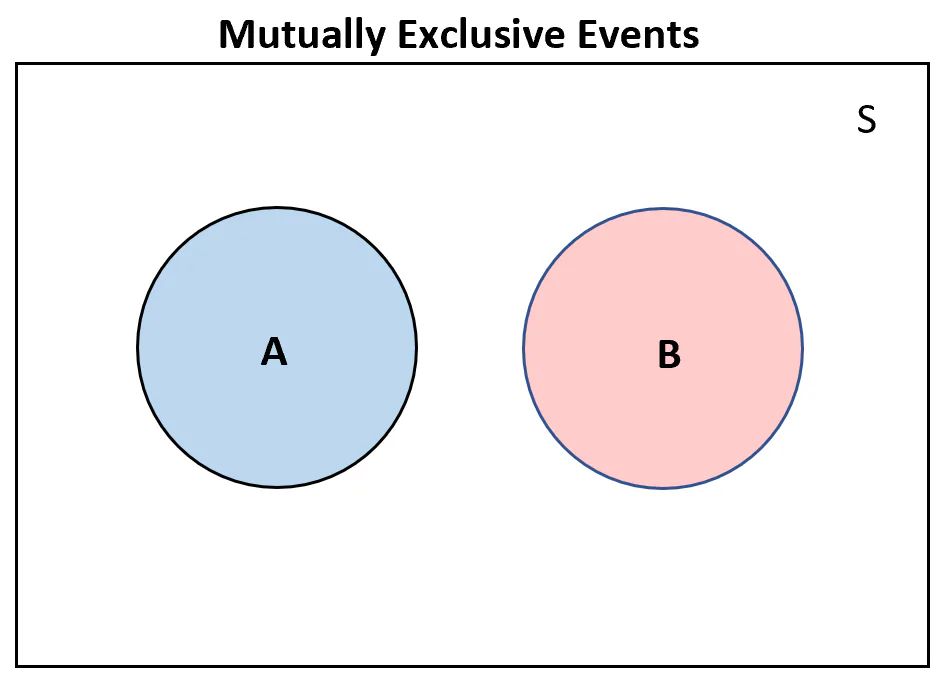
For students who find probability challenging, focus on visual aids like Venn diagrams to show the lack of overlap between mutually exclusive events. On Wayground, you can create a scaffolded version of the quiz with a dyslexia-friendly font or wider spacing. For digital assignments, you can also reduce the number of answer choices to lower cognitive load for specific students.

Accessibility
Features
Wayground Super
School & District
Wayground for Business
Create a quiz
Create a presentation
Wayground AI
Subjects
Mathematics
Social Studies
Science
Physics
Chemistry
Biology
About
Our Story
Wayground Blog
Media Kit
Careers
Support
F.A.Q.
Help & Support
Privacy Policy
Terms of Service
Teacher Resources
2026 Wayground


Get our app

