


Percent Error Quizzes
Master percent error calculations with our comprehensive collection of interactive quizzes designed to help students practice identifying and computing measurement uncertainties. These self-paced assessments provide instant feedback on percent error problems, allowing learners to strengthen their skills in analyzing experimental data and understanding the relationship between theoretical and actual values.

20 questions
Measurement Percent Error

Quiz
•
7th Grade
23 questions
Percent Error Practice
Quiz
•
7th Grade
15 questions
Percent Error Problems
Quiz
•
6th - 8th Grade

12 questions
Percent Change & Percent Error
Quiz
•
7th Grade
19 questions
Measurement Percent Error
Quiz
•
7th Grade

19 questions
Percent Error Proportion
Quiz
•
7th Grade
12 questions
Percent Error Problems
Quiz
•
7th Grade
23 questions
Percent Error Practice
Quiz
•
6th - 9th Grade
19 questions
Percent Error
Quiz
•
7th Grade
19 questions
Percent Error and Percent Interest
Quiz
•
7th Grade
19 questions
Percent Error Range
Quiz
•
7th Grade
9 questions
Percent Error
Quiz
•
7th Grade
Explore Percent Error Quizzes
Percent error assessment provides students with essential practice in calculating the accuracy of measurements and experimental results by comparing observed values to accepted or theoretical values. These interactive quizzes available through Wayground help students master the fundamental skills of applying the percent error formula, interpreting results within acceptable tolerance ranges, and understanding the practical applications of error analysis in scientific and mathematical contexts. Through targeted practice questions, students develop proficiency in identifying sources of measurement uncertainty, calculating absolute differences between values, and expressing error as a percentage to evaluate the precision of data collection methods across various real-world scenarios. Wayground empowers educators with access to millions of teacher-created percent error quiz collections that can be seamlessly integrated into mathematics and science instruction. The platform's comprehensive search and filtering capabilities allow teachers to locate age-appropriate assessment materials aligned with curriculum standards, while built-in customization tools enable differentiation for diverse learning needs and skill levels. These digital quiz resources support flexible delivery formats suitable for classroom instruction, independent practice, homework assignments, and remediation activities, giving teachers the versatility to reinforce percent error concepts through immediate feedback mechanisms that help students identify misconceptions and strengthen their analytical problem-solving abilities in measurement and data analysis contexts.
FAQs
How do I teach percent error?
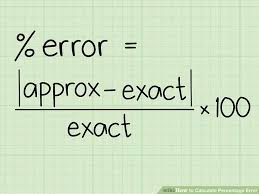
Introduce percent error as a way to measure the accuracy of a guess or measurement. Start with the formula: Percent Error = (|Experimental Value - Theoretical Value| / |Theoretical Value|) × 100. Use a simple, relatable example, like guessing the number of jellybeans in a jar, to make the concept of 'experimental' vs. 'theoretical' values concrete before moving to scientific measurements.
What exercises help students practice calculating percent error?
Effective practice moves from simple calculations to real-world applications. Start with problems where the experimental and theoretical values are clearly given. Then, introduce word problems where students must first identify these values from a short scenario, such as a lab experiment or a sports statistic. Finally, challenge students with problems that require them to compare the percent error of two different measurements to determine which was more accurate.
What are the most common mistakes students make with percent error?
The most frequent error is dividing by the wrong number. Students often mistakenly divide by the experimental (measured) value instead of the theoretical (accepted) value. Another common issue is forgetting to take the absolute value of the difference, which can lead to a negative percent error.
How can I use this percent error quiz in my class?
This quiz is available as a printable PDF for hands-on practice or as an interactive digital assignment on the Wayground platform. The digital version can be used as a self-grading quiz, providing immediate feedback. For paper assignments, you can use the included answer key for manual grading or scan student work with the Wayground for Teachers app to grade it automatically.
How does percent error fit into the math curriculum?
Aligned with Common Core State Standards, percent error is a practical application of concepts learned in the Ratios and Proportional Relationships domain. It builds directly on students' ability to work with percentages and solve multi-step problems, providing a critical bridge between abstract mathematical skills and their use in real-world data analysis and scientific contexts.
How can I differentiate this topic for struggling students?
For students who find the multi-step formula challenging, you can use Wayground's 'Reduced answer choices' feature on digital assignments to lower cognitive load. You can also provide a scaffolded version of the quiz that breaks the problem down: first, find the difference; second, divide by the theoretical value; third, convert to a percentage.

Accessibility
Features
Wayground Super
School & District
Wayground for Business
Create a quiz
Create a presentation
Wayground AI
Subjects
Mathematics
Social Studies
Science
Physics
Chemistry
Biology
About
Our Story
Wayground Blog
Media Kit
Careers
Support
F.A.Q.
Help & Support
Privacy Policy
Terms of Service
Teacher Resources
2026 Wayground


Get our app

