
Resource Type


Subjects
4th Grade Primary and Secondary Sources Quizzes
Assess your Grade 4 students' understanding of primary and secondary sources with this comprehensive history quiz. Practice identifying different types of historical sources through engaging questions that provide instant feedback for self-paced learning.

11 questions
Primary and Secondary Sources Review

Quiz
•
4th Grade

10 questions
Primary vs Secondary Sources
Quiz
•
4th Grade
16 questions
Primary and Secondary Sources
Quiz
•
4th Grade

20 questions
Primary and Secondary Sources (like the cards!)
Quiz
•
4th Grade

15 questions
Primary/Secondary sources
Quiz
•
4th Grade

15 questions
Chapter 1- Primary Secondary Sources and Vocab
Quiz
•
4th Grade
21 questions
Primary vs. Secondary Sources
Quiz
•
4th Grade
15 questions
Timeline and Primary & Secondary Sources Review
Quiz
•
4th Grade
20 questions
Primary and Secondary Sources
Quiz
•
4th - 5th Grade
23 questions
Primary and Secondary Sources
Quiz
•
4th - 5th Grade
10 questions
Primary and Secondary Sources
Quiz
•
4th - 8th Grade
Explore 4th Grade Primary and Secondary Sources Quizzes
Primary and secondary sources form a foundational concept in Grade 4 history education, teaching young learners to distinguish between firsthand accounts and interpretations of historical events. Wayground's comprehensive quiz collection provides targeted assessment tools that help students practice identifying and analyzing different types of historical sources through engaging practice questions. These quizzes develop critical thinking skills as students learn to evaluate the reliability and perspective of various sources, from diary entries and photographs to textbooks and encyclopedias. The interactive format delivers immediate feedback, allowing students to strengthen their understanding of how historians gather and interpret evidence from the past. Wayground's platform supports teachers with access to millions of educator-created resources specifically designed for primary and secondary source instruction at the Grade 4 level. The robust search and filtering capabilities enable teachers to locate quizzes aligned with curriculum standards and learning objectives, while customization tools allow for differentiation based on individual student needs. Teachers can deploy these digital assessments for formative evaluation, homework assignments, or review sessions, with the flexibility to adapt content for remediation or enrichment purposes. The platform's comprehensive collection ensures educators have varied question formats and source examples to reinforce students' ability to analyze historical evidence and develop essential research skills throughout their social studies curriculum.
FAQs
How do I teach students to distinguish between primary and secondary sources?
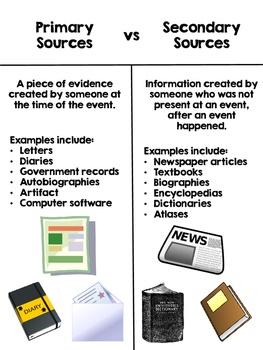
Start by anchoring instruction in concrete examples: a soldier's diary entry versus a historian's analysis of the same war. Teach students to ask two diagnostic questions about any source: Was this created by someone who directly witnessed the event? And was it produced during or after the time period being studied? Once students internalize these questions, move to practice with mixed document sets so they must apply the distinction without scaffolding.
What exercises help students practice identifying primary and secondary sources?
The most effective practice exercises present students with a variety of source types, including photographs, letters, textbook excerpts, newspaper articles, and artifacts, and ask them to classify and justify each one. Quizzes that require students to explain their reasoning, not just label sources, build the analytical muscle needed for historical inquiry. Pairing classification tasks with brief source analysis questions reinforces both identification and interpretation skills simultaneously.
What mistakes do students commonly make when identifying primary and secondary sources?
The most common error is assuming that older sources are automatically primary and newer ones are secondary. Students also frequently misclassify encyclopedias and textbooks as primary sources because they feel authoritative. Another persistent misconception is that photographs are always primary sources, when in fact a photo taken decades after an event to illustrate a documentary is secondary. Quizzes that include deliberate edge cases help students confront and correct these misunderstandings.
How can I use primary and secondary source quizzes to support historical literacy skills?
Use source-identification quizzes as a gateway to deeper historical literacy by connecting classification to credibility and bias analysis. Once students can reliably distinguish source types, quizzes that prompt them to evaluate reliability, intended audience, and purpose extend that skill into genuine historical thinking. This progression, from identification to interpretation, mirrors the actual work of historians and prepares students for document-based essay tasks.
How do I use Wayground's primary and secondary sources quizzes in my classroom?
Wayground's primary and secondary sources quizzes are available as printable PDFs for traditional classroom use and in digital formats for technology-integrated environments, including the option to host them as a live quiz on Wayground. Teachers can use them for direct instruction, independent practice, homework, or remediation. For students who need additional support, Wayground's accommodation tools, such as read aloud and reduced answer choices, can be applied to individual students without disrupting the rest of the class.
How do I differentiate primary and secondary source instruction for students at different skill levels?
For struggling learners, scaffold with anchor charts that list defining characteristics of each source type and use simple, high-interest examples before introducing complex documents. For advanced students, push beyond classification toward evaluation: asking why a source's origin affects its reliability or how two secondary sources about the same event might differ. Wayground's differentiation tools allow teachers to adjust content complexity within the same assignment, so all learners can access the skill at an appropriate level of challenge.

Accessibility
Features
Wayground Super
School & District
Wayground for Business
Create a quiz
Create a presentation
Wayground AI
Subjects
Mathematics
Social Studies
Science
Physics
Chemistry
Biology
About
Our Story
Wayground Blog
Media Kit
Careers
Support
F.A.Q.
Help & Support
Privacy Policy
Terms of Service
Teacher Resources
2026 Wayground


Get our app

