

11th Grade Quantum Numbers Quizzes
Practice your understanding of quantum numbers with this comprehensive Grade 11 chemistry quiz designed to assess your knowledge of electron configuration principles. Test yourself with targeted questions that provide instant feedback to strengthen your grasp of quantum number relationships and applications.

40 questions
Electron Configuration and Quantum Numbers Review

Quiz
•
11th Grade

20 questions
QUANTUM NUMBERS
Quiz
•
11th Grade

25 questions
Electron Configuration and Quantum Numbers
Quiz
•
11th Grade

15 questions
Electron Configuration and Quantum Numbers
Quiz
•
11th Grade
25 questions
Quantum Numbers
Quiz
•
11th Grade

11 questions
Chemistry: Quantum Numbers and Principles
Quiz
•
11th Grade
15 questions
Quantum Numbers and Electron Configuration
Quiz
•
11th Grade
15 questions
Electron Configuration and Quantum Numbers
Quiz
•
11th Grade
14 questions
Quantum Numbers and Atomic Orbitals M4 L2 Chemistry
Quiz
•
11th Grade
15 questions
Quantum Numbers
Quiz
•
11th Grade
15 questions
Quantum Numbers
Quiz
•
11th Grade
18 questions
Quantum NUmbers
Quiz
•
11th Grade
Browse by grade
Explore 11th Grade Quantum Numbers Quizzes
Quantum numbers represent one of the most fundamental concepts in Grade 11 chemistry, describing the unique address of each electron within an atom's electronic structure. Through Wayground's comprehensive quiz collection, students engage with carefully designed practice questions that systematically build their understanding of the four quantum numbers: principal (n), azimuthal (l), magnetic (ml), and spin (ms). These assessment resources challenge learners to apply quantum mechanical principles, interpret electron configurations, and predict atomic behavior through targeted feedback that reinforces correct reasoning while addressing common misconceptions. Students develop critical analytical skills as they work through problems involving orbital shapes, energy levels, and electron probability distributions. Wayground supports chemistry educators with millions of teacher-created quantum numbers quizzes that can be precisely filtered by difficulty level, specific quantum number focus, and curriculum standards alignment. The platform's robust search capabilities allow teachers to quickly locate resources that match their instructional needs, whether introducing the Pauli exclusion principle or reinforcing Hund's rule applications. Customization tools enable educators to modify existing assessments, adjust question difficulty, and create differentiated versions for diverse learning needs. These digital-first resources facilitate flexible delivery through multiple formats, supporting both formative assessment during instruction and summative evaluation of student mastery, while providing detailed analytics that inform targeted remediation strategies and enrichment opportunities for advanced learners.
FAQs
How do I teach quantum numbers to high school chemistry students?
Start by introducing the principal quantum number (n) as a foundation before layering in the angular momentum (l), magnetic (ml), and spin (ms) quantum numbers one at a time. Connecting each quantum number to a physical meaning — energy level, sublevel shape, orbital orientation, and electron spin — helps students build a mental model rather than memorizing abstract rules. Using orbital diagrams alongside quantum number notation reinforces how the four numbers work together to describe a unique electron in an atom.
What exercises help students practice identifying valid quantum number combinations?
The most effective practice involves presenting students with sets of four quantum numbers and asking them to identify which combinations are physically valid and which violate the rules — for example, catching cases where l equals n or ms falls outside +1/2 and -1/2. Progressive problem sets that move from isolated rule-checking to full electron configuration assignments build both accuracy and speed. Quantum numbers quizzes that include detailed answer keys with explanations, rather than just correct values, help students understand why a combination is invalid, not just that it is.
What mistakes do students commonly make when working with quantum numbers?
The most frequent error is confusing the allowed values of l relative to n — students often assign l values that equal or exceed n rather than staying within 0 to n-1. A second common mistake is treating ml as simply ranging from -l to +l without recognizing that zero is always included, which leads to undercounting orbitals. Students also frequently conflate the principal quantum number with the period number on the periodic table, which breaks down when dealing with transition metals and d subshells.
How can I use quantum numbers quizzes to differentiate instruction for students at different levels?
For struggling students, begin with quizzes that isolate one quantum number at a time before combining all four, and consider using Wayground's reduced answer choices accommodation to lower cognitive load on multiple-choice problems. Advanced students benefit from open-ended problems that require them to determine all possible quantum number sets for electrons in a given element or to explain why certain combinations violate the Pauli Exclusion Principle. Wayground also supports read aloud and extended time settings that can be assigned to individual students, so the same quiz can serve the full range of learners in one class.
How do I use Wayground's quantum numbers quizzes in my classroom?
Wayground's quantum numbers quizzes are available as printable PDFs for traditional classroom use and in digital formats for technology-integrated or hybrid environments. Teachers can assign them as in-class practice, homework, or host them directly as a quiz on Wayground to collect student responses and track performance. Both formats include complete answer keys, making them practical for independent practice as well as teacher-led instruction.
How do quantum numbers connect to electron configuration and orbital notation?
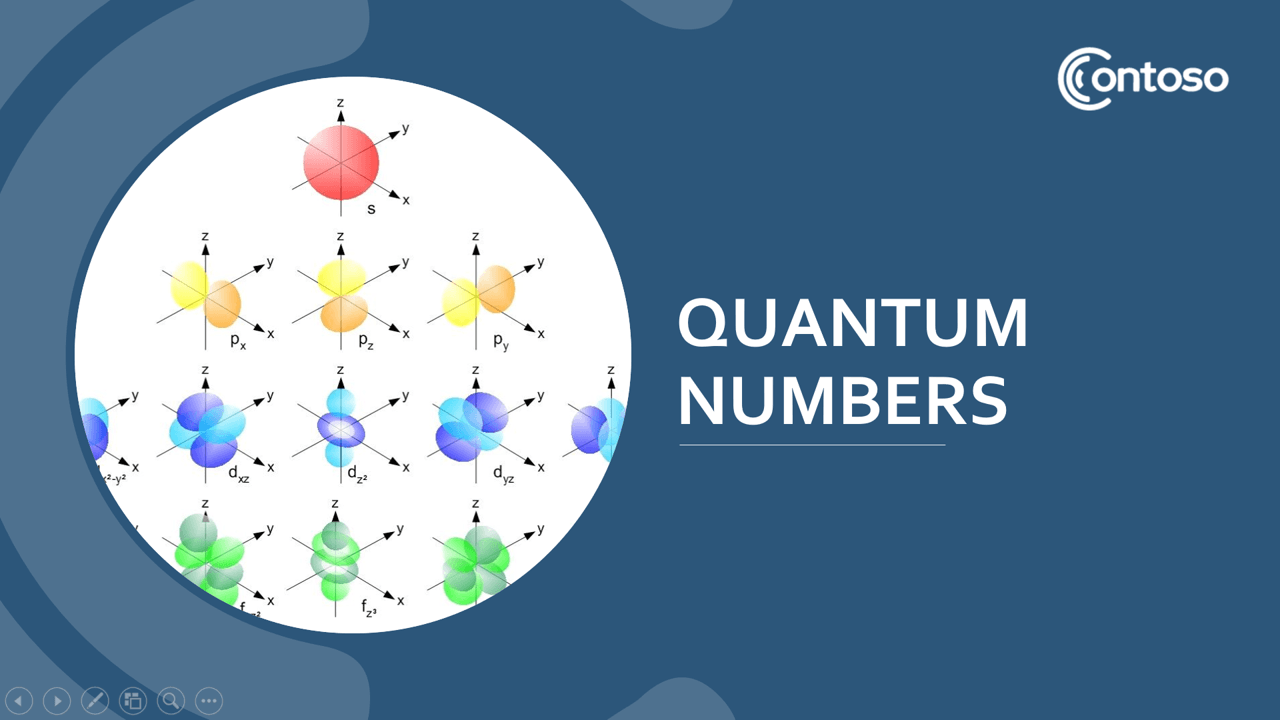
Quantum numbers are the underlying logic of electron configuration — each electron in an atom is uniquely described by its specific combination of n, l, ml, and ms values, which directly correspond to its position in an orbital diagram. The principal quantum number determines the energy level, l determines the sublevel (s, p, d, or f), ml specifies which orbital within that sublevel, and ms distinguishes the two electrons in a paired orbital. Teaching quantum numbers before electron configuration gives students a rule-based framework for understanding why configurations are written the way they are, rather than treating them as arbitrary notation.

Accessibility
Features
Wayground Super
School & District
Wayground for Business
Create a quiz
Create a presentation
Wayground AI
Subjects
Mathematics
Social Studies
Science
Physics
Chemistry
Biology
About
Our Story
Wayground Blog
Media Kit
Careers
Support
F.A.Q.
Help & Support
Privacy Policy
Terms of Service
Teacher Resources
2026 Wayground


Get our app

