


6th Grade Seafloor Spreading Quizzes
Test your understanding of seafloor spreading with this comprehensive Grade 6 science quiz featuring practice questions and instant feedback. Assess your knowledge of how new oceanic crust forms at mid-ocean ridges through self-paced questions designed for Earth & Space Science learners.

20 questions
Seafloor Spreading

Quiz
•
6th Grade

12 questions
Seafloor Spreading
Quiz
•
6th Grade
25 questions
Unit 6 Seafloor Spreading Review
Quiz
•
6th Grade

21 questions
Continental Drift and Seafloor Spreading and Boundaries
Quiz
•
6th Grade

12 questions
3.5 Lesson Check - Continental Drift & Seafloor Spreading
Quiz
•
6th Grade

20 questions
FAC#7 Seafloor Spreading
Quiz
•
6th Grade
11 questions
Seafloor Spreading
Quiz
•
6th Grade
19 questions
Continental Drift and Seafloor Spreading
Quiz
•
6th Grade
9 questions
Seafloor Spreading
Quiz
•
6th Grade
20 questions
Plate Tectonics: Continental Drift & Seafloor Spreading
Quiz
•
6th Grade
10 questions
Seafloor Spreading Process
Quiz
•
6th Grade
14 questions
Seafloor Spreading Quiz Review
Quiz
•
6th Grade
Explore 6th Grade Seafloor Spreading Quizzes
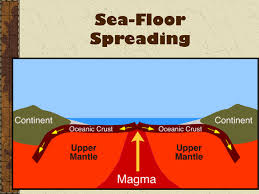
Seafloor spreading represents a fundamental concept in Grade 6 Earth and Space Science that explains how new oceanic crust forms at mid-ocean ridges through volcanic activity and tectonic plate movement. Wayground's comprehensive quiz collection provides students with targeted assessment opportunities to demonstrate their understanding of this critical geological process, including practice questions that explore the role of magma in creating new seafloor, the relationship between seafloor spreading and continental drift, and the evidence scientists use to support this theory. These carefully designed quizzes help students develop essential scientific thinking skills while receiving immediate feedback on their comprehension of plate tectonics, ocean floor features, and the dynamic nature of Earth's surface. Wayground's platform empowers teachers with access to millions of educator-created resources specifically designed to support seafloor spreading instruction and assessment in Grade 6 classrooms. The robust search and filtering capabilities enable teachers to quickly locate quizzes that align with specific learning standards and curriculum requirements, while built-in customization tools allow for seamless differentiation to meet diverse student needs and learning levels. Teachers can deploy these digital-first assessments in multiple formats to support both formative and summative evaluation, making them invaluable for lesson planning, identifying areas requiring remediation, providing enrichment opportunities for advanced learners, and reinforcing key concepts about Earth's geological processes throughout the unit.
FAQs
How do I teach seafloor spreading to middle or high school students?
Start by grounding students in the structure of the ocean floor, particularly mid-ocean ridges and divergent plate boundaries, before introducing the mechanism of seafloor spreading. Use visual aids like magnetic stripe diagrams and age maps of the ocean floor to make the process concrete. Connecting seafloor spreading to convection currents in the mantle and the broader theory of plate tectonics helps students understand why it matters, not just how it works.
What practice exercises help students understand seafloor spreading?
Effective practice focuses on interpreting magnetic stripe patterns in oceanic crust, calculating seafloor age based on distance from spreading centers, and analyzing data from deep-sea drilling projects. Students benefit from problems that ask them to relate evidence of magnetic reversals to the timeline of seafloor formation. These exercises build both data literacy and conceptual understanding of how new oceanic crust forms and migrates away from mid-ocean ridges.
What misconceptions do students commonly have about seafloor spreading?
A frequent misconception is that continents move through the ocean floor rather than being carried on tectonic plates as the ocean floor itself expands. Students also often confuse seafloor spreading with continental drift, treating them as separate unrelated theories rather than complementary components of plate tectonics. Another common error is misreading magnetic stripe symmetry, where students fail to recognize that stripes mirror on either side of a mid-ocean ridge.
How can I use seafloor spreading quizzes to assess student understanding?
Quizzes that ask students to interpret magnetic stripe data, sequence the formation of oceanic crust, or explain the relationship between seafloor spreading and continental drift provide strong formative assessment opportunities. Look for errors in how students describe the direction of plate movement or the role of convection currents, as these reveal conceptual gaps rather than surface-level recall issues. Using the included answer keys allows for efficient review and targeted follow-up instruction.
How do I use Wayground's seafloor spreading quizzes in my classroom?
Wayground's seafloor spreading quizzes are available as printable PDFs for traditional classroom use and in digital formats for technology-integrated learning environments, giving teachers flexibility regardless of their classroom setup. Teachers can also host quizzes as a quiz directly on Wayground, enabling interactive student practice with built-in answer key support for immediate feedback. Wayground's search and filtering tools make it straightforward to locate quizzes by concept, such as magnetic reversals, divergent boundaries, or convection currents, so lesson planning stays efficient.
How does seafloor spreading support the theory of plate tectonics?
Seafloor spreading provides direct physical evidence for plate tectonics by demonstrating that oceanic crust is continuously created at mid-ocean ridges and moves outward, carrying a record of magnetic reversals preserved in the rock. The symmetrical pattern of magnetic stripes on either side of a ridge, combined with the observation that oceanic crust is youngest near spreading centers and oldest near subduction zones, confirms that the ocean floor is dynamic rather than static. This evidence was pivotal in establishing plate tectonics as the unifying framework for understanding Earth's geological systems.

Accessibility
Features
Wayground Super
School & District
Wayground for Business
Create a quiz
Create a presentation
Wayground AI
Subjects
Mathematics
Social Studies
Science
Physics
Chemistry
Biology
About
Our Story
Wayground Blog
Media Kit
Careers
Support
F.A.Q.
Help & Support
Privacy Policy
Terms of Service
Teacher Resources
2026 Wayground


Get our app

