


6th Grade Vague Pronouns Quizzes
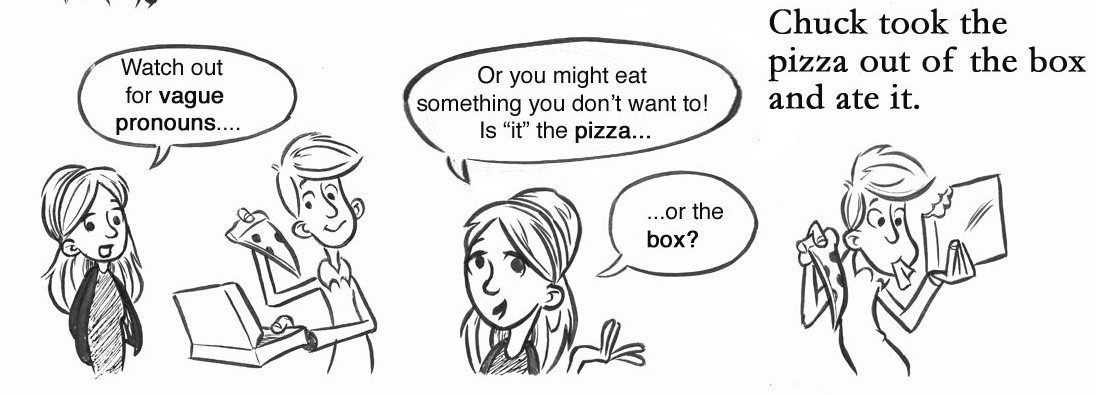
Test your understanding of vague pronouns with this Grade 6 English quiz designed to assess your ability to identify and correct unclear pronoun references. Practice recognizing when pronouns lack clear antecedents and receive instant feedback to strengthen your grammar skills through self-paced assessment.
18 questions
Vague Pronouns

Quiz
•
6th Grade
10 questions
Vague Pronouns
Quiz
•
6th Grade

20 questions
Vague Pronouns
Quiz
•
6th Grade

18 questions
Vague Pronouns
Quiz
•
6th Grade

18 questions
Vague Pronouns Worksheet
Quiz
•
6th Grade

25 questions
Vague Pronouns
Quiz
•
6th - 7th Grade
18 questions
Vague Pronouns
Quiz
•
6th Grade
10 questions
Vague Pronouns RETAKE!
Quiz
•
6th Grade
10 questions
Vague Pronouns - Identifying and Correcting PRACTICE
Quiz
•
6th Grade
10 questions
Vague Pronouns QUIZ
Quiz
•
6th - 8th Grade
15 questions
Pronouns & Vague Pronouns
Quiz
•
6th - 8th Grade
21 questions
Vague Pronouns
Quiz
•
6th - 8th Grade
Explore 6th Grade Vague Pronouns Quizzes
Vague pronouns present a common challenge for Grade 6 students as they develop more sophisticated writing skills and learn to communicate with greater precision. Wayground's comprehensive quiz collection addresses this critical grammar concept through targeted assessment tools that help students identify unclear pronoun references and practice creating clearer, more effective sentences. These practice questions guide learners through scenarios where pronouns like "it," "they," or "this" create confusion for readers, providing immediate feedback to reinforce proper pronoun usage. Students gain understanding of how vague pronouns weaken writing clarity and develop the analytical skills necessary to recognize and correct these issues in both their own work and in various text examples. Wayground supports English teachers with millions of teacher-created quiz resources specifically designed to address pronoun clarity and related grammar concepts at the Grade 6 level. The platform's robust search and filtering capabilities allow educators to quickly locate assessments aligned with state standards and curriculum requirements, while customization tools enable teachers to modify existing quizzes or create new ones tailored to their students' specific needs. These digital-first quiz formats provide flexible delivery options for classroom instruction, homework assignments, or independent practice sessions, supporting both remediation for struggling learners and enrichment opportunities for advanced students. Teachers can leverage detailed analytics and progress tracking to identify areas where students need additional support with vague pronoun recognition, enabling targeted skill reinforcement that strengthens overall writing proficiency.
FAQs
How do I teach students to identify vague pronoun references in their writing?
Start by teaching students to draw an arrow from each pronoun back to its antecedent. If the arrow points to more than one possible noun, or to no noun at all, the pronoun reference is vague. Model this process with mentor sentences before asking students to apply it independently, and emphasize that readers should never have to guess what a pronoun refers to.
What exercises best help students practice correcting vague pronouns?
The most effective practice moves students through a progression: first identifying which pronoun is unclear, then naming the possible antecedents causing confusion, and finally rewriting the sentence for clarity. Sentence revision tasks are especially valuable because they require students to make an active grammatical decision rather than simply circle an error. Quizzes that sequence from identification to revision build this skill systematically.
What are the most common mistakes students make with pronoun references?
The most frequent error is using 'it,' 'this,' 'they,' or 'that' to refer to a broad idea or entire clause rather than a specific noun. For example, writing 'They say it will rain' uses both 'they' and 'it' without clear antecedents. Students also commonly place a pronoun too far from its antecedent, allowing intervening nouns to create ambiguity. Targeted practice identifying these specific patterns helps students recognize and self-correct them in their own writing.
How do I differentiate vague pronoun instruction for struggling writers versus advanced students?
For struggling writers, begin with sentences containing only one possible antecedent confusion and work on naming the problem before fixing it. Advanced students benefit from revising multi-sentence passages where the vague pronoun cascades across sentences, or from analyzing published writing for ambiguous references. On Wayground, teachers can use reduced answer choices for students who need additional support, lowering cognitive load while keeping the skill target the same.
How can I use Wayground's vague pronouns quizzes in my classroom?
Wayground's vague pronoun quizzes are available as printable PDFs for traditional classroom use and in digital formats for technology-integrated or remote learning environments. Teachers can also host the quizzes as a quiz directly on Wayground, enabling real-time student responses and instant feedback. Each quiz includes a complete answer key, making them practical for independent practice, grammar warm-ups, or targeted remediation sessions.
At what point in a writing unit should I introduce vague pronoun lessons?
Vague pronoun instruction is most effective after students have a working understanding of pronoun-antecedent agreement, since clarity of reference builds on the concept that pronouns must match a specific noun. Introduce it during the revision stage of the writing process, when students are already reviewing their drafts for clarity. This contextual placement helps students apply the skill directly to their own writing rather than treating it as an isolated grammar rule.

Accessibility
Features
Wayground Super
School & District
Wayground for Business
Create a quiz
Create a presentation
Wayground AI
Subjects
Mathematics
Social Studies
Science
Physics
Chemistry
Biology
About
Our Story
Wayground Blog
Media Kit
Careers
Support
F.A.Q.
Help & Support
Privacy Policy
Terms of Service
Teacher Resources
2026 Wayground


Get our app

