Eukaryotes vs. Prokaryote

Flashcard
•
Biology
•
9th - 10th Grade
•
Practice Problem
•
Hard

Wayground Content
FREE Resource
Student preview

15 questions
Show all answers
1.
FLASHCARD QUESTION
Front
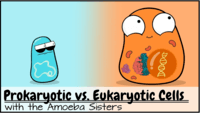
What is a eukaryote?
Back
A eukaryote is an organism whose cells contain a nucleus and other organelles enclosed within membranes. Examples include plants, animals, and fungi.
2.
FLASHCARD QUESTION
Front
What is a prokaryote?
Back
A prokaryote is a unicellular organism that lacks a nucleus and membrane-bound organelles. Bacteria and archaea are examples of prokaryotes.
3.
FLASHCARD QUESTION
Front
What do both prokaryotes and eukaryotes contain?
Back
Both prokaryotes and eukaryotes contain ribosomes, which are essential for protein synthesis.
4.
FLASHCARD QUESTION
Front
What is the main difference between prokaryotic and eukaryotic cells?
Back
The main difference is that eukaryotic cells have a nucleus and membrane-bound organelles, while prokaryotic cells do not.
5.
FLASHCARD QUESTION
Front
What type of cells are plants and animals?
Back
Plants and animal cells are examples of eukaryotic cells.
6.
FLASHCARD QUESTION
Front
What is the function of ribosomes?
Back
Ribosomes are responsible for synthesizing proteins by translating messenger RNA (mRNA) into polypeptide chains.
7.
FLASHCARD QUESTION
Front
Do prokaryotic cells have a cell wall?
Back
Yes, most prokaryotic cells have a cell wall that provides structure and protection.
Access all questions and much more by creating a free account
Create resources
Host any resource
Get auto-graded reports

Continue with Google

Continue with Email

Continue with Classlink

Continue with Clever
or continue with

Microsoft
%20(1).png)
Apple

Others
Already have an account?
Similar Resources on Wayground

15 questions
Biomolecules
Flashcard
•
8th - 10th Grade
15 questions
Honors Biology Photosynthesis
Flashcard
•
9th - 10th Grade
15 questions
Cells and Cell Organelles
Flashcard
•
9th - 10th Grade
15 questions
Intro to Macromolecules
Flashcard
•
9th - 10th Grade
15 questions
Intro to Cells Unit - Flashcard Review
Flashcard
•
9th - 10th Grade
15 questions
Macromolecules
Flashcard
•
9th - 10th Grade
15 questions
Mitosis vs Meiosis
Flashcard
•
9th Grade
15 questions
Fall 2024 Semester Study Guide
Flashcard
•
9th Grade
Popular Resources on Wayground
7 questions
History of Valentine's Day

Interactive video
•
4th Grade
15 questions
Fractions on a Number Line

Quiz
•
3rd Grade
20 questions
Equivalent Fractions
Quiz
•
3rd Grade
25 questions
Multiplication Facts
Quiz
•
5th Grade
22 questions
fractions
Quiz
•
3rd Grade
15 questions
Valentine's Day Trivia
Quiz
•
3rd Grade
20 questions
Main Idea and Details
Quiz
•
5th Grade
20 questions
Context Clues
Quiz
•
6th Grade
Discover more resources for Biology
22 questions
Human Body Systems Overview
Quiz
•
9th Grade
25 questions
photosynthesis and cellular respiration
Quiz
•
9th Grade
15 questions
African American Impact in the 1980s
Quiz
•
9th Grade
20 questions
Symbiotic Relationships
Quiz
•
9th Grade
20 questions
Food Chains and Food Webs
Quiz
•
7th - 12th Grade
10 questions
Exploring Food Webs and Energy Pyramids
Interactive video
•
6th - 10th Grade
20 questions
Cladogram Practice
Quiz
•
10th Grade
20 questions
CFA #2 Unit 3 Human Body Systems (21.2 & 21.3)
Quiz
•
9th - 12th Grade