

Types of Plate Boundaries

Presentation
•
Science
•
10th Grade
•
Practice Problem
•
Hard
Standards-aligned

Jeanette Delos Santos
Used 71+ times
FREE Resource
27 Slides • 10 Questions
1
Describe the different types of plate boundaries
2
According to the plate tectonics model, the entire lithosphere of the Earth is broken into numerous segments called plates.
Each plate is slowly but continuously moving.
Can be detected by seismograph or seismometer
P and S waves are the two types of seismic waves that can be detected by a seismometer
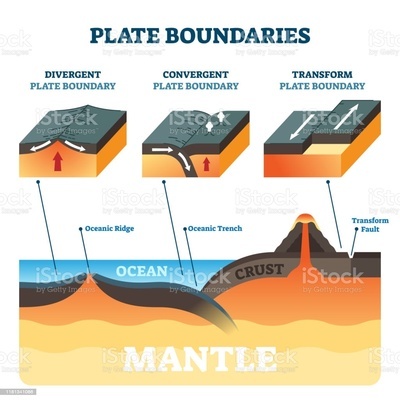
As a result of the motion of the plates, three types of plate boundaries were formed: Divergent, Convergent, and Transform fault boundaries
3
Step forward and wiggle fists (Move it out do the Sid)
Step back and wiggle fists (Take it back and do the Sid)
Step left and then drift (slide)
Step right and then drift (slide)
Criss cross and mammoth (Criss cross and do the Manny) (2x)
Jump, Jump, shake your rump
Walk it like a granny!
4
Did you know that the ground you are standing on right now is actually moving? Can you feel it? Scientists says it’s because of PLATE TECTONICS. Today you are going to learn more about this and how active our planet is.

5
Our topic for this week will be about the Types of Plate Boundaries. Studying plate boundaries is important because along these boundaries deformation of the lithosphere is happening. These geologic events have a great impact not only on the environment but also on us. So, at the end of the lesson, you will be able to

6
Name and describe the different types of plate boundaries
Explain the occurrence of such plate boundaries and its effect to surrounding and people
Identify the location of the major plates in the world
Describe how each plate of the continent emerged as such from the type of boundaries
Discuss the movement of the different boundaries according to the arrow
7
10 items

8
Multiple Choice
1. Which description is the best match for divergent plate boundaries?
A. Two plates move away from each other.
B. Two plates move towards each other.
C. Two plates slip past each other.
D. One plate moves in, the other moves out.
9
Multiple Choice
2. Which phrase would best describe the process of subduction?
A. Sinking process
B. Rising process
C. Colliding process
D. Sliding process
10
Multiple Choice
3. A divergent boundary at two oceanic plates can result in a ____.
A. rift valley
B. volcanic island arc
C. continental volcanic arc
D. subduction zone
11
Multiple Choice
4. What type of boundary occurs where two plates move together, causing one plate to descend into the mantle beneath the other plate?
A. transform fault boundary
B. divergent boundary
C. convergent boundary
D. transitional boundary
12
Multiple Choice
5. New ocean crust is formed at ____.
A. divergent boundaries
B. convergent boundaries
C. continental volcanic arcs
D. transform fault boundaries
13
Multiple Choice
6. At a transform fault boundary, ____.
A. new oceanic crust is formed
B. oceanic lithosphere is destroyed
C. lithosphere is neither destroyed nor produced
D. new continental crust is formed
14
Multiple Choice
7. Which of the following is a geographic example of a transform fault boundary?
A. the East African Rift valley
B. the Mid-Atlantic Ridge
C. the San Andreas Fault
D. the Andes Mountains
15
Multiple Choice

8.What type of plate boundary is illustrated in the Figure?
A. transform fault boundary
B. divergent boundary
C. convergent oceanic-oceanic boundary
D. convergent oceanic-continental boundary
16
Multiple Choice

9. What feature is labeled B in the Figure?
A. trench
B. ocean ridge
C. volcanic island arc
D. continental volcanic arc
17
Multiple Choice

10. What process is illustrated by the area labeled G in the Figure?
A. seafloor spreading
B. continental volcanism
C. rifting
D. subduction
18
> Plates are large pieces of the upper few hundred kilometers of Earth that move as a single unit as it floats above the mantle.
> The plates are in constant motion. As they interact along their margins, important geological processes take place, such as the formation of mountain belts, earthquakes, and volcanoes.

19

20
are the edges where two plates meet
are found at the edge of the lithospheric plates
21
22
23
According to study, plates are moving at an average rate of between 0.60 cm/yr to 10cm/yr

24
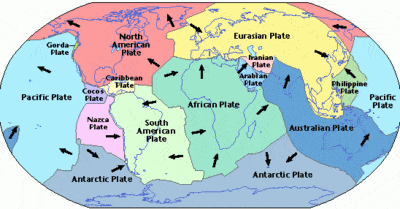
Formation of earthquakes, volcanoes and mountain ranges are happening along the plate boundaries. Geologic features served as bases in the marking of plate boundaries.
25
What do the arrows in the map indicate?
Are all plates moving in the same direction?

26
The arrows on the map tell the direction of movement of each plate. Each plate is slowly moving relative to each other causing geologic events to happen along plate boundaries.

27
What other geologic events could be formed by these types of plate boundaries?
28
Studying plate boundaries is important because along these boundaries deformation of the lithosphere is happening . These geologic events have a great impact not only on the environment but also on us.

29
Which plate boundaries move away from each other?
Which plate boundaries move towards each other?
Which plate boundary slides past each other horizontally?
What are the three basic types of plate boundaries?

30
The plates move towards each other

31
Divergent Boundary-the plates move away from each other.

32
The plates slide past each other.

33

34
The plates are layers of rigid, solid rock. As they move, plates interact at their edges or boundaries.
35
Mohorovicic Discontinuity "Moho"
The Mohorovicic Discontinuity, or "Moho," is the boundary between the crust and the mantle. The red line in the diagram shows its location.
"discontinuity" is used for a surface at which seismic waves change velocity.
One of these surfaces exists at an average depth of 8 kilometers beneath the ocean basin and at an average depth of about 32 kilometers beneath the continents.

At this discontinuity, seismic waves accelerate. This surface is known as the Mohorovicic Discontinuity or often simply referred to as the "Moho." (image by geology.com)
36

37
Plates rip apart at a divergent plate boundary, causing volcanic activity and shallow earthquakes;
At a convergent plate boundary, one plate dives (“subducts”) beneath the other, resulting in a variety of earthquakes and a line of volcanoes on the overriding plate;
Transform plate boundaries are where plates slide laterally past one another, producing shallow earthquakes but little or no volcanic activity.
Describe the different types of plate boundaries
Show answer
Auto Play
Slide 1 / 37
SLIDE
Similar Resources on Wayground

32 questions
Nucleosynthesis
Presentation
•
KG
30 questions
World War I
Presentation
•
10th Grade
30 questions
The Molecules of Life
Presentation
•
10th Grade
32 questions
Climate
Presentation
•
10th Grade
34 questions
Levels of Organization, Food Chains, and Webs
Presentation
•
10th Grade
31 questions
Absolute Value Inequalities
Presentation
•
10th Grade
31 questions
Cell terms part 2 - 2023
Presentation
•
10th Grade
29 questions
Lab Safety Is Common Sense
Presentation
•
KG
Popular Resources on Wayground
10 questions
How much do you know about our Portrait of an Eagle?

Quiz
•
10th Grade
10 questions
Fast Food Slogans
Quiz
•
6th - 8th Grade
21 questions
Continents and Oceans
Quiz
•
6th Grade
20 questions
Parts of Speech
Quiz
•
5th Grade
16 questions
Subject & Predicate
Quiz
•
5th Grade
25 questions
Multiplication Facts
Quiz
•
5th Grade
12 questions
Map Skills
Quiz
•
3rd Grade
22 questions
Continents and Oceans
Quiz
•
5th Grade
Discover more resources for Science
10 questions
Exploring Chemical and Physical Changes

Interactive video
•
6th - 10th Grade
10 questions
Decoding the Periodic Table of Elements
Interactive video
•
6th - 10th Grade
10 questions
Exploring the Periodic Table
Interactive video
•
6th - 10th Grade
14 questions
Physical and Chemical Changes
Quiz
•
10th Grade
22 questions
Periodic Table Review
Quiz
•
9th - 12th Grade
10 questions
Exploring the States of Matter
Interactive video
•
6th - 10th Grade
10 questions
Exploring Physical and Chemical Changes
Interactive video
•
6th - 10th Grade
21 questions
Macromolecules and Enzymes Study Guide
Quiz
•
9th - 10th Grade