
Search Header Logo
  1. Resource Library
  2. Math
  3. Probability And Statistics
  4. Experimental Probability
  5. Types Of Probabilities
Types of Probabilities

Types of Probabilities

Assessment

Presentation

Mathematics

11th - 12th Grade

Practice Problem

Medium

CCSS
8.SP.A.4, 7.NS.A.3, 7.EE.B.3

+3

Standards-aligned

Created by

Diane Tucker

Used 10+ times

FREE Resource

14 Slides • 11 Questions

1

Types of Probabilities
Slide image

2

Ojectives

Learning Objectives: Students will distinguish between the types of probabilities and determine probability of an event.

Language Objective: Students will express their reasoning in written form.

3

Warm Ups

Integers and Absolute Value
To find an absolute value of a number, just find its distance from 0 on number line! For example, the distance of 12 and −12 from zero on number line is 12!

Example
Evaluate the value.

 189×58=\frac{|−18|}{9}×|5−8|=  

4

Multiple Choice

Evaluate the value.

8 − |2 − 14| − |−2| =

1

-6

2

-2

3

18

4

22

5

Multiple Choice

Evaluate the value.

 2  102=|−2|\ −\ \frac{|−10|}{2}=  

1

-7

2

-3

3

3

4

7

6

Multiple Choice

Evaluate the value.

 2 × 4+405=|2\ ×\ −4|+\frac{|−40|}{5}=  

1

-3

2

-16

3

0

4

16

7

Backgraound

Probability theory was initially developed in 1654 in a series of letters between two French mathematicians, Blaise Pascal and Pierre de Fermat, as a means of determining the fairness of games. It is still used today to make sure that casino customers lose more money than they win, and in many other areas, including setting insurance rates.

8

Background

At the heart of probability theory is randomness. Rolling a die, flipping a coin, drawing a card and spinning a game board spinner are all examples of random process. In a random process no individual event is predictable, even though the long range pattern of many individual events often is predictable.

9

Vocabulary

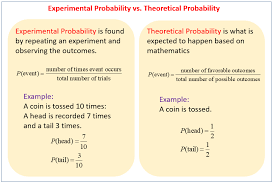
Experimental Probability- the result of an actual experiment conducted to find the results . (does happen)

Theoretical Probability- the results of what could happen, with out conduction an experiment.

10

Multiple Choice

What type of probability is the following?

Rolling a six-sided die, what is the probability of landing on a one?

1

Theoretical Probability

2

Experiential Probability

11

Multiple Choice

What type of probability is the following?

If a dice is rolled 6000 times and the number '5' occurs 990 times, what is the probability of landing on a 5?

1

Theoretical Probability

2

Experimental Probability

12

Calculating Probabilities

When calculating the probability of something happening, the “something” is called an event, and the probability of the event happening is written P(event).

EXAMPLE 1: The probability of rolling a 3 on a die would be written as ____.

13

Fill in the Blank

Type answer...

14

Probability

Probabilities are always expressed as a value between 0 and 1. The probability of an event that is certain to happen is 1 or 100%, while the probability of an impossible event is 0 or 0%.

To calculate a probability, you count the number of outcomes in the event of interest and divide this number by the total number of outcomes

15

Formula


Slide image

16

Example of Theoretical Probability

A bag contains 4 blue marbles, 6 green marbles and 3 yellow marbles. A marble is drawn at random from the bag.

 A) What's the probability of drawing a green marble?

 B) What's the probability of drawing a yellow marble?

C) What's the probability of drawing a green OR yellow marble?

17

18

Multiple Choice

A bag contains 4 blue marbles, 6 green marbles and 3 yellow marbles. A marble is drawn at random from the bag.

What's the probability of drawing a blue marble?

1

9/13

2

6/13

3

4/13

4

3/13

19

Multiple Choice

A bag contains 4 blue marbles, 6 green marbles and 3 yellow marbles. A marble is drawn at random from the bag.

What's the probability of drawing a blue marble or a green marble?

1

10/13

2

9/13

3

6/13

4

4/13

20

Example of Experimental Probability

This type of table is called a two-way table. The total number of people in the sample is 755.  The row totals are 325 and 430. The column totals are 70 and 685. Notice that 325 + 430 = 755, and 70 + 685 = 755.

Slide image

21


Calculate the following probabilities using the table above:

A) P(a driver is a mobile phone user)

B) P(a driver had no accident in the last year) =

C) P(a driver using a mobile phone had no accident in the last year) =

22

Multiple Choice

Question image

Calculate the following probabilities using the table above:

P(a driver is not a mobile phone user)

1

5/151

2

5/86

3

5/14

4

86/151

23

Multiple Choice

Question image

Calculate the following probabilities using the table above:

P(a driver had an accident in the last year) =

1

5/86

2

5/151

3

14/151

4

0

24

Multiple Choice

Question image

Calculate the following probabilities using the table above:

P(a driver not using a mobile phone had an accident in the last year) =

1

5/14

2

5/86

3

5/151

4

0

25

End of Notes

Homework Due on Friday.

Slide image

Types of Probabilities

Slide image

Show answer

Auto Play

Slide 1 / 25

SLIDE
