Search Header Logo
Respiratory system

Respiratory system

Assessment

Presentation

•

Biology, Science

•

7th Grade

•

Practice Problem

•

Medium

•
NGSS
MS-LS2-3, MS-LS1-7, MS-LS1-6

+1

Standards-aligned

Created by

Kasthuri Subramaniam

Used 40+ times

FREE Resource

9 Slides • 31 Questions

1

Respiratory system

Slide image

2

CHECKLIST

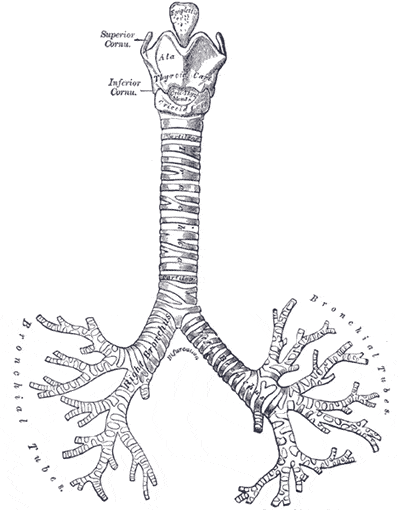
  • Draw and label the internal structures of the human respiratory system and describe the breathing mechanism.

  • Describe the movement and exchange of oxygen and carbon dioxide in the human body.

3

Slide image

4

Slide image


5

Multiple Choice

Question image
What is tube that is also known as your wind pipe?
1
esophogus
2
bronchi
3
trachea
4
alveoli

6

Multiple Choice

Question image

Flap of tissue that covers the opening to the windpipe during swallowing

1

Pharynx

2

Trachea

3

Epiglottis

7

Multiple Choice

Membrane layer which covers the lungs
1
Visceral pleura
2
Alveolar Ducts
3
Alveoli
4
Bronchi

8

Multiple Choice

Alveoli increase the surface area in the lungs to allow...
1
More nutrients to be absorbed
2
You to breathe faster
3
You to breathe slower
4
More O2 and CO2 to exchange

9

Multiple Choice

This is the airway that has two pairs of vocal chords attached to it
1
Lungs
2
Diaphragm
3
Pharynx
4
Larynx

10

Multiple Choice

Made up of spongy, elastic tissue that stretches as you breathe
1
Alveoli
2
Lungs
3
Nasal Cavity
4
Pharynx

11

Multiple Choice

What is the function of the respiratory system
1
Take in O2 only
2
Remove CO2 only
3
Take in O2 ad remove CO2
4
Make sugar

12

Multiple Choice

Passage way that moistens the air and has hairs to trap dust and particles
1
Nasal cavity
2
Bronchi
3
Mouth cavity
4
Larynx

13

Multiple Choice

Smaller tubes within the lungs
1
Bronchioles
2
Bronchi
3
Lungs
4
Alveoli

14

Multiple Choice

Muscular structure that helps to expand and contract the lungs, forcing air in and out
1
Pharynx
2
Nasal cavity
3
Alveoli
4
Diaphragm

15

Multiple Choice

Clusters of tiny air sacs that allow the exchange of oxygen and carbon dioxide
1
Pharynx
2
Diaphragm
3
Alveoli
4
Lungs

16

Multiple Choice

Two short tubes that carry air into the lungs
1
Trachea
2
Bronchioles
3
Lungs
4
Bronchi

17

Multiple Choice

This is a tube about 12cm long with c-shaped rings of cartilage to keep it open

1

Nasal cavity

2

Trachea

3

Mouth Cavity

4

Pharynx

18

Slide image

19

Exchange of gasses

  • Exchange of oxygen and carbon dioxide due to the difference in concentration in the alveolus and blood capillary.

  • Diffusion of oxygen from the alveolus into the blood capillary.

  • Formation of an unstable compound, that is, oxyhaemoglobin.

  • Release of oxygen into the body cells.

  • Oxidation of food during cellular respiration to release energy.

  • Diffusion of carbon dioxide from the cell into the blood capillary then into the alveolus

20

Slide image

21

Alveolus

  • Factors that affect the efficiency of the alveolus to maximise the gaseous exchange are

  • thickness,

  • moisture,

  • surface area, and

  • network of capillaries.

22

Slide image

23

Multiple Choice

Normally in the blood, hemoglobin is saturated with oxygen only up to

1

80%

2

95%

3

75%

4

50%

24

Multiple Choice

Blood arriving in the capillary from the body has a...
1
Higher concentration of carbon dioxide (CO2) and a lower concentration of oxygen (O2)
2
Higher concentration of oxygen (O2) and a lower concentration of carbon dioxide (CO2)

25

Multiple Choice

Gaseous exchange happens because of...

1

Osmosis

2

Respiration

3

Diffusion

4

Semi-permeable membranes

26

Multiple Choice

Each haemoglobin molecule can bind reversibly with

1

one atom of oxygen

2

one molecule of oxygen

3

two molecules of oxygen

4

four molecules of oxygen

27

Multiple Choice

When carbon dioxide binds directly with haemoglobin it forms

1

carbaminohaemoglobin

2

carboxyhaemoglobin

3

carbon diooxyhaemoglobin

4

carboglobin

28

Multiple Choice

The main blood vessel responsible for taking oxygenated blood to the body is the

1

pulmonary artery

2

aorta

3

vena cava

4

pulmonary veins

29

Multiple Choice

What happens when the intercostals contract during inhalation?

1

The diaphragm relaxes

2

The ribs are elevated

3

Pressure in the lungs increases

4

The size of the thoracic cavity decreases

30

Multiple Choice

What are the main muscles of inhalation?

1

The diaphragm and intercostal muscles

2

The scalenes and the abdominal muscles

3

The diaphram and abdominal muscles

4

The diaphragm and latissimus muscles

31

Multiple Choice

A contraction of the diaphragm during inhalation causes it to flatten. What else does the contraction result in?

1

An increase in the volume of the thoracic cavity

2

Increase in alveolar pressure

3

A decrease in lung volume

4

A decrease in the volume of the thoracic cavity

32

Multiple Choice

What are the products of cellular respiration?
1
Energy (ATP), Water, and Carbon DIoxide.
2
Water and Oxygen
3
Oxygen and Carbon Dioxide
4
Water and Energy (ATP)

33

Multiple Choice

Which gas is more soluble in blood (or water)?

1

O2

2

CO2

3

both have the same solubility

34

Multiple Choice

Question image
Letter D is pointing to which Respiratory organ?
1
Alveoli
2
Diaphragm
3
Lung
4
Bronchi

35

Multiple Choice

Question image

The air sacs that are covered with capillaries where gas exchange takes place.

1

Bronchi

2

Trachea

3

Oxygen

4

Alveoli

36

Multiple Choice

Which of the following are features of the alveoli that adapt them to gas exchange?

I. High surface area
II. Thin walls
III. Dry surfaces
1
I and II only
2
I only
3
II and III
4
I, II, and III

37

Multiple Choice

Respiration is the 
1
Intake of oxygen and release of carbon dioxide over a membrane
2
Release of energy from food inside cells
3
Mechanical movement to inhale and exhale air
4
Feature that enable an animal to survive in its habitat

38

Multiple Choice

The movement by diffusion of oxygen and carbon dioxide across a membrane
1
Ventilation
2
Breathing
3
Gas exchange
4
Respiration

39

Multiple Choice

Question image

Gas exchange is needed to supply _____________ to cells and remove __________________

1

carbon dioxide; oxygen

2

oxygen; food

3

oxygen; carbon dioxide

4

carbon dioxide; water

40

Multiple Choice

Mechanical movement to inhale and exhale air
1
Gas Exchange
2
Respiration
3
Breathing
4
Transport

Respiratory system

Slide image

Show answer

Auto Play

Slide 1 / 40

SLIDE