

Search Header Logo
  1. Resource Library
  2. Ela
  3. Grammar
  4. ...
  5. Figurative Language: Intro Lesson
Figurative Language: Intro Lesson

Figurative Language: Intro Lesson

Assessment

Presentation

English

3rd Grade

Practice Problem

Medium

CCSS
L.3.5A, L.11-12.5A, RI.3.10

+15

Standards-aligned

Created by

Maria Cabreza

Used 139+ times

FREE Resource

18 Slides • 10 Questions

1

Figurative Language Lesson 1

Cabreza Class Nov 4-13
Slide image

2

Why are you stuttering? Are you tongue-tied?

What does this mean?

Slide image

3

It's raining cats and dogs!

What does this mean?

Slide image

4

Why don't you speak to me? ...Cat's got your tongue?


Slide image

5

What is Literal Language?

  • You mean exactly what you say.

6

What is Nonliteral or

Figurative Language?

  • What you say is not what you really mean.

7

tongue-tied

Literal versus Nonliteral (Figurative)

Slide image

8

raining cats and dogs

Literal versus Nonliteral (Figurative)

Slide image

9

cat's got your tongue

Literal versus Nonliteral (Figurative)

Slide image

10

The wind caressed her cheek as she watched the sun go down.

The wind didn't really caress her cheek, but it sounds more interesting saying that than the wind blew against her cheek.

11

The cookies were as hard as rocks after being baked for too long.

The cookies are not really rocks, but they are being compared to rocks to make a point that the cookies are really hard.

12

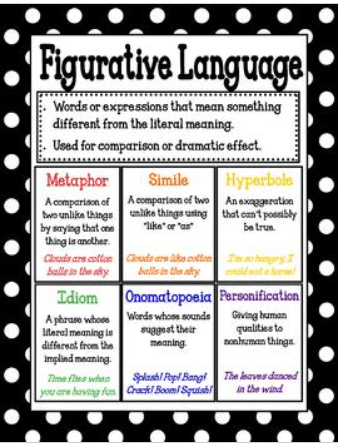
Types of Figurative Language

  • https://youtu.be/VOrcxEUw9WE

  • Simile

  • Metaphor

  • Personification

  • Hyperbole

  • Idioms

Slide image

13

IDIOM: A common phrase or expression that has a nonliteral or figurative meaning.

Slide image

14

Multiple Choice

This type of Figurative Language is a common expression that has a nonliteral meaning.

1

SIMILE

2

METAPHOR

3

IDIOM

4

PERSONIFICATION

15

SIMILE: A comparison of two things using like or as


Slide image

16

METAPHOR: A direct comparison of two unlike things without using like or as

Slide image

17

HYPERBOLE: An extreme exaggeration

Slide image

18

PERSONIFICATION: Gives human qualities or characteristics to nonhuman objects, ideas, or animals

Slide image

19

Multiple Choice

What is literal language?

1

You are just joking.

2

It has a deeper meaning.

3

You mean what you say.

20

Multiple Choice

What is nonliteral or figurative language?

1

You mean what you say.

2

You are just joking.

3

Does not mean what it says.

21

Multiple Choice

This is a figurative language that compares.

It uses the words like or as.

1

SIMILE

2

METAPHOR

3

PERSONIFICATION

4

HYPERBOLE

22

Multiple Choice

This type of figurative language is a direct comparison of two unlike things WITHOUT USING like or as.

1

SIMILE

2

METAPHOR

3

PERSONIFICATION

4

HYPERBOLE

23

Multiple Choice

This TYPE of figurative language is an extreme exaggeration.

1

SIMILE

2

METAPHOR

3

PERSONIFICATION

4

HYPERBOLE

24

Multiple Choice

This TYPE of figurative language gives human characteristics to non human objects, ideas, or animals.

1

SIMILE

2

METAPHOR

3

PERSONIFICATION

4

HYPERBOLE

25

Multiple Choice

Why do authors use figurative language in their writing?

1

to make fun of things

2

to make writing interesting

3

to make readers imagine

26

Open Ended

VIP: Write one Very Important Point you learned in this lesson.

27

Poll

Is the lesson about figurative language clear to you?

Yes, totally!

Yes, but I would need more examples.

So-so (Maybe)

Not really...still muddy.

28

TODAY, WE LEARNED...

  • With literal language, you mean what you say.

  • With nonliteral language, you DO NOT mean what you say.

  • Nonliteral language is also known as Figurative Language.

  • Common types of nonliteral or figurative language are Simile, Metaphor, Hyperbole, Personification, and Idioms.
Slide image

Figurative Language Lesson 1

Cabreza Class Nov 4-13

Slide image

Show answer

Auto Play

Slide 1 / 28

SLIDE
