Search Header Logo
Covalent Bonds

Covalent Bonds

Assessment

Presentation

Chemistry

10th - 11th Grade

Practice Problem

Medium

NGSS
HS-PS1-1, HS-PS1-2, HS-PS1-3

+3

Standards-aligned

Created by

Stacy King

Used 43+ times

FREE Resource

15 Slides • 10 Questions

1

Covalent Bonds

Slide image

2

Covalent Bond

formed between nonmetals

Slide image

3

Covalent Bond

electronegativity attraction forces being stronger than the repulsion forces

Slide image

4

Covalent Bond

Low melting point

do not conduct electricity

primarily gases

5

Covalent bond

atoms with high kinetic energy react with other atoms to become more stable

Slide image

6

Covalent Bond

bond energy is the amount of energy to break a chemical bond

Slide image

7

Covalent Bond

Electron Dot or Lewis Dot

signifies the bonding pair of electrons

Slide image

8

covalent bond

polar- unequal sharing of electrons

creates dipoles

Slide image

9

Covalent bond

non polar is equal sharing of electrons

Slide image

10

Covalent Bond

Electron Dot or Lewis Dot

signifies the bonding pair of electrons

Slide image

11

Polyatomic ions

a bonded set of 2 or more atoms that function as a single unit

Slide image

12

Covalent Bonds

Resonance/hybrid Structures

are electron dot structures that have multiple correct lewis dot arrangements

Slide image

13

Octet Exceptions

Free Radicals have odd number of electrons

Slide image

14

Octet exceptions

electron deficient the central atom does not have a filled valence shell

Slide image

15

Octet Exceptions

hypervalency atoms can have more than 8 electrons

Slide image

16

Multiple Choice

Question image
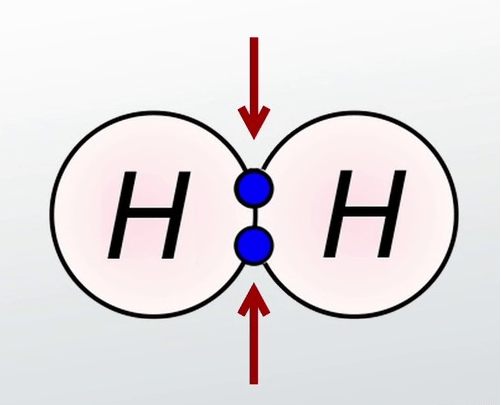
What type of bond is shown in this image?
1
Ionic
2
Polar Covalent
3
Nonpolar Covalent
4
Van der Waals Force

17

Multiple Choice

Question image
What two types of atoms make a covalent bond?
1
2 Nonmetals
2
1 Nonmetal and 1 Metal
3
2 Metals
4
2 Noble Gases

18

Multiple Choice

How do covalent bonds form?
1
Donating & receiving valence e- between atoms.
2
Opposite slight charges attract each other between compounds.
3
Scientists are still not sure how they form.
4
Sharing valence e- between atoms.

19

Multiple Choice

Compared to ionic compounds, molecular compounds generally have...
1
stronger chemical bonds
2
poor conductivity
3
a high melting point
4
lower densities

20

Multiple Choice

Question image
Partial charges like the ones shown here are called:
1
dipoles
2
deltas
3
ions
4
magnetic poles

21

Multiple Choice

Question image
In this Lewis structure, the symbol above F means...
1
electrons are being transferred to Fluorine
2
electrons are less attracted to F than H
3
electrons are more attracted to F than H
4
Fluorine has formed a cation

22

Multiple Choice

Electronegativity is a measurement of the ability of a nucleus to...
1
attract bonding electrons
2
attract other nuclei
3
attract elenece in the non-valence energy levels

23

Multiple Choice

Covalent bonds are between...
1
Metal and Non-metal
2
Non-metal and Non-metal
3
Metal and Metal

24

Multiple Choice

Valence electrons are found

1

in the innermost energy level of an atom

2

in the middle energy levels of an atom

3

in the outermost energy levels of an atom

25

Multiple Choice

In an electron dot diagram, two pairs of shared electrons represents a ...
1
single bond
2
double bond
3
triple bond
4
quadruple bond

Covalent Bonds

Slide image

Show answer

Auto Play

Slide 1 / 25

SLIDE