- Resource Library
- Science
- Engineering & Science Practices
- Experiment
- Unit 1 Test Review Controlled Experiments

Unit 1 Test Review - Controlled experiments
Presentation
•
Science
•
7th Grade
•
Practice Problem
•
Medium
+6
Standards-aligned
Amy Carey
Used 18+ times
FREE Resource
13 Slides • 25 Questions
1
Unit 1 Test Review
Controlled Experiments
2
Science Safety (in class)
Always follow directions (Golden Rule of Science)
Enter the lab only with permission
Be respectful of the space and each other
No drinking or eating in the lab (water okay)
Read all directions before beginning
In case of an accident... NOTIFY YOUR TEACHER IMMEDIATLY
3
Science Safety (at home)
Always follow directions (Golden Rule)
Establish a point person
Protect your electronics
4
Fill in the Blank
Type answer...
5
Observations & Inferences
An observation is a statement describing a fact.
There are qualitative and quantitative observations.
An inference is a logical interpretation of an event based on observations and prior knowledge.
6
Multiple Choice
What is a quantitative observation about the object in this picture?
the object has round “eyes”
the object is 4.71 cm tall
the object is gray
the object is a toy
7
Multiple Select
A measurement is a repeatable observation of a quantity. A measurement includes what? (choose all that apply)
number
unit
decimal point
uncertainty
8
Multiple Choice
What is the measurement of the volume of liquid in the graduated cylinder?
6 mL
6.4 mL
6.44 mL
6.444 mL
9
Multiple Choice
What SI units are used to measure mass?
meters
liters
grams
celcius
10
Controlled Experiments
Independent variable (IV) - This is the variable that is directly changed by the experimenter
Dependent variable (DV) - a measured quantity, potentially changing as a result of the IV
Control variables (CVs) - fixed variables or constants; factors not being tested; kept constant so experiment focuses on the IV
11
Controlled Experiments continued...
Experimental Groups - each different group that is part of the IV
Control Group - Group in which the IV is removed to provide a baseline or point of comparison. Not all experiments have an control group
Control Variables and the Control Group are different but often mixed up!
12
Multiple Choice
13
Multiple Choice
Experiment: How does watching TV during studying affect a student’s test grades?
The students grades are the ___________ variable.
independent
dependent
14
Multiple Choice
Experiment: How does the flavor of ice cream affect the speed of melting?
The flavor of ice cream is the ___________ variable.
independent
dependent
15
Multiple Choice
A student wants to test how different amounts of UV light affect the growth of the bacteria, Staphylococcus aureus. She wants to grow the bacteria in petri dishes for her experiment. Which of the following variables should NOT be held constant in this experiment?
amount of UV light bacteria is exposed to
amount of time to grow bacteria
location of petri dishes while growing bacteria
type of bacteria (Staphylococcus aureus)
16
Accuracy & Precision
Accuracy: how close a measurement is to the actual value
Accuracy is determined by finding the average measurement and comparing that average to the actual value
Data set precision: how close a set of measurements are to one another
Data set precision is determined by finding the range (highest to lowest value) in data. (can also use standard deviation & error bars)
Tool precision: how finely divided a measuring device is (how small the increments are)
Tool precision determined by the quality of the measuring device… the smaller the divisions, the more certain digits there are
17
Multiple Choice
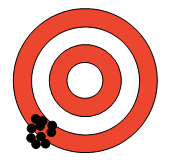
This bullseye demonstrates...
High Accuracy & High Precision
High Accuracy & Low Precision
Low Accuracy & High Precision
Low Accuracy & Low Precision
18
Multiple Choice
The actual height of the object is 3.56 cm.
Is this data set accurate?
yes
no
can't determine
19
Tables & Graphs
Enough said?
20
Open Ended
What is wrong with this table?
21
22
Multiple Choice
What type of graph should be used for this data? (remember continuous and categorical variables?!)
pie chart
bar graph
XY scatter plot
Multi XY scatter plot
23
Multiple Choice
What type of graph should be used for this data? (remember continuous and categorical variables?!)
pie chart
bar graph
XY scatter plot
Multi XY scatter plot
24
Multiple Choice
What type of graph should be used for this data? (remember continuous and categorical variables?!)
pie chart
bar graph
XY scatter plot
Multi XY scatter plot
25
Fill in the Blank
Type answer...
26
Fill in the Blank
Type answer...
27
Multiple Choice
What is the technique called if a scientist was to use this graph to estimate the height of an 8.7 year old human child?
trend line
line of best fit
interpolation
extrapolation
28
Interpreting Results
Discussing errors & assumptions. Analyzing data.
29
Open Ended
Explain this cartoon to someone that doesn't know anything about error bars.
30
Multiple Select
Scientific assumptions might be (check all that apply):
a belief that something that was not a control variable did not affect the results
thinking that the controlled variables were correctly controlled
the expected results
the opinion that the same procedure was followed for all measurements
a known error
31
Open Ended
Joey is performing an experiment where they make cupcakes with different amounts of flour. In one batch Joey uses two, 1/2 cups to measure the flour, in another batch they use four, 1/4 cups to measure the flour. Is this an error?
32
Multiple Choice
A scientist would conclude that a warm glow stick would conclusively glow longer than a hot glow stick.
True
False
33
Hypothesis
a prediction based on background knowledge
an educated guess suggesting an answer to a problem or set of observations
If…then…because… (citation).
If (choose an experimental group), then (predict the DV), because (research) (citation).
34
Multiple Choice
After the 'If' in a hypothesis,
choose an experimental group to make a prediction about
predict the dependent variable (maximum or minimum)
use scientific research to support the prediction
Use the first part of the full citation to create the in-text citation
35
Multiple Choice
After the 'then' in a hypothesis,
choose an experimental group to make a prediction about
predict the dependent variable (maximum or minimum)
use scientific research to support the prediction
Use the first part of the full citation to create the in-text citation
36
Multiple Choice
After the 'because' in a hypothesis,
choose an experimental group to make a prediction about
predict the dependent variable (maximum or minimum)
use scientific research to support the prediction
Use the first part of the full citation to create the in-text citation
37
Valid Scientific Experiments
https://youtu.be/CJfdUy4LwfQ.
(I can't embed this link but you can copy/paste into your web browser to view)
38
End of review slides
This slide show is just ONE way to prepare for the test. It in no way encompasses all the information that will be on the test, you still need to review your notes, activities, homeworks, quizzes, etc. GOOD L
Unit 1 Test Review
Controlled Experiments

Show answer
Auto Play
Slide 1 / 38
SLIDE

Similar Resources on Wayground
31 questions
Systems Interacting
Presentation
•
7th Grade
35 questions
Interactions in Ecosystems
Presentation
•
7th Grade
36 questions
Levels of Organization - Cells to Biome
Presentation
•
KG
33 questions
Atoms and the periodic table
Presentation
•
8th Grade
33 questions
ENERGY TRANSFORMATION
Presentation
•
6th Grade
33 questions
Chemical Bonding
Presentation
•
8th Grade
31 questions
01.25.2022 Diffusion and Osmosis
Presentation
•
7th Grade
36 questions
Ecological Succession & Human Impact on Ground&Surface water
Presentation
•
7th Grade
Popular Resources on Wayground
10 questions
5.P.1.3 Distance/Time Graphs
Quiz
•
5th Grade
10 questions
Fire Drill
Quiz
•
2nd - 5th Grade
20 questions
Equivalent Fractions
Quiz
•
3rd Grade
22 questions
School Wide Vocab Group 1 Master
Quiz
•
6th - 8th Grade
20 questions
Main Idea and Details
Quiz
•
5th Grade
20 questions
Context Clues
Quiz
•
6th Grade
20 questions
Inferences
Quiz
•
4th Grade
12 questions
What makes Nebraska's government unique?
Quiz
•
4th - 5th Grade
Discover more resources for Science
19 questions
Introduction to Properties of Waves
Presentation
•
6th - 8th Grade
16 questions
Interactions within Ecosystems
Presentation
•
6th - 8th Grade
10 questions
Exploring the Layers of the Earth
Interactive video
•
6th - 10th Grade
16 questions
Photosynthesis and Cellular Respiration Review
Quiz
•
7th Grade
20 questions
Abiotic & Biotic Factors
Quiz
•
7th Grade
10 questions
Exploring the Evolution of Cell Theory
Interactive video
•
7th Grade
17 questions
Human body systems
Quiz
•
7th Grade
20 questions
Energy Transformations
Quiz
•
6th - 8th Grade