
Forms of Energy
Presentation
•
Science
•
6th - 7th Grade
•
Practice Problem
•
Medium
+11
Standards-aligned
Joshua Rochon
Used 91+ times
FREE Resource
9 Slides • 43 Questions
1
Forms of Energy
6th Grade Science
2
Open Ended
What is energy?
3
Multiple Choice
4
5
6
Multiple Choice
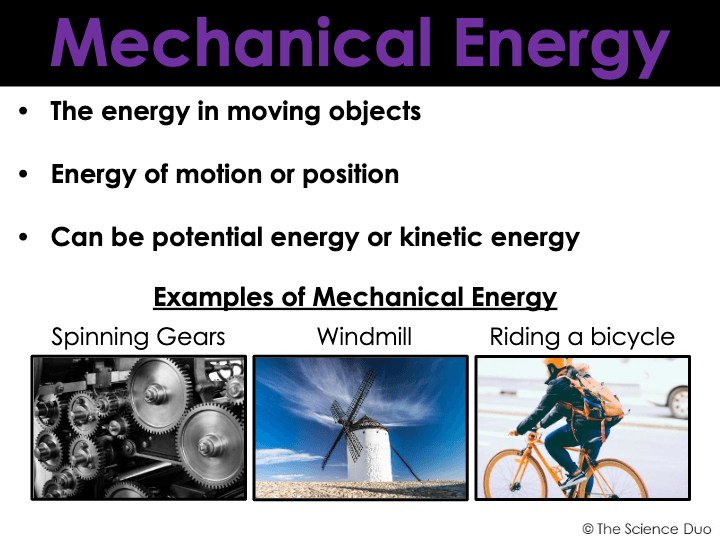
Which of the following actions does not require mechanical energy to function?
Sharpen a pencil.
Riding a bike.
Rotating a motor.
Melting ice.
7
Multiple Choice
8
Multiple Choice
9
Multiple Choice
Which statement best defines Mechanical Energy?
Energy produced by a machine or moving part.
Energy that is produced by an electrical current in a circuit.
Energy from the sun.
Energy that travels in waves due to vibrations.
10
Multiple Choice
Which of the following is an example of mechanical kinetic energy?
Mowing the lawn
Gasoline in a gas can
Firework that has not been lit
Food on a plate
11
12
Multiple Choice
1. Sources of radiant energy include .
Running, a potato, and gasoline
A microwave, fire, and water vapor
People, coal, and a blender
Stars, the Sun, and a lamp
13
Multiple Choice
Thermal energy that is transferred from one substance to another.
heat
temperature
thermal energy
radiation
14
15
Multiple Choice
Which of the following is an example of chemical energy being changed into kinetic energy?
Digested food giving you energy to jump.
A battery giving a flashlight energy to light up.
A hand hitting a drum making music.
Two liquids mixed together and get hot.
16
Multiple Choice
Which of the following is NOT an example of chemical energy?
A glow stick
A battery
A rock about to fall off a cliff
A burning match
17
Multiple Choice
Which of the following is NOT an example of chemical energy?
A glow stick
A battery
A rock about to fall off a cliff
A burning match
18
19
Multiple Choice
Which type of electricity is the most useful type of energy we use today?
Static Electricity
Proton Electricity
Current Electricity
20
Multiple Choice
What is Static Electricity?
build up of negatively charged electrons on a surface
build up of neutrally charged electrons on a surface
build up of positively charged electrons on a surface
21
Multiple Choice
Why is a battery important in an electrical circuit?
As a source of energy.
As a path for electricity to flow through.
As a connector to connect all parts of a circuit.
22
Multiple Choice
23
Multiple Choice
a buildup of electric charges on an object
static electricity
electric force
electrical circuit
electric discharge
24
Multiple Choice
A device that makes electricity by using chemical reactions, stores energy until it is needed
circuit
battery
insulator
copper wire
25
Multiple Choice
A device that makes electricity by using chemical reactions, stores energy until it is needed
circuit
battery
insulator
copper wire
26
27
Multiple Choice
Nuclear energy uses _____ to turn turbines to power a generator.
wind
water
steam
solar
28
Multiple Choice
29
Multiple Choice
What are the two major forces involved with nuclear energy?
Fission and Fusion
Alpha and Beta particles
Gamma and Fission
Radioactivity and Alpha Decay
30
Multiple Choice
What are the two major forces involved with nuclear energy?
Fission and Fusion
Alpha and Beta particles
Gamma and Fission
Radioactivity and Alpha Decay
31
32
Multiple Choice
What happens to the molecules inside bridges when temperature increases? Why are there joints in the structure?
Molecules move more, joints prevent them from hitting each other
Molecules move less, they shrink in size
Molecules move more, joints allow them room to expand without breaking bridge
Molecules are not affected by temperature
33
Multiple Choice
Cold things often have a _________ kinetic energy because_______
lower; particles are moving around less
lower; particles are moving around more
higher; particles are moving around the same
higher; particles do not move
34
Multiple Choice
What type of thermal energy transfer is occurring at point B?
Convection
Conduction
Radiation
Kinetic
35
Multiple Choice
What type of thermal energy transfer is occurring at point C?
Convection
Conduction
Radiation
Heat
36
Multiple Choice
What type of thermal energy transfer is occurring at point A?
Radiation
Convection
Conduction
None of the above
37
Multiple Choice
What type of thermal energy transfer is warming the man from the fire?
Convection
Conduction
Radiation
Heat
38
Multiple Choice
How do you increase the kinetic energy of molecules?
Decrease the temp
change the energy input
increase the thermal energy
expand the molecules and increase the density
39
Multiple Choice
Thermal energy always moves from hot to cold.
true
false
40
Multiple Choice
Thermal energy always moves from hot to cold.
true
false
41
42
Multiple Choice
43
Multiple Choice
44
Multiple Choice
45
Multiple Choice
46
Multiple Choice
47
Multiple Choice
48
Multiple Choice
49
Multiple Choice
50
Multiple Choice
51
Multiple Choice
In which medium will sound travel fastest?
air
water
glass
salt water
52
Multiple Choice
In which medium will sound travel fastest?
air
water
glass
salt water
Forms of Energy
6th Grade Science

Show answer
Auto Play
Slide 1 / 52
SLIDE

Similar Resources on Wayground
43 questions
Newton's 3 Laws of Motion Guided Lesson
Presentation
•
6th Grade
45 questions
Unit 1 Lesson 3: Erosion and Deposition by Water
Presentation
•
6th Grade
43 questions
Intro to the Solar System
Presentation
•
6th Grade
46 questions
The Periodic Table
Presentation
•
6th - 8th Grade
48 questions
Earth's Movements (Seasons, Day/Night)
Presentation
•
6th Grade
47 questions
Proportional Relationships
Presentation
•
7th Grade
52 questions
LEAP REVIEW #1
Presentation
•
6th Grade
49 questions
Measures of Variation 2020
Presentation
•
7th Grade
Popular Resources on Wayground
10 questions
5.P.1.3 Distance/Time Graphs
Quiz
•
5th Grade
10 questions
Fire Drill
Quiz
•
2nd - 5th Grade
20 questions
Equivalent Fractions
Quiz
•
3rd Grade
22 questions
School Wide Vocab Group 1 Master
Quiz
•
6th - 8th Grade
20 questions
Main Idea and Details
Quiz
•
5th Grade
20 questions
Context Clues
Quiz
•
6th Grade
20 questions
Inferences
Quiz
•
4th Grade
12 questions
What makes Nebraska's government unique?
Quiz
•
4th - 5th Grade
Discover more resources for Science
19 questions
Introduction to Properties of Waves
Presentation
•
6th - 8th Grade
16 questions
Interactions within Ecosystems
Presentation
•
6th - 8th Grade
10 questions
Exploring the Layers of the Earth
Interactive video
•
6th - 10th Grade
16 questions
Photosynthesis and Cellular Respiration Review
Quiz
•
7th Grade
20 questions
Abiotic & Biotic Factors
Quiz
•
7th Grade
15 questions
Punnett Squares
Quiz
•
6th Grade
10 questions
Exploring the Evolution of Cell Theory
Interactive video
•
7th Grade
17 questions
Human body systems
Quiz
•
7th Grade