Search Header Logo
Semester 1 2nd Review

Semester 1 2nd Review

Assessment

Presentation

Science

8th Grade

Medium

NGSS
MS-PS1-2, MS-PS1-5, MS-PS1-4

+1

Standards-aligned

Created by

Sabrina Robinson

Used 26+ times

FREE Resource

7 Slides • 29 Questions

1

Semester 1 2nd Review

Conservation of Matter

Slide image

2

3

Slide image

4

Slide image

5

Multiple Choice

Which of the following properties are chemical properties?

1

a tee shirt is extra large

2

100 pennies weighs 90 g

3

vinegar produces carbon dioxide bubbles when combined with baking soda.

4

the density of copper is 8.96 g/cm3

6

Multiple Choice

______________________ can only be recognized when substances react or do not react chemically with one another.

1

Physical properties

2

Chemical properties

3

Flammable properties

4

Colorful properties

7

Multiple Choice

When an object has the ability to be stretched into a thin wire this is

1

Density

2

Ductility

3

Dirtability

4

Dissovility

8

Multiple Choice

What word describes the relationship between the mass of a material and its volume?

1

Volume

2

Weight

3

Height

4

Density

9

Multiple Choice

Question image

Nanaki is investigating some of the properties of eggs through a series of experiments. She records her results in a table, but she is not sure which changes are physical and which are chemical.


Based on the information in the table, which experiment(s) caused chemical changes and how do you know?

1

All of the experiments caused chemical changes, because they were all irreversible and changed the appearance of the eggs.

2

Experiments 2, 3, and 4 caused chemical changes, because they changed the basic properties of the eggs; Experiment 1 did not, because it only created a mixture.

3

Experiments 3 and 4 caused chemical changes, because they involved heat and resulted in new substances; Experiments 1 and 2 did not, because they only created mixtures.

4

Experiment 4 caused a chemical change, because it created a new, crusty brown substance; the others did not, because they only caused changes in phase and color without changing the chemical makeup of the eggs

10

Multiple Choice

Reacts with Water: Chemical or Physical Property

1

Chemical Property

2

Physical Property

11

Multiple Choice

Physical properties are
1
properties that can be observed without changing the identity of the substance
2
properties that describe how a substance changes into a completely different substance

12

Multiple Choice

Solubility (dissolves): Chemical or Physical Property
1
Chemical Property
2
Physical Property

13

Multiple Choice

Question image

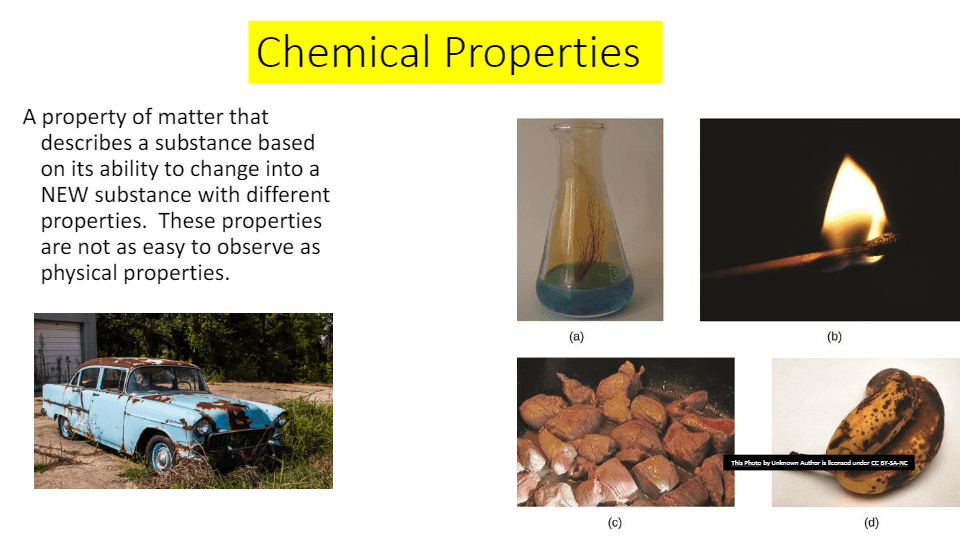
Ability to rust is this type of property:

1

Physical property

2

Chemical property

14

Slide image

15

Slide image

16

Multiple Choice

On a hot summer day, you make a glass of refreshing sweet iced tea by combining boiling water, tea, sugar, and ice. What type of change occurs and how do you know?

1

Physical change; sugar dissolves in the tea and water, but the chemical composition remains the same.

2

Physical change; sugar dissolves in the tea and water which breaks the bonds of the molecules.

3

Chemical change; sugar dissolves in the tea and water due to heat being added to the water.

4

Chemical change; sugar dissolves in the tea and water which breaks the bonds of the molecules.

17

Multiple Choice

Question image

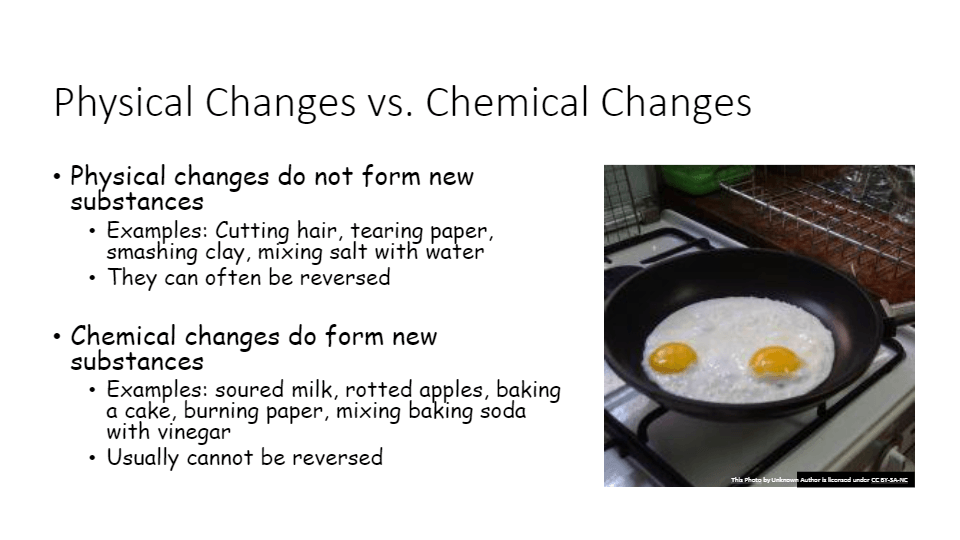
Is this an example of a physical or chemical change?

1

physical

2

chemical

18

Multiple Choice

Question image

Is this an example of a physical or chemical change?

1

physical

2

chemical

19

Multiple Choice

Question image

Is this an example of a physical or chemical change?

1

physical

2

chemical

20

Multiple Choice

A chemical change may involve

1

Evolution of gas

2

Change in temperature

3

Change in colour

4

All of the above

21

Multiple Choice

Question image

What does the picture represent ?

1

physical change

2

chemical change

22

Multiple Choice

Which of the following is a example of physical change ?

1

burning of wood

2

photosynthesis

3

melting of ice-cream

4

ripening of fruit

23

Multiple Choice

Which of the observations indicates that a chemical change has occurred?

1

A tray of water evaporates while sitting on a window sill.

2

A flashlight feels warm after it has been on for a long time

3

A gas is generated when two liquids are mixed together.

4

Paint dries after it is applied to a wall.

24

Multiple Choice

Question image

Is sharpening a pencil a physical or chemical change?

1

Physical

2

Chemical

25

Multiple Choice

One cup of water is left outside for two days when it was checked there was only half a cup left. What happened?

1

evaporation; chemical change

2

condensation; physical change

3

evaporation; physical change

4

condensation; chemical change

26

27

Multiple Choice

Question image

How many oxygen atoms are in this chemical formula?

1

6 oxygen atoms

2

2 oxygen atoms

3

3 oxygen atoms

4

4 oxygen atoms

28

Multiple Choice

How many nitrogen atoms does NH3 have?

1

1

2

2

3

3

4

4

29

Multiple Choice

What is the Law of Conservation of mass?
1
Mass is created in a chemical reaction
2
Mass is created in a physical change
3
New chemicals formed from a chemical reaction have a larger overall mass than the original reactants
4
Mass is never created or destroyed

30

Multiple Choice

Which are the reactants in the following reaction?

2Mg + O2 ---> 2MgO

1

Mg and O

2

MgO

3

Mg and MgO

4

O and MgO

31

Multiple Choice

What will weigh more when a chemical change is complete? The reactants before the chemical reaction, or the product after the reaction is complete?

1

They both will weigh the same

2

The product always weighs more than the reactant

3

The reactant will weigh more than the product

4

They both will loose mass after the reaction

32

Multiple Choice

In a reaction A + B ----> C,  reactant A has 5g and product  C has 9g. How many grams does reactant B should have? 
1
4g
2
5g
3
9g
4
14g

33

Multiple Choice

If reaction starts with 20g of reactants it should produce 
1
a total of 40g of products
2
a total of 10g of products
3
a total of 80 g of products
4
a total of 20g of products

34

Multiple Choice

In a chemical reaction, table sugar (sucrose) is mixed with sulfuric acid. The result of the reaction is a towering black structure of elemental carbon, water vapor, carbon dioxide, and sulfur dioxide gases. How can conservation of matter be proved using this reaction?

1

The masses of the sugar, sulfuric acid, and glassware should be recorded before the experiment, then the resulting reactant masses should be compared with the original masses.

2

The masses of the resultant gases and structure should be weighed to show that the resultants are heavier than the products.

3

The masses of the resultant gases and structure should be weighed to show that the resultants are lighter than the products.

4

The masses of the sugar, sulfuric acid, and glassware should be recorded before the experiment, then the energy lost can be added to the resultants and compared to the original masses.

35

Multiple Choice

Question image

Consider the following chemical equation.


What explanation from the evidence within the chemical equation BEST supports the idea that matter is conserved in a chemical reaction?

1

There are the same number of atoms of oxygen and hydrogen in the reactants as there are in the products.

2

There are the same number of elements in the reactants as there are in the products.

3

More reactants, hydrogen and oxygen, were added to make the product, water.

4

Two reactants, hydrogen and oxygen, combined to make one product, water.

36

Multiple Choice

Question image

Directions: Read the passage about mass in a combustion reaction.


The combustion of methane is a reaction in which methane gas burns in oxygen to produce carbon dioxide and water vapor. It is represented by the equation:


CH4 (g) + 2O2 (g) → CO2 (g) + 2H2O (g)


In the equation, one molecule of methane gas requires two molecules of oxygen gas to produce one molecule of carbon dioxide gas and two molecules of water in vapor form. The molecules in the equation can be modeled with circles to represent atoms and straight lines to represent the bonds between them, as shown in the picture.


A student observes the model and claims that the total mass of the reaction is conserved. Is the student's claim correct? Why or why not?

1

No, because the arrangement of atoms is different in the reactants and products.

2

Yes, because the reactants and products are made of atoms of the same elements.

3

Yes, because the number of atoms of each element is the same on both sides of the equation.

4

No, because the total number of atoms in products is greater than the total number of atoms in reactants.

Semester 1 2nd Review

Conservation of Matter

Slide image

Show answer

Auto Play

Slide 1 / 36

SLIDE