
- Resource Library
- Science
- Earth & Space Science
- Earthquakes And Volcanoes
- Plate Tectonics, Earthquakes, & Volcanoes

Plate Tectonics, Earthquakes, & Volcanoes

Presentation
•
Science
•
8th Grade
•
Practice Problem
•
Easy
+1
Standards-aligned

Autumn Lambert
Used 51+ times
FREE Resource
25 Slides • 4 Questions
1

2
Multiple Select
What evidence suggests that continents move?
Shapes of continents
Locations of mountain ranges and rock formations
Fossil distribution
Weather events
3
Late 1800's geophysicist and meteorologist
"Pangea"

4
A single large landmass that existed about 245 million years ago.
Mountains formed as the land masses collided.

5
Laurasia: Moved northward , then separated again into N.A. and Eurasia.
Gondwana: Became S.A. and Africa, Antarctica, Australia, and India.

6

7
Open Ended
Why would many scientists not accept the hypothesis of continental drift?
8
Theory that continents shift in position over time.

9
Describes the large-scale movements in Earth's crust (lithosphere).
Helps also explain how and why features in Earth's crust form and geologic events occur.

10
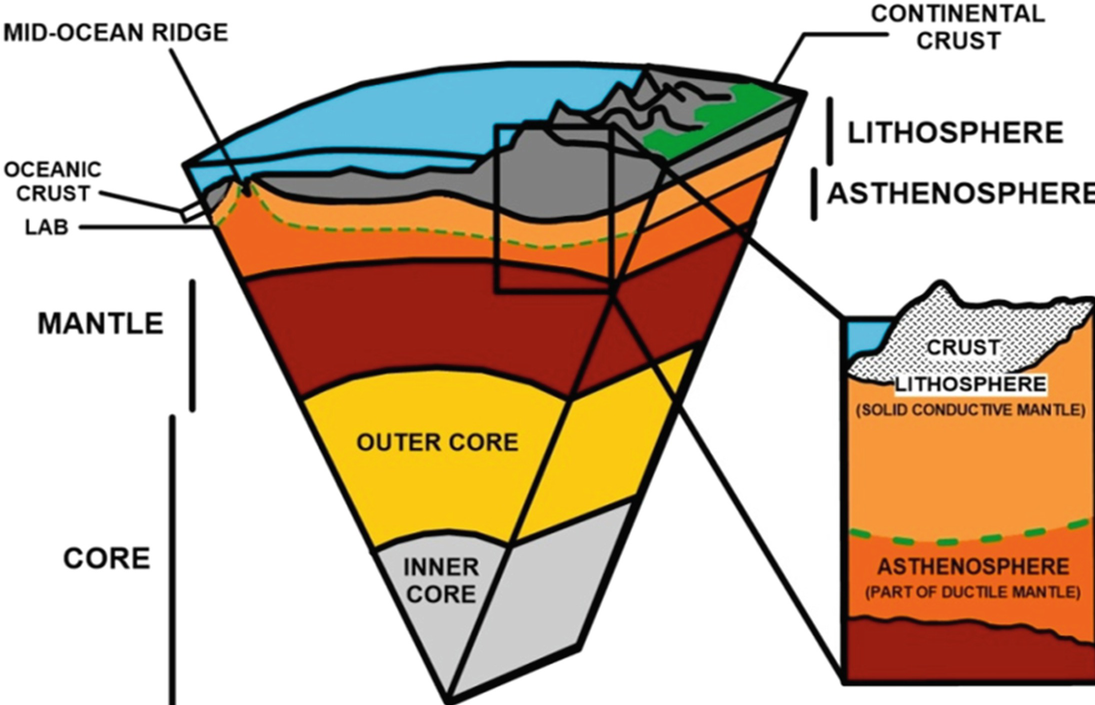
Lithosphere: Includes crust and upper, solid part of the mantle.
Asthenosphere: Also part of the mantle, but is more fluid and is able to flow slowly.

11
12
Convection currents cause the movement of material due to different densities caused by differences in temperature.

13

14
Divisions of the lithosphere.
These plates move around on top of the asthenosphere due to convection currents in the asthenosphere.
Plates move in different directions and at different speeds.

15

16
Continental plates (the ones with the continents) are thicker.
Oceanic plates are thinner, but much more dense.

17
Multiple Choice
Referring only to the principal of superposition, what would you expected the sea-floor to look like?
flat and smooth
uneven and mountainous
18
Scientists expected the sea-floor to be smooth and level.
Instead, they found huge underwater mountain ranges (mid-ocean ridges).

19
Mid-ocean ridges form along cracks in the crust.
The youngest rocks are found nearest to the ridge.
The age of the rocks increases with distance from the ridge.

20

21
Rocks on either side of the ridge contain magnetic patterns that are mirror images of each other.

22
Molten rock from inside the Earth rises through cracks, cools, and forms new crust along the ridge.
The old crust breaks along the mid-point and moves apart in opposite directions.
As the sea floor is pushed apart, so are the continents on the same plate.

23

24
Open Ended
If the sea floor has been spreading for millions of years, why is the Earth not getting larger?
25
Scientists have found huge trenches (deep canyons) in the sea floor.
Dense oceanic crust is sinking at the trench at the same rate as new crust is forming at the ridge.

26
May be on the ocean floor, the edges of continents, or within continents.

27
Convergent: where two plates collide.
Divergent: where two plates separate.
Transform: where two plates slide past one another.

28
MANTLE CONVECTION: drags plates along.
RIDGE PUSH: moves plates away from mid-ocean ridges as rock cools.
SLAB PULL: tugs plates along as the dense edge of a plate sinks below another.

29

Show answer
Auto Play
Slide 1 / 29
SLIDE
Similar Resources on Wayground

22 questions
Earth History - Law of Superposition
Presentation
•
8th Grade
23 questions
Newton's 2nd Law of Motion
Presentation
•
8th - 9th Grade
22 questions
Earth/Space Review 2-Stars & Sun
Presentation
•
8th Grade
22 questions
Exploring Earth's Surface
Presentation
•
8th Grade
23 questions
Electromagnetic Spectrum Review
Presentation
•
8th Grade
21 questions
Graphing Motion
Presentation
•
8th Grade
24 questions
Atoms
Presentation
•
8th Grade
20 questions
Weathering Erosion Deposition
Presentation
•
8th Grade
Popular Resources on Wayground
21 questions
Continents and Oceans

Quiz
•
6th Grade
20 questions
Parts of Speech
Quiz
•
5th Grade
16 questions
Subject & Predicate
Quiz
•
5th Grade
25 questions
Multiplication Facts
Quiz
•
5th Grade
12 questions
Map Skills
Quiz
•
3rd Grade
22 questions
Continents and Oceans
Quiz
•
5th Grade
15 questions
Rounding Decimals
Quiz
•
5th Grade
20 questions
Brand Labels
Quiz
•
5th - 12th Grade
Discover more resources for Science
20 questions
Newton's Laws of Motion
Quiz
•
8th Grade
20 questions
Scientific Method and Variables
Quiz
•
8th Grade
20 questions
Scientific method and variables
Quiz
•
8th Grade
20 questions
Claim, Evidence and Reasoning (CER)
Quiz
•
6th - 8th Grade
21 questions
Newton's Laws of Motion
Quiz
•
8th Grade
20 questions
Elements, Compounds and Mixtures
Quiz
•
8th Grade
10 questions
Exploring Chemical and Physical Changes

Interactive video
•
6th - 10th Grade
26 questions
Force - Net Force, Balanced and Unbalanced Forces
Quiz
•
8th Grade