

Electric Current

Presentation
•
Science
•
7th Grade
•
Practice Problem
•
Medium
+5
Standards-aligned

Rachael Lasky
Used 33+ times
FREE Resource
18 Slides • 21 Questions
1
Electric Current
2
Electricity Review
Resistance is a property of matter that affects the flow of electricity. Some substances have more resistance than others.
Friction can cause electrons to be transferred from one object to another.
These static electrical charges can build up on an object and be discharged slowly or rapidly
This is called static electricity
3
Multiple Choice
A positively charged object has lost electrons
4
Multiple Choice
5
Multiple Choice
6
Multiple Choice
7
Electricity is Related to Magnetism
Magnetic Fields can produce electrical current in conductors
Electricity can produce a magnetic field and cause iron and steel objects to act like magnets
Electromagnets are temporary magnets that lose their magnetism when the electric current is removed
8
Electric Current
When Electric charges are made to flow through a material, they produce an electric current
An electric current is the continuous flow of electric charges through a material
The amount of charge that passes through a wire at a given period of time is the rate of electric current
The unit for the rate of electric current is the Ampere (A)
9
Multiple Choice
10
Multiple Choice
11
Current in a Circuit
The electric currents that power your computer need very specific paths to work.
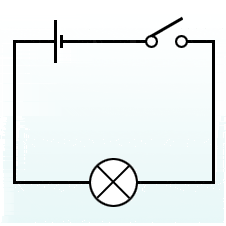
In order to maintain an electric current, charges must be able to flow continuously in a loop
An electric circuit is a complete, unbroken path that charges can flow through
12
Multiple Choice

13
Multiple Choice
14
What Affects Current Flow?
Imagine you are on a water slide at an amusement park. You climb the steps, sit down, and whoosh! The water current carries you down the slide.
Electric charges flow in much the same way water moves down the slide
Current flow is affected by the energy of the charges and the properties of the objects that the charges flow through
15
Electric Currents
Electric currents flow through wires like water through pipes
Charges flow because of differences in electric potential energy
Potential energy from an energy source (like a battery) gets converted into different forms of energy
If a circuit contains a light bulb, its potential energy is converted into light and heat.
16
Voltage
Voltage is the difference in electric potential energy per charge between two points in a circuit
The energy difference causes charges to flow
17
Multiple Choice
The difference in electrical potential energy per charge between two points in a circuit
Insulator
Resistance
Voltage
18
Multiple Choice
Charges flow through wires because of differences in electrical
Kinetic Energy
Potential Energy
19
Conductors
Charges can flow more easily through some materials than others.
A conductor is a material that charge can move through easily.
Electrons can move freely, allowing conductors to be charged by induction.
Metals such as copper are good conductors
20
Multiple Choice
21
Multiple Choice
22
Insulators
Wires such as copper wires, are surrounded by insulators
Insulators are materials, such as rubber, that do not allow charges to flow
However, electrons can move around within their own atoms (causing polarization)
Electrons can be stripped off when charging by friction
23
Semiconductors
Materials that behave sometimes as conductors and sometimes as insulators
24
Conductors vs. Insulators
The difference between conductors and insulators comes from how strongly electrons are attached to atoms
The atoms in conductors have loosely bound electrons that can move freely
Electrons in insulators cannot move freely among atoms
25
Multiple Choice

A material that prevents heat or an electric current from flowing
Conductor
Insulator
Magnetism
Electric Circuit
26
Multiple Choice
Which of the following is an insulator?
Penny
Iron
Tire
Paperclip
27
Multiple Choice
Which of the following is a conductor?
Paper clip
Chips
Styrofoam
Straw
28
Resistance
Resistance is the measure of how difficult it is for charges to flow through an object
The greater the resistance, the less current there is for a given voltage
The unit of measure of resistance is the ohm
29
Factors that determine Resistance
Diameter
Length
Material
Temperature
30
Diameter and Resistance
What is easier for you? Slurping a milkshake using a thicker or thinner straw?
This same idea affects resistance.
Current flows more easily through a wide wire than a narrow wire
31
Length and Resistance
It would also be easier to drink your milkshake with a short straw vs. a long one
Similarly, shorter lengths have less resistance
The longer the object is, the greater its resistance
32
Material and Resistance
Some materials have electrons that are held tightly to their atoms
They have a high resistance because it is difficult for charges to move
Conductors have less resistance than insulators for this reason
33
Temperature and Resistance
Electrical resistance of most materials increases as temperature increases
34
Multiple Choice
Material through which charge can easily flow
Electric Current
Conductor
Electric Circuit
Insulator
35
Multiple Choice
The measure of how difficult it is for charges to flow through a material
Voltage
Conductor
Resistance
Insulator
36
Multiple Choice
The continuous flow of electric charges through a material
Electric circuit
Electric Current
Resistance
Conductor
37
Multiple Choice
Which of the following does NOT determine the resistance of a wire?
Temperature
Diameter
Length
Color
38
Multiple Choice
All electrical devices contain electric
acid
gears
circuits
motors
39
Multiple Choice
Potential electric current can be converted into
Heat
Matter
Waste
Food
Electric Current
Show answer
Auto Play
Slide 1 / 39
SLIDE
Similar Resources on Wayground

32 questions
Heat Transfer: Convection, Conduction, Radiation & Cel vs Kelvin
Presentation
•
6th - 8th Grade
35 questions
Coriolis Effect, Jet Streams, and Global Winds
Presentation
•
7th Grade
34 questions
Electricity Test
Presentation
•
7th Grade
34 questions
Introduction to Microsoft Excel
Presentation
•
7th Grade
33 questions
Lesson over Atoms and the Periodic Table
Presentation
•
8th Grade
35 questions
Forces
Presentation
•
8th Grade
35 questions
Water in the Atmosphere
Presentation
•
6th Grade
34 questions
6th grade Tectonic Plates Lesson
Presentation
•
6th Grade
Popular Resources on Wayground
21 questions
Continents and Oceans

Quiz
•
6th Grade
20 questions
Parts of Speech
Quiz
•
5th Grade
16 questions
Subject & Predicate
Quiz
•
5th Grade
25 questions
Multiplication Facts
Quiz
•
5th Grade
12 questions
Map Skills
Quiz
•
3rd Grade
22 questions
Continents and Oceans
Quiz
•
5th Grade
15 questions
Rounding Decimals
Quiz
•
5th Grade
20 questions
Brand Labels
Quiz
•
5th - 12th Grade
Discover more resources for Science
17 questions
7.6D Aqueous Solutions
Quiz
•
7th Grade
20 questions
Claim, Evidence and Reasoning (CER)
Quiz
•
6th - 8th Grade
10 questions
Exploring Chemical and Physical Changes

Interactive video
•
6th - 10th Grade
16 questions
Photosynthesis and Cellular Respiration Review
Quiz
•
7th Grade
20 questions
Food Webs + Energy Pyramids
Quiz
•
7th Grade
24 questions
Cell Organelles
Quiz
•
7th Grade
20 questions
Human Body Systems
Quiz
•
7th Grade
10 questions
Exploring the Periodic Table
Interactive video
•
6th - 10th Grade