Semester 1 3rd Review
Presentation
•
Science
•
8th Grade
•
Practice Problem
•
Medium
+3
Standards-aligned

Sabrina Robinson
Used 23+ times
FREE Resource
4 Slides • 30 Questions
1
Semester 1 3rd Review
2
3
Multiple Select
You are riding a bicycle home from school. You average 5 meters per second and you are headed south. What motion can you determine from this data? Select all that apply.
Acceleration
Distance
Speed
Velocity
4
Multiple Choice
In which of the following graphs below did one runner overtake (run past) the other?
5
Multiple Choice
How long did Bob take to complete the race?
17 seconds
12 seconds
14 seconds
15 seconds
6
Multiple Choice
How long did Charlie stop for a rest?
2.5 seconds
2 seconds
3 seconds
5 seconds
7
Multiple Choice
Which runner stopped for a rest?
Albert
Bob
Charlie
8
Multiple Choice
Which runner won the race?
Albert
Bob
Charlie
9
Multiple Choice
Segment B-C The bus is _________________.
at rest
returning (to original position)
moving forward
10
Multiple Choice
Segment A-B The bus is _________________.
at rest
returning (to original position)
moving forward
11
Multiple Choice
Segment O-A The bus is _________________.
at rest
returning (to original position)
moving forward
12
Multiple Choice
Match the description to the graph:
"The car is coming back."
13
Multiple Choice
Match the description to the graph:
"The speed of the car is decreasing."
14
Multiple Choice
Match the description to the graph:
"The car is traveling at a constant speed away from start."
15
Multiple Choice
Match the description to the graph:
"The car is stopped."
16
Multiple Choice
In which of the following graphs below are both runners moving at the same speed?
17
Multiple Select
The distance-versus-time graph represents the motion of John and Peter in roller blades.
Which BEST describes the skaters' movement? Select ALL that apply.
Peter is moving slower than John and in an opposite direction.
John is moving faster than Peter and in the same direction.
Both are moving at a constant speed and in the same direction.
Both are moving at a constant speed and in opposite directions.
John's speed is increasing, and Peter's speed is decreasing, while both move in the same direction.
18
Multiple Choice
The driver of a car completes a trip. The graph displays data about the car's motion during the trip.
Which of the following statements about the car's motion is true?
The total time for the car trip was 50 minutes.
The car returned to where it had started the trip at the end of the trip.
The car did not slow down during the trip.
The car did not travel at a constant speed during the entire trip.
19
20
Multiple Choice
What car has the fastest acceleration?
Car goes from 0-60 Mph in 3 seconds
Car goes from 0-60 Mph in 4 seconds
Car goes from 0-60 Mph in 5 seconds
Car goes from 0-60 Mph in 6 seconds
21
Multiple Choice
22
Multiple Choice
When a car goes around a corner at 20 mph, why do we say it accelerates?
The car is accelerating because of the velocity is constant
The car accelerates because it's going 20 mph
Cars always accelerate when they are in motion
The car is accelerating because it's changing direction
23
Multiple Choice
Mrs. Hayes kept a chart of the velocity and acceleration of her runners at the track meet last week.
Which of the following statements BEST explains the relationship between the acceleration and velocity of the runners?
The runner with the lowest velocity at 20m will have the lowest acceleration.
The runner with the highest velocity will always have the highest acceleration.
The velocity of a runner can never increase when running an extended distance.
The runner with the greatest change in velocity will have the highest acceleration.
24
25
Multiple Choice
A student is investigating mass and acceleration. The student applies the same force to two boxes, as shown in the table.
The student claims that box 1 must have a smaller mass than box 2. Which argument best supports the student's claim?
Heavier objects require less force than lighter objects to accelerate at the same rate.
Heavier objects require greater force than lighter objects to accelerate at the same rate.
Lighter objects require less force than heavier objects to start moving but will accelerate at the same rate.
Lighter objects require greater force than heavier objects to start moving but will accelerate at the same rate.
26
Multiple Choice
27
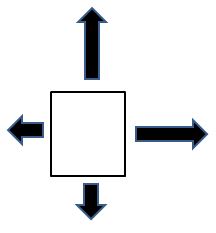
Multiple Select
This object would be moving (pick all that are correct):
up
down
left
right
28
Multiple Choice
Whenever an object is moving, there is always this force opposing the motion:
inertia
momentum
friction
applied force
29
Multiple Choice
Examine the table provided. Which of the objects is producing the greatest force?
Soccer Ball
Tennis Ball
Marble
Ping-Pong Ball
30
Multiple Choice
The masses of four objects are given in this table. If all objects are struck with the same amount of force, which one will have the greatest acceleration?
Object 1
Object 2
Object 3
Object 4
31
Multiple Choice
In which scenario is the object in equilibrium?
the book on the table
the car gaining speed
the rope being pulled
the weight being lifted
32
Multiple Choice
Pamela rolled the ball into the grass. The ball slowed down and eventually came to a stop while rolling on the grass.
Which of the following BEST explains why the ball stopped rolling?
The ball stopped rolling when it reached the grass because the force of friction acted on the ball causing it to stop moving.
The ball stopped rolling when it reached the grass because the force of gravity acted on the ball causing the ball to stop moving.
The ball stopped rolling when it reached the grass because the ball did not have enough acceleration to continue rolling in the grass.
The ball stopped rolling when the force causing the ball to roll ran out, and there was no additional force applied to the ball to keep it in motion.
33
Open Ended
What did you learn in this lesson?
34
Poll
How prepared do you think you are for the final exam?
Very prepared
Prepared
Not quite ready
Not prepared at all
Semester 1 3rd Review
Show answer
Auto Play
Slide 1 / 34
SLIDE

Similar Resources on Wayground
27 questions
2/3-8.L.1: Bacteria
Lesson
•
8th Grade
27 questions
Ecosystems
Lesson
•
8th Grade
26 questions
Volcanoes
Lesson
•
8th Grade
29 questions
The Sun
Lesson
•
8th Grade
25 questions
Newton's 3rd Law of Motion
Lesson
•
8th Grade
25 questions
Isotopes
Lesson
•
8th Grade
30 questions
Properties of Light
Lesson
•
8th Grade
28 questions
Acids and Bases Lesson
Lesson
•
8th Grade
Popular Resources on Wayground
10 questions
5.P.1.3 Distance/Time Graphs
Quiz
•
5th Grade
10 questions
Fire Drill
Quiz
•
2nd - 5th Grade
20 questions
Equivalent Fractions
Quiz
•
3rd Grade
15 questions
Hargrett House Quiz: Community & Service
Quiz
•
5th Grade
20 questions
Main Idea and Details
Quiz
•
5th Grade
20 questions
Context Clues
Quiz
•
6th Grade
20 questions
Inferences
Quiz
•
4th Grade
15 questions
Equivalent Fractions
Quiz
•
4th Grade
Discover more resources for Science
20 questions
Recognizing Violence and Being an Upstander
Quiz
•
8th Grade
19 questions
Introduction to Properties of Waves
Lesson
•
6th - 8th Grade
16 questions
Interactions within Ecosystems
Lesson
•
6th - 8th Grade
10 questions
Exploring the Layers of the Earth
Interactive video
•
6th - 10th Grade
20 questions
Newton's Laws of Motion
Quiz
•
8th Grade
46 questions
8th Science STAAR Review
Quiz
•
8th Grade
10 questions
Exploring the Dynamics of Ocean Currents
Interactive video
•
6th - 10th Grade
23 questions
Newton's 3 Laws of Motion
Quiz
•
8th Grade