

LESSON - 3rd 6wks

Presentation
•
Chemistry
•
9th - 12th Grade
•
Medium
+3
Standards-aligned

Kyle Pearson
Used 14+ times
FREE Resource
18 Slides • 30 Questions
1
Electromagnetic Spectrum
Periodic Trends
Atomic Theory
Classifying Reactions
Balancing Chemical Equations
Molar Mass
Moles
Percent Composition Cm
2

3

4
Multiple Choice
Select the order of waves from long wavelength to short wavelength on the EMS
5


6
Multiple Choice
7
Multiple Choice
8
Multiple Choice

As you move down a GROUP on the periodic table the atomic radius get bigger. This is because ____________.
The atoms have more neutrons in the nucleus.
The atoms have more protons in the nucleus.
The atoms have more energy levels for the electrons
The atoms have greater repulsion forces between the protons and electrons
9
Multiple Choice
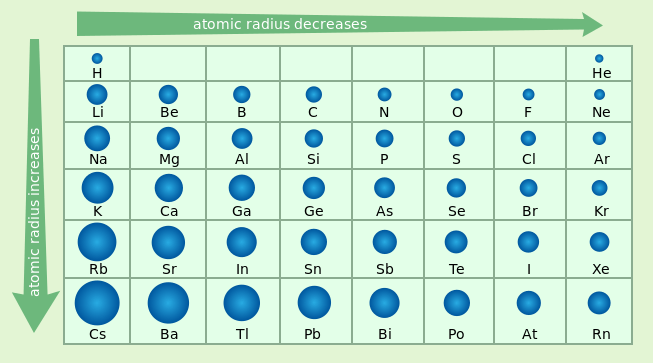
As you move across a period on the periodic table the atomic radius tend to get smaller because, ______________.
the atoms have more mass making them heavier.
more neutrons, making the nucleus bigger.
the atoms have more protons, pulling the electrons closer to the nucleus
the atoms have less energy levels for the electrons to occupy.
10
Multiple Select
Where is electronegativity and ionization energy the highest on the Periodic Table?
Click all that apply
up the group
down the group
left to right
right to left
11

12
Democritus
everything in the world is made of tiny particles called atomos,
surrounded by empty space.
Aristotle
believed that matter was made of 4 elements, earth, wind, water, and fire.
13
J.J. Thomson
won a Noble Prize for his discovery of electrons
Ernest Rutherford
is considered the Father of the Nuclear Age with his Gold Foil
experiment that discovered the nucleus
14
John Dalton's Postulates
ALL matter is made of tiny atoms
Atoms that are the same are identical in every aspect
Atoms CANNOT be divided, they are indivisible
Atoms CANNOT be CREATED or DESTROYED
Atoms combine to form compounds
In chemical reactions atoms are combined, separated, and rearranged
15
Werner Heisenbery
came up with the Uncertainty Principle that says it is impossible to determine the exact position and speed of an electron when it is orbiting the nucleus.
Niels Bohr's
theory was that electrons moved around the nucleus at fixed energies
and distances.
16
Multiple Select
John Dalton stated:
click ALL that apply
Atoms are tiny, invisible particles.
Atoms of one element are all the same.
Atoms of different elements are different.
Compounds form by combining atoms.
Atomos means indivisible
17
Multiple Choice
He claimed that matter was made of small, hard particles that he called “atomos.”
Democritis
Dalton
Bohr
Einstein
18
Multiple Choice

Which Scientist created this model and
proposed the theory that atoms orbit the nucleus in specific orbits.
Democritus
Dalton
Bohr
Rutherford
19
Multiple Select
Rutherford is know for ......
Gold foil experiment
Noble Prize for finding electrons
discovering the nucleus
Father of the Nuclear Age
20
Multiple Choice
JJ Thomson won the Noble Peace prize for discovering what subatomic particle?
nucleus
neutron
proton
electron
21
Multiple Select
Aristotle believed that matter was made of what 4 elements?
22

23

Why are reactions balanced?
24
Fill in the Blanks
What is the mass of the products ?
H2(g) + O2(g) >> H2O(l)
2 g + 32 g >>
Type answer...
25
Multiple Choice
Matter has to be balanced or the chemical equation will blow up
26
Multiple Select
Identify the REACTANTS :
H2O + CO2 → HCO + HO
carbon dioxide
hydrogen monoxide
dihydrogen monoxide
carbonic aicd
27
Fill in the Blanks
What reaction has one product?
(one word answer)
Type answer...
28
Fill in the Blanks
What reaction has water and carbon dioxide as products?
(one word answer)
Type answer...
29
Fill in the Blanks
What reaction produces the products of water and an ionic compound?
(one word answer)
Type answer...
30
Multiple Choice
31
Fill in the Blanks
What reaction only has 1 reactant?
(one word answer)
Type answer...
32
Fill in the Blanks
What chemical reaction has 2 compounds on both sides of yield sign (arrow)?
(one word answer)
Type answer...
33
Fill in the Blanks
What chemical reaction has an element and compound on both sides of the yield sign (arrow)?
(one word answer)
Type answer...
34

35
Multiple Select
Click all the things you can use to balance a chemical equation
coefficient
subscripts
superscripts
chemical symbols
36
Multiple Select
Find the ERROR(s) in the decomposition reaction and replace them with the correct information.
4H2(g) + 2O2(g) >> 4H2O(l)
it is not balance
coefficients need to be reduced
the (g) and (l) are in the wrong place
decomposition reaction
combination reaction
37
Multiple Select
Identify the letter in the parenthesis
4H2(g) + 2O2(g) >> 4H2O(l)
(g) gas
(g) gel like
(l) liquid
(l) light gas
(l) Iodine
38

39
Mole concept is used to help chemists count very small particles
Avogadro's Number = 6.02e23
Molar mass (g/mol) is the mass of one mole of substance
example - molar mass of water is 18 g/mol
40
1 mole particles = 6.02e23 particles
1 mole particles = molar mass (g) from Periodic Table
1 molar particles = 22.4 liters (volume)
1 molecule = # atoms in that molecule
41
Identify the GIVEN and what the problem is asking you to convert to
Diagonal Rule - SAME UNIT (words ONLY)
Find the other half your conversion factor
Round the answer using sig figs from the GIVEN
42
Fill in the Blanks
How many atoms of carbon are in one molecule of sugar C6H12O6?
Type answer...
43
Multiple Choice
Ammonium nitrate, NH4NO3, commonly known as ANFO, is a compound used to make explosive devices. How many grams are in one mole of ammonium nitrate to the nearest thousandths place?
31.014 g
45.021 g
48.045 g
80.043 g
44
Multiple Choice
If one Monster energy drink contains 0.16 g of caffeine, how many moles of caffeine do we consume when we drink 1 can of Monster?
The chemical formula for caffeine is C8H10N4O2 and the molar mass is 194.
194.19 moles
1.07 moles
0.00082 moles
1213.69 moles
45
Multiple Choice
A student needs 65.0 g of copper(II) chloride for an experiment.
How many atoms of copper is this?
2.91e23 atoms
3.91e25 atoms
2.35e23 atoms
4.70e23 atoms
46
Hopefully you watched the lesson and have practiced!
47

48
Fill in the Blanks
What is the percent composition of hydrogen in dihydrogen monoxide to the nearest whole number?
(don't put the % sign in the answer)
Type answer...
Electromagnetic Spectrum
Periodic Trends
Atomic Theory
Classifying Reactions
Balancing Chemical Equations
Molar Mass
Moles
Percent Composition Cm
Show answer
Auto Play
Slide 1 / 48
SLIDE
Similar Resources on Wayground

43 questions
4/22 Solutions in Chemistry
Presentation
•
9th - 12th Grade
45 questions
(Full Lesson) Biology EOC Reporting Category 5 Review
Presentation
•
9th - 12th Grade
44 questions
Introduction to Moles
Presentation
•
9th - 12th Grade
41 questions
Covalent Bonding
Presentation
•
8th - 12th Grade
41 questions
Lewis Dot Structures
Presentation
•
9th - 12th Grade
42 questions
Chapter 13 Vocab Review - Thermochemistry
Presentation
•
10th - 12th Grade
41 questions
Arrhenius & Bronsted Lowry Acids & Bases
Presentation
•
9th - 12th Grade
Popular Resources on Wayground
10 questions
Safety Day 2026 – Student Review

Quiz
•
9th Grade
21 questions
Continents and Oceans
Quiz
•
6th Grade
20 questions
Parts of Speech
Quiz
•
5th Grade
16 questions
Subject & Predicate
Quiz
•
5th Grade
25 questions
Multiplication Facts
Quiz
•
5th Grade
12 questions
Map Skills
Quiz
•
3rd Grade
22 questions
Continents and Oceans
Quiz
•
5th Grade
15 questions
Rounding Decimals
Quiz
•
5th Grade
Discover more resources for Chemistry
20 questions
electron configurations and orbital notation
Quiz
•
9th - 12th Grade
20 questions
Periodic Table Trends
Quiz
•
11th Grade
25 questions
Writing and Naming Binary Ionic compounds
Quiz
•
10th Grade
20 questions
COUNTING ATOMS
Quiz
•
10th Grade
50 questions
Unit 3: Atomic Assault Summative Review
Quiz
•
11th Grade
20 questions
Physical or Chemical Change/Phases
Quiz
•
8th Grade - University
15 questions
Periodicity Module Exam Practice Quiz
Quiz
•
9th - 12th Grade
20 questions
Naming Ionic Compounds
Quiz
•
10th Grade