

Waves

Presentation
•
Science
•
5th - 6th Grade
•
Practice Problem
•
Medium
+8
Standards-aligned

Nichole Erwin
Used 43+ times
FREE Resource
16 Slides • 13 Questions
1
Mrs. Erwin
Surf's up bruh!
2
Waves are a pattern of motion that transfer energy from place to place
without transferring matter. There are different types of waves.
Sound waves travel through air and allow us to hear sound. Water waves
move on top of water. Light waves move in straight lines through space.
For now we will focus on sound and water waves.
3
Waves transport energy, not matter, from place
to place. Remember that matter is made of particles too small to be seen.
4
Particles or a (medium) are required to transport some types of waves, such as sound waves.
When the wave travels, the particles do not travel with the wave.
It may appear that ocean waves are moving particles of water
toward you, but in fact, the water is only moving up and down.
5
We can test this by placing a heavy
ball in a wave tank.
The waves move from one side of the
tank to the other, but the ball does not
travel, it only moves
up and down
6
Multiple Choice
What do waves carry from place to place?
Energy, but not matter or particles
Energy and matter or particles
Matter or particles but not energy
Neither energy nor matter or particles
7
Scientists put waves into two general
categories: transverse waves and longitudinal waves. Transverse
waves vibrate perpendicular to
the direction that the wave travels.
Ocean waves are a great example
of a transverse wave. “The wave”
at a sporting event is also a transverse
wave.

8
9
Multiple Choice
What do the people in the video represent in the "wave"?
The people are the medium that the energy passes through.
The people are the energy that is traveling?
10
Multiple Choice
Which is a Transverse Wave?
11
Longitudinal waves vibrate in the same
direction that the wave travels.
Picture standing at one end of a
spring toy, with a friend holding the
other end. If you pull your end and let
go, you will create a compression in the spring that travels down its
length. Sounds waves are an example
of longitudinal waves.

12
13
Multiple Choice
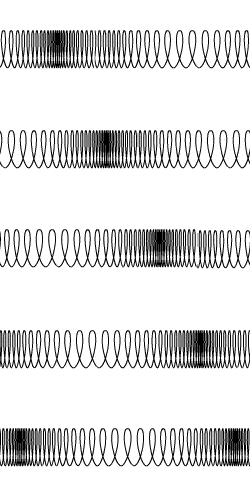
What type of wave is this?
Longitudinal
Transverse
Electromagnetic
x ray
14
Multiple Choice
In a longitudinal wave, the parts where the coils are far apart is called_________.
longitudinal
compressions
rarefactions
contractions
15
Multiple Choice
In a longitudinal wave, the parts where the coils are close together are called what?
longitudes
rarefactions
compressions
contractions
16
Amplitudeis a measure of the wave’s
height. It also tells us how much energy a wave has. Waves with more energy have higher amplitudes.
The amplitude of a sound wave determines the sound’s loudness. When you turn the volume up on the TV, you are increasing the amplitude of the sound waves.

17
Multiple Choice
Amplitude reflects the amount of ____________________ in a wave.
energy
compression
rarefaction
speed
18
Wavelength measures the distance
between wave crests. The closer the
crests of the wave are to each other,
the more energy the waves have.
The opposite is also true:
when the wavelength is longer, the
waves have less energy.

19
Multiple Choice
A _____________________ is the distance between a point on one wave and the identical point of the next wave.
amplitude
wavelength
frequency
compression
20
Sound waves are caused by vibrations.
Since air is made of particles (matter), it transports sound very well.
When a speaker vibrates it creates longitudinal waves that travel in
ALL directions.
21
You can easily see how speakers
create vibrations by sprinkling
something small and light, like
sand, onto a speaker. The sand
particles will bounce due to the
vibrations.
Since sound waves travel in all
directions you can hear sound even
when you are not directly in front of
the source.
22
Open Ended
What happen to the the salt when they played different frequencies?
23
Multiple Choice
24
Amplifiers make music louder.
Rock stars use electronics to increase
the amplitude of their sound waves.
That means they use electricity to
make the speakers vibrate with more
energy, which increases the amplitude.
Rock on!
25
Poll
Mrs. Erwin rocked that guitar!
Yes she did! That was cool!
She's okay!
I could do better!
26
Most of the sounds we hear travel through the air, but sound can also travel through solids and liquids too. Some solids, like metal and glass,
are good at transmitting sounds. Other solids, including heavy fabrics and
foam, muffle sounds. Sound can also move through liquids. Some animals,
such as dolphins and whales, communicate with each other underwater by using sound waves. We call that "echolocation."
27
Multiple Choice
What is echolocation?
The way bats fly.
The noise dolphins make underwater.
High-frequency sounds
The food rabbits eat.
28
Multiple Select
Echolocation helps animals do what 3 things ... (Click all that apply)
Locate food
Sleep better
Navigate
Avoid predators
29
Earthquakes travel as waves too.
Earthquakes can transmit so much
energy that they topple buildings and
destroy property. By understanding
how these waves travel we can warn
people when there is an earthquake
in their part of the world.

Mrs. Erwin
Surf's up bruh!
Show answer
Auto Play
Slide 1 / 29
SLIDE
Similar Resources on Wayground

23 questions
Energy Flow in Ecosystems
Presentation
•
6th Grade
23 questions
How does light bounce and bend?
Presentation
•
5th Grade
22 questions
Clouds
Presentation
•
5th - 6th Grade
20 questions
States of Matter Review
Presentation
•
3rd Grade
22 questions
Classifying Rocks
Presentation
•
6th Grade
22 questions
Asteroids Comets and Meteoroids
Presentation
•
5th Grade
22 questions
Matter & Atoms Review
Presentation
•
6th Grade
22 questions
Seasons
Presentation
•
6th Grade
Popular Resources on Wayground
10 questions
How much do you know about our Portrait of an Eagle?

Quiz
•
10th Grade
10 questions
Fast Food Slogans
Quiz
•
6th - 8th Grade
21 questions
Continents and Oceans
Quiz
•
6th Grade
20 questions
Parts of Speech
Quiz
•
5th Grade
16 questions
Subject & Predicate
Quiz
•
5th Grade
25 questions
Multiplication Facts
Quiz
•
5th Grade
12 questions
Map Skills
Quiz
•
3rd Grade
22 questions
Continents and Oceans
Quiz
•
5th Grade
Discover more resources for Science
9 questions
Properties of matter and Mixtures
Quiz
•
5th Grade
20 questions
Mixtures and Solutions Practice
Quiz
•
5th Grade
10 questions
6.6D - Relative Density Review
Quiz
•
6th Grade
20 questions
Claim, Evidence and Reasoning (CER)
Quiz
•
6th - 8th Grade
20 questions
Food Chains and Food Webs Review
Quiz
•
5th Grade
20 questions
Density
Quiz
•
6th Grade
10 questions
Exploring Chemical and Physical Changes

Interactive video
•
6th - 10th Grade
11 questions
Understanding Light Review 4
Quiz
•
5th Grade