
Search Header Logo
Advanced Mole Conversions

Advanced Mole Conversions

Assessment

Presentation

Chemistry

10th Grade

Practice Problem

Medium

NGSS
HS-PS1-7

Standards-aligned

Created by

Joshua Baltzell

Used 149+ times

FREE Resource

7 Slides • 6 Questions

1

Advanced Mole Conversions

This lesson is designed as an extension to show you more advanced mole conversion formats. This will help you as we get deeper into stoichiometry.
Slide image

2

Review the Basics

First, let's review some of the basics so we know what we're covering.

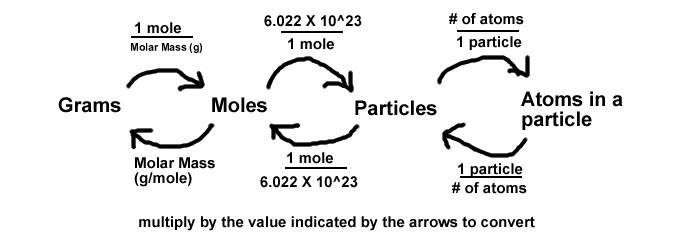
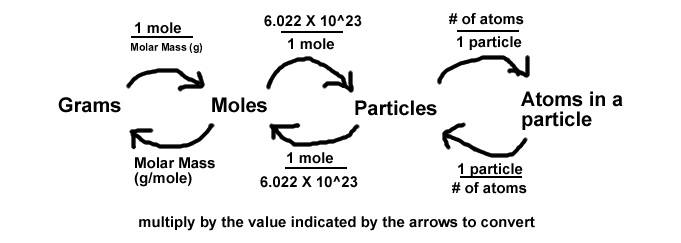
Whenever working with mass, moles, or particles, we can always convert between them for any element or compound by using the conversion factors molar mass and Avogadro's number.

g/mol

 6.02210236.022\cdot10^{23}  

3

Example

If I have 4.3 moles of Lithium, how many grams of Lithium is that?


Slide image

4

Multiple Choice

You try, just to make sure you're ready to move on to this level of material:

If you had 3 moles of Sodium, how many grams of sodium would you have?

1

68.97 g Na

2

7.663 g Na

3

0.1305 g Na

4

1.807E24 atoms Na

5

Moles within Compounds

When looking at individual compounds, we can see the number of atoms used to construct any compound. Since atoms are directly transferable to moles, we can convert between moles of an atom to moles of a compound using mole to mole ratios.


It takes 2 moles of hydrogen and 1 mole of oxygen to make 1 mole of dihydrogen monoxide. Each of these numbers creates a conversion factor.

6

Mole to Mole Conversions

The image shows us multiple ratios we can make based on the formula for water. We can see that for every 2 moles of hydrogen we have, there will be 1 mole of oxygen.


Therefore, if I had 7 moles of hydrogen, I could calculate the number of moles of oxygen: 3.5 (Remember that we can have decimals for moles, but not for atoms).

Slide image

7

Multiple Choice

For the compound Fe2O3, if we had 4 moles of Iron (Fe), how many moles of oxygen would we have?

1

6 moles O

2

3 moles O

3

4 moles O

4

9 moles O

8

Multiple Choice

For the compound MgF2, if we had 6 moles of fluoride, how many moles of the entire compound would we have?

1

3 moles MgF2

2

6 moles MgF2

3

1 mole MgF2

4

2 moles MgF2

9

This is an intermediate step...

  • We can use this to convert between elements and compounds now!

  • Say I had 50 grams of H2O, and wanted to know how many grams of Oxygen this was.

  • I could spend time using the Law of Definite proportions to find the proportional percent of each element, or I could just convert (which is different steps but it mathematically doing the same thing).

10

Example

Using the conversion factors that I already know, and the ones we just learned, I can set up my railroad tracks to calculate the mass of pure oxygen in 50 grams of H2O.


This will be helpful for when I want to use an element to create a compound, or when I want to find details about an element within a compound.

Slide image

11

Multiple Choice

Question image

For the compound NaCl, if we had 10 grams of Chlorine (Cl), how many moles of Sodium would we have?

1

0.282 mol Na

2

3.55 mol Na

3

35.45 mol Na

4

1.55 mol Na

12

Multiple Choice

If I had 17.0 grams of Hydrogen (H) in the compound HCl, how many grams of Chloride (Cl) would we have?

1

597.9 g Cl

2

0.4757 g Cl

3

46.23 g Cl

4

2.563 g Cl

13

Multiple Choice

Question image

For the compound AgNO3, it took

 5.87310245.873\cdot10^{24}   atoms of oxygen (O) to make the compound. How many grams of silver (Ag) was needed to make the compound?
Hint: If you need help setting up the problem, check the image.

1

350.8 g Ag

2

1052.3 g Ag

3

107.9 g Ag

4

 2.1110262.11\cdot10^{26}  g Ag

Advanced Mole Conversions

This lesson is designed as an extension to show you more advanced mole conversion formats. This will help you as we get deeper into stoichiometry.

Slide image

Show answer

Auto Play

Slide 1 / 13

SLIDE
