Biogeochemical Cycles: Nutrient Cycles
Presentation
•
Biology
•
9th - 12th Grade
•
Practice Problem
•
Medium
+8
Standards-aligned
Kaitlin Medeiros
Used 178+ times
FREE Resource
25 Slides • 23 Questions
1
Biogeochemical Cycles: Nutrient Cycles
2
3
Poll
True or False: The Nutrient Cycle moves abiotic factors throughout a system.
True
False
4
5
6
7
8
9
10
Multiple Choice
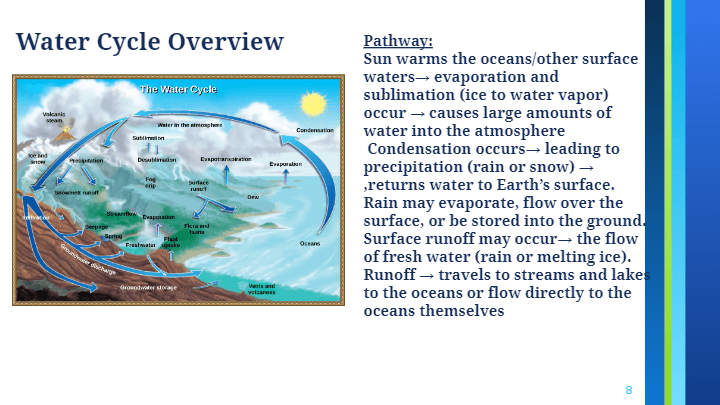
What is the largest reservoir for water?
the ocean
rocks and minerals
the atmosphere
glaciers
11
Multiple Choice
The water cycle is driven by
water
wind
the sun
Earth's rotation
12
Multiple Choice
When water turns to vapor and rises into the atmosphere from the ocean, it is called
condensation
transpiration
evaporation
sublimation
13
Multiple Choice
In the water cycle, at which point does water enter?
In the clouds
In the ocean
Groundwater
Through rain, snow, sleet and hail
There is not a starting point
14
Multiple Choice
The movement of water from the atmosphere to land is called
evaporation
transpiration
groundwater storage
precipitation
15
16
17
18
19
20
21
Multiple Choice
22
Multiple Choice
Human processes mainly contribute to the
release of carbon dioxide in the atmosphere
decrease of the total amount of carbon found on Earth
depletion of carbon dioxide reserves in the atmosphere
increase the amount of carbon contained in rock materials.
23
Multiple Choice
Animals use O2 in the process of _____ to make more CO2
photosynthesis
fermentation
cellular respiration
decomposition
24
Multiple Choice
Plants use CO2 in the process of _____ to make _____ and O2
photosynthesis, greenhouse gases
photosynthesis, glucose
cellular respiration, greenhouse gases
cellular respiration, glucose
25
Multiple Choice
Humans obtain carbon by eating plants or eating other animals. Why do humans require carbon?
For cellular respiration.
For effective removal of CO2 gas.
For synthesis of all families of macromolecules.
For synthesis of lipids and carbohydrates only.
26
Multiple Choice
Human activity can increase CO2 levels in the atmosphere through
Photosynthesis
Burning of fossil fuels
Planting more trees
Removing nitrogen from fertilizer.
27
Multiple Choice
According to the diagram, deforestation
Can release carbon dioxide gas back into the atmosphere.
Directly creates fossil fuels.
Fixes carbon atoms in the soil,
Removes dissolved carbon dioxide from lakes and rivers.
28
Multiple Choice
29
30
31
32
33
Multiple Choice
Why do living things need nitrogen?
To get energy
To make amino acids
To make proteins
To make proteins AND amino acids
34
Multiple Choice
35
Multiple Choice
What is the largest reservoir for nitrogen?
the ocean
rocks and minerals
the atmosphere
bacteria
36
Multiple Choice
37
38
39
40
41
42
43
Multiple Choice
Where is the largest reservoir for the phosphorus cycle?
rocks and minerals
the ocean
the atmopshere
fossil fuels
44
Multiple Choice
Excess phosphates from fertilizer runoff can
be used to synthesize lipids.
be absorbed directly by phosphate rock.
be decomposed and returned to large bodies of water.
provide nutrients for algal blooms, which can cause eutrophication.
45
Multiple Choice
46
Multiple Choice
In an ecosystem, what happens to the atoms of certain chemical elements, such as carbon, oxygen, and nitrogen?
They move into and out of living systems.
They are only found in abiotic factors.
They move out of living systems and do not return.
They move into living systems and remain there.
47
Multiple Choice
Describing the cycling of elements between living organisms and the non-living environment.
Chemical
Biological
Geological
Biogeochemical
48
Biogeochemical Cycles: Nutrient Cycles

Show answer
Auto Play
Slide 1 / 48
SLIDE

Similar Resources on Wayground
44 questions
Major Cell Organelles-Eukaryotic Cells
Presentation
•
10th Grade
45 questions
Biology Midterm Review Part 2
Presentation
•
9th - 12th Grade
45 questions
DNA Structure
Presentation
•
9th - 12th Grade
42 questions
Environmental Interactions
Presentation
•
9th - 12th Grade
43 questions
Blood and Immune System
Presentation
•
10th - 12th Grade
45 questions
Photosynthesis
Presentation
•
9th - 11th Grade
Popular Resources on Wayground
20 questions
STAAR Review Quiz #3
Quiz
•
8th Grade
20 questions
Equivalent Fractions
Quiz
•
3rd Grade
6 questions
Marshmallow Farm Quiz
Quiz
•
2nd - 5th Grade
20 questions
Main Idea and Details
Quiz
•
5th Grade
20 questions
Context Clues
Quiz
•
6th Grade
20 questions
Inferences
Quiz
•
4th Grade
19 questions
Classifying Quadrilaterals
Quiz
•
3rd Grade
12 questions
What makes Nebraska's government unique?
Quiz
•
4th - 5th Grade
Discover more resources for Biology
14 questions
Ecological Succession: Primary and Secondary
Quiz
•
9th Grade
20 questions
Structure & DNA Replication Quiz
Quiz
•
9th Grade
50 questions
Biology EOC Review
Quiz
•
9th Grade
33 questions
Module C - Virus vs Cells, Biomolecules & Enzymes
Quiz
•
9th Grade
25 questions
photosynthesis and cellular respiration
Quiz
•
9th Grade
25 questions
STAAR Evolution Vocabulary
Quiz
•
9th Grade
20 questions
Food Chains and Food Webs
Quiz
•
7th - 12th Grade
20 questions
Genetics 2026
Quiz
•
10th Grade