

Redox Titrations Revision (OCR)

Presentation
•
Chemistry
•
12th Grade
•
Practice Problem
•
Easy

Kitty Murdoch
Used 19+ times
FREE Resource
35 Slides • 13 Questions
1
Redox Titrations Revision (OCR)
2

3

4

5
Multiple Choice
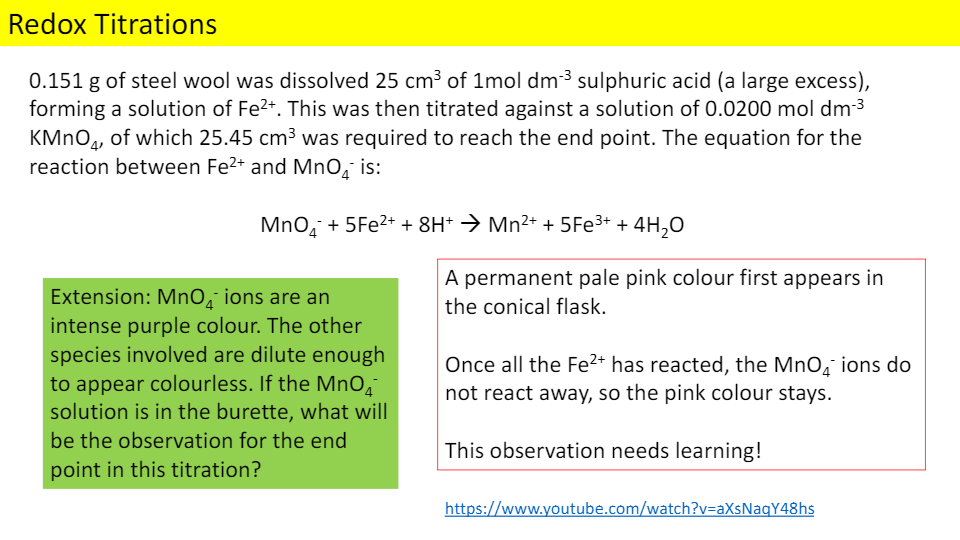
0.151 g of steel wool was dissolved 25 cm3 of 1mol dm-3 sulphuric acid (a large excess), forming a solution of Fe2+. This was then titrated against a solution of 0.0200 mol dm-3 KMnO4, of which 25.45 cm3 was required to reach the end point. The equation for the reaction between Fe2+ and MnO4- is:
MnO4- + 5Fe2+ + 8H+ --> Mn2+ + 5Fe3+ + 4H2O
i) Calculate the moles of MnO4- used in the titration.
5.09 x 10⁻⁴ mol
5.09 x 10⁻³ mol
0.7859
7.8586
6

7
Multiple Choice
0.151 g of steel wool was dissolved 25 cm3 of 1mol dm-3 sulphuric acid (a large excess), forming a solution of Fe2+. This was then titrated against a solution of 0.0200 mol dm-3 KMnO4, of which 25.45 cm3 was required to reach the end point. The equation for the reaction between Fe2+ and MnO4- is:
MnO4- + 5Fe2+ + 8H+ --> Mn2+ + 5Fe3+ + 4H2O
ii) Calculate the moles of Fe2+ in the solution.
2.545 x 10⁻³ mol
2.545 x 10⁻² mol
1.018 x 10⁻⁴ mol
1.018 x 10⁻³ mol
8

9
Multiple Choice
0.151 g of steel wool was dissolved 25 cm3 of 1mol dm-3 sulphuric acid (a large excess), forming a solution of Fe2+. This was then titrated against a solution of 0.0200 mol dm-3 KMnO4, of which 25.45 cm3 was required to reach the end point. The equation for the reaction between Fe2+ and MnO4- is:
MnO4- + 5Fe2+ + 8H+ --> Mn2+ + 5Fe3+ + 4H2O
iii) Calculate the mass of Fe in the steel wool
0.142011 g
5.68 x 10⁻³ g
4.56 x 10⁻⁵ g
10

11
Multiple Choice
0.151 g of steel wool was dissolved 25 cm3 of 1mol dm-3 sulphuric acid (a large excess), forming a solution of Fe2+. This was then titrated against a solution of 0.0200 mol dm-3 KMnO4, of which 25.45 cm3 was required to reach the end point. The equation for the reaction between Fe2+ and MnO4- is:
MnO4- + 5Fe2+ + 8H+ --> Mn2+ + 5Fe3+ + 4H2O
iv) Calculate the % by mass of Fe in the steel wool.
92%
53%
42%
94.0 %
12

13
14

15
Multiple Choice

A metal ore contains Fe(II). 6.46 g of the ore is dissolved in sulfuric acid and the resulting solution is made up to 250cm3. 25cm3 of this solution is titrated against 21.40cm3 of 0.0200 mol dm-3 potassium manganate (VII) solution. Calculate the percentage by mass of iron(II) in the sample of ore.
18.5%
1.85%
0.83%
8.3%
16

17

18

19

20

21

22

23

24

25
Multiple Choice
30 cm3 of bleach was added to an excess of acidified iodide ions. Bleach contains chlorate (I) ions, ClO- which will oxidise I- to I2 (ClO- is reduced to Cl-).
The I2 formed was titrated against 0.200 mol dm-3 of sodium thiosulphate 29.45cm3 was required.
2ClO-(aq) + 4H+(aq) + 4I-(aq) → 2Cl-(aq) + 2I2(aq) + 2H2O(l)
I2 + 2S2O32- --> 2I- + S4O62-
Calculate the moles of S2O32-
0.00589 mol
0.323 mol
0.897 mol
26

27
Multiple Choice
30 cm3 of bleach was added to an excess of acidified iodide ions. Bleach contains chlorate (I) ions, ClO- which will oxidise I- to I2 (ClO- is reduced to Cl-).
The I2 formed was titrated against 0.200 mol dm-3 of sodium thiosulphate 29.45cm3 was required.
2ClO-(aq) + 4H+(aq) + 4I-(aq) → 2Cl-(aq) + 2I2(aq) + 2H2O(l)
I2 + 2S2O32- --> 2I- + S4O62-
Calculate the moles of I2
0.00589 mol
0.01178 mol
0.002945 mol
28

29
Multiple Choice
30 cm3 of bleach was added to an excess of acidified iodide ions. Bleach contains chlorate (I) ions, ClO- which will oxidise I- to I2 (ClO- is reduced to Cl-).
The I2 formed was titrated against 0.200 mol dm-3 of sodium thiosulphate 29.45cm3 was required.
Calculate the concentration of chlorate ions in the bleach.
2ClO-(aq) + 4H+(aq) + 4I-(aq) → 2Cl-(aq) + 2I2(aq) + 2H2O(l)
I2 + 2S2O32- --> 2I- + S4O62-
Calculate the concentration of ClO-
0.098 mol dm-3
8.835 x 10⁻⁵
30

31

32

33

34
Multiple Choice
0.500g of bronze was reacted with nitric acid giving a Cu2+ solution. The solution was reacted with iodide ions, I- forming a solution of iodine, I2.
This iodine solution was then titrated with 0.200 mol dm-3 solution of sodium thiosulphate, 22.40cm3 of this was required.
Calculate the % by mass of copper in bronze
56.9 %
227.6 %
28.4%
35

36

37

38

39

40
Multiple Choice
2S2O32– (aq) + I2(aq) ==> S4O62– (aq) + 2I– (aq)
25.0 cm3 of a solution of iodine in potassium iodide solution required 26.5 cm3 of 0.0950 mol dm–3 sodium thiosulphate solution to titrate the iodine.
What is the concentration of iodine to 3s.f?
0.0504
0.0389
0.504
41

42
Multiple Choice
1.51 g of the wire was dissolved in excess of dilute sulphuric acid and the solution made up to 250 cm3 in a standard graduated flask.
A 25.0cm3 sample of this solution was pipetted into a conical flask and needed 25.45 cm3 of 0.0200 mol dm–3 KMnO4 for complete oxidation.
Calculate the percentage of iron in a sample of steel wire to 3s.f.
94.2%
52.8%
33%
43

44
Multiple Choice
3. 8.25g of an iron(II) salt was dissolved in 250 cm3 of pure water. 25.0 cm3 samples were pipetted from this stock solution and titrated with 0.0200 mol dm–3 potassium manganate(VII) solution. The titration value obtained was 23.87 cm3 . Remember MnO4- : 5Fe2+
Guided steps:
Calculate the moles of manganate(VII) used in the titration.
Calculate the moles of iron(II) ion titrated
Calculate the mass of iron(II) titrated
Calculate the total mass of iron in the original sample of the iron(II) salt.
Calculate the % iron in the salt and enter the numbers to 3s.f below
16.1%
68.3%
1.61%
6.83%
45

46

47
Multiple Choice
3.00 g of a lawn sand containing an iron(II) salt was shaken with dilute H2SO4. The resulting solution required 25.00 cm3 of 0.0200 mol dm-3 potassium manganate(VII) to oxidise the Fe2+ ions in the solution to Fe3+ ions. Use this to calculate the percentage by mass of Fe2+ ions in this sample of lawn sand.
4.65%
0.93%
48

Redox Titrations Revision (OCR)
Show answer
Auto Play
Slide 1 / 48
SLIDE
Similar Resources on Wayground

39 questions
CCU6.J Molecular Geometry
Presentation
•
12th Grade
41 questions
Sp1_M1.L8 ¿Ser o estar?
Presentation
•
12th Grade
43 questions
R3.2 Electron Transfer Reactions (except 3.2.9-11) + S3.1.6 + R1
Presentation
•
12th Grade
47 questions
Ser + Adjetivos
Presentation
•
12th Grade
39 questions
6. Phase Diagrams
Presentation
•
12th Grade
44 questions
Maya, Aztec, Inca
Presentation
•
6th - 8th Grade
45 questions
Cellular Respiration
Presentation
•
11th - 12th Grade
41 questions
Manifest Destiny
Presentation
•
11th Grade
Popular Resources on Wayground
6 questions
PRIDE Always and Everywhere
Presentation
•
12th Grade
20 questions
Lab Safety Quiz

Quiz
•
6th Grade
26 questions
KOR Review Kahoot Questions
Quiz
•
8th Grade
21 questions
Continents and Oceans
Quiz
•
6th Grade
12 questions
Unit Zero lesson 2 cafeteria
Presentation
•
9th - 12th Grade
20 questions
Parts of Speech
Quiz
•
5th Grade
10 questions
Riddles Riddles fun Riddles
Quiz
•
6th - 12th Grade
16 questions
Subject & Predicate
Quiz
•
5th Grade
Discover more resources for Chemistry
20 questions
Scientific Method
Quiz
•
10th - 12th Grade
12 questions
Significant figures
Quiz
•
9th - 12th Grade
14 questions
Matter Module Exam Practice Quiz
Quiz
•
9th - 12th Grade
15 questions
Lab Safety & Equpiment
Quiz
•
9th - 12th Grade
20 questions
Chemistry Flame Assessment
Quiz
•
9th - 12th Grade
15 questions
Solutions: Solute and Solvent
Quiz
•
9th - 12th Grade
17 questions
Chem Subatomic Particles Review
Quiz
•
9th - 12th Grade
23 questions
Temperature Conversions Practice (Kelvin and Celsius)
Quiz
•
10th - 12th Grade