
- Resource Library
- Science
- Earth & Space Science
- Solar System
- Gravity In Our Solar System 2: Orbital Speeds

Gravity In Our Solar System 2: Orbital Speeds

Presentation
•
Science
•
6th - 8th Grade
•
Easy
+3
Standards-aligned

Joshua Ellis
Used 69+ times
FREE Resource
9 Slides • 10 Questions
1
Gravity In Our Solar System 2:
Orbital Speeds
Objective: I will be able to explain patterns in planetary data using my knowledge of gravity.

2
3
Open Ended

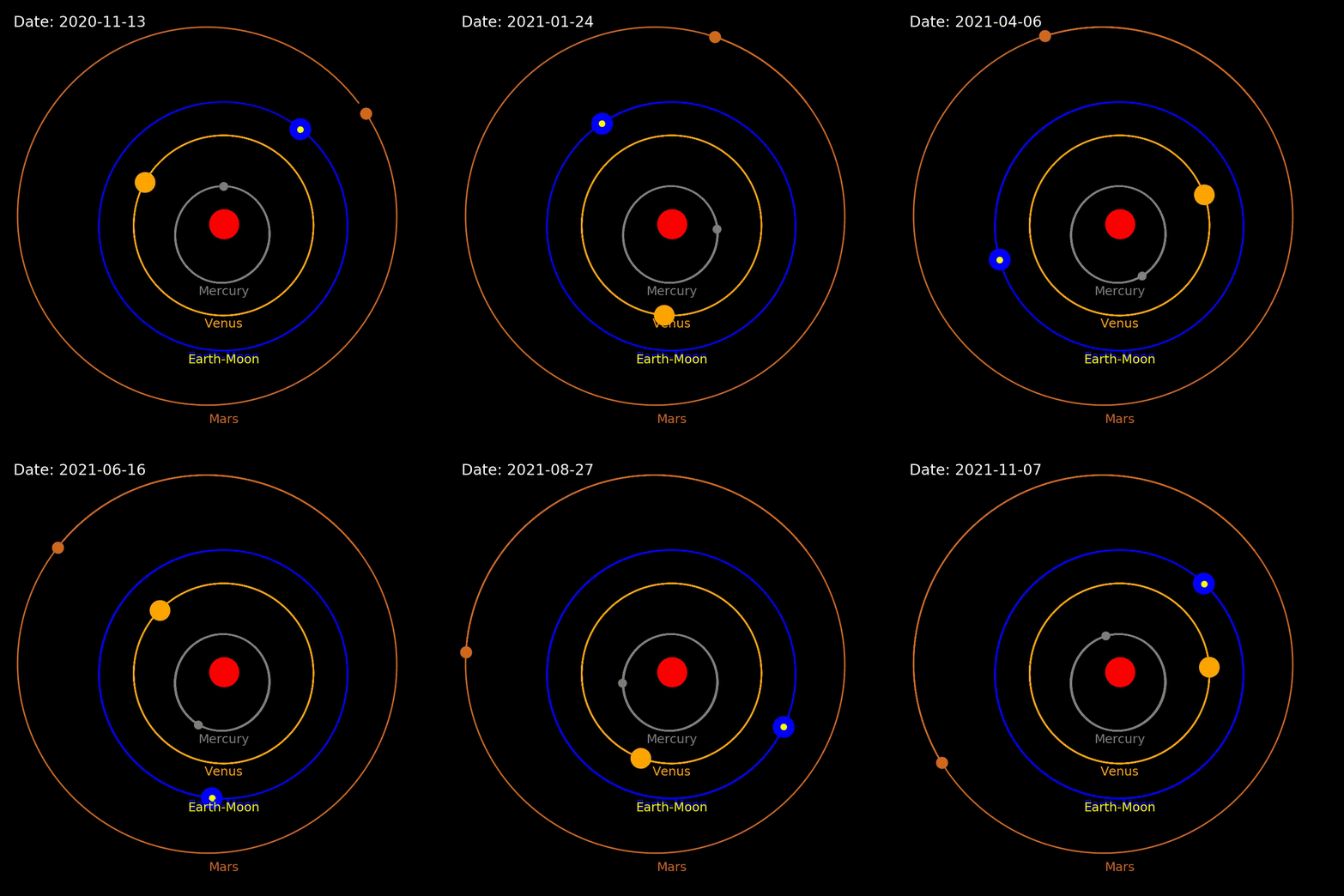
This is a model of the inner solar system. The orange object in the middle represents the Sun.
Write down as many observations as you can about the motion of these planets.
4
Open Ended
One observation you probably made was that Mercury is moving the fastest and Mars is moving the slowest.
It seems that planets closer to the Sun travel at faster speeds.
Why do you think that is?
5
Lets apply what we have learned about gravity to this observation.
6
Multiple Choice

What happens to the strength of gravity when two objects move closer together?
7

Imagine it like the planets are on a "gravity treadmill." The planet needs to move at a certain speed in order to stay on the treadmill.
8

Now imagine we increase the gravity on the treadmill. The planet will need to run faster if it does not want to get pulled off the treadmill.
9

Lets look at some real planet data. First, lets practice reading this table.
10
Fill in the Blanks

Which planet is the closest to the Sun?
Type answer...
11
Fill in the Blanks

What is the average distance between Mars and the Sun?
Type answer...
12
Fill in the Blanks

Which planet is moving the slowest?
Type answer...
13
Fill in the Blanks

How many years does it take Saturn to complete one orbit around the Sun?
Type answer...
14

Now you will answer an open response question. You will be looking for a pattern in this data.
15
16
Open Ended

How does a planet's orbital speed depend on its distance from the Sun? Support your answer using data from the table.
Sentence Frame:
As the distance from the Sun increases/decreases, the _______ increases/decreases. For example... [use data to compare two planets to demonstrate your point]
17
Possible Answer
As the distance from the Sun increases, the orbital speed decreases. For example, Earth moves at 30 km/s, but Saturn only moves 10 km/s.
Green = the relationship
Red = evidence

18
Multiple Choice

The diagram shows the orbit of a comet around the Sun. Three different points in the orbit have been labeled A, B, and C.
At which point in its orbit would you expect the comet to have the slowest speed?
19
Open Ended

Explain why we would expect this comet to move faster at point A and slower at point C.
Gravity In Our Solar System 2:
Orbital Speeds
Objective: I will be able to explain patterns in planetary data using my knowledge of gravity.
Show answer
Auto Play
Slide 1 / 19
SLIDE

