

Diction and Syntax

Presentation
•
English, Education
•
11th Grade
•
Practice Problem
•
Easy
+23
Standards-aligned

Tiana Mccowan
Used 259+ times
FREE Resource
11 Slides • 8 Questions
1
Diction and Syntax
English 3
2
Objective
We will evaluate how the author's diction and syntax contribute to the mood, voice, and tone. We will make connections between texts.
3
Vocabulary
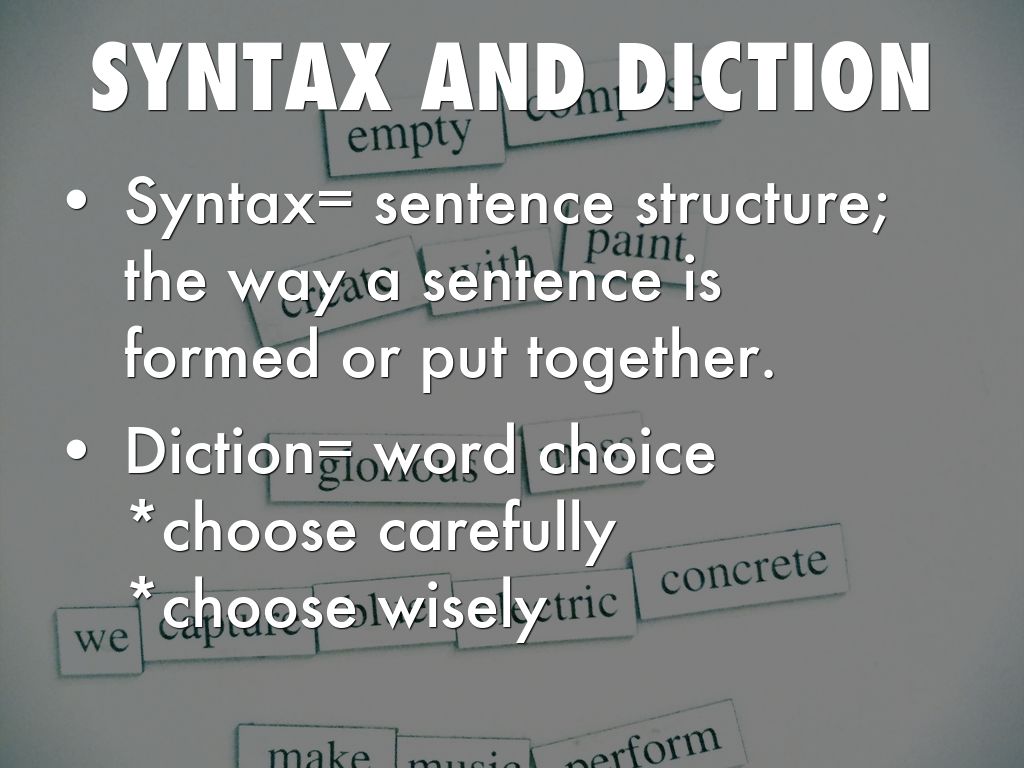
Diction - word choice, or the type of language an author uses
Mood - the emotional atmosphere of a piece of writing, created through diction, figurative language, and other choices
Syntax - word order, or the way in which the elements of language (words, phrases, clauses, etc.) are arranged to create well-formed sentences
Tone - the author’s, speaker’s, or narrator’s attitude toward a subject, evident through diction and other style elements
Voice - the use of language that conveys the distinctive personality of the writer or speaker, the narrator, or a particular character
4
Multiple Choice
Define DICTION
word order, or the way in which the elements of language (words, phrases, clauses, etc.) are arranged to create well-formed sentences
the emotional atmosphere of a piece of writing, created through diction, figurative language, and other choices
word choice, or the type of language an author uses
5
Multiple Choice
Define SYNTAX
the author’s, speaker’s, or narrator’s attitude toward a subject, evident through diction and other style elements
word order, or the way in which the elements of language (words, phrases, clauses, etc.) are arranged to create well-formed sentences
word choice, or the type of language an author uses
6
In order to evaluate how the author's diction and syntax contribute to the mood, voice, and tone of text note the following:
the author’s purpose for writing
the mood, voice, and tone of a text
the type of language and vocabulary that is used
the types of sentence structures that are used
7
Guide Questions for Diction
Are the words simple and easy to understand or complex and technical?
Does the author use vague or abstract wording or is the writing precise and concrete?
Is the language used formal or informal? Academic or nonacademic?
What are the effects of the words that the author chooses on the mood, voice, and tone of the text?
Is the diction that the author uses effective in conveying the mood, voice, and tone of the text?
8
Multiple Select
Which of the following are questions you can use as a guide to help evaluate the author's DICTION? Check all that apply.
Does the author ask many questions within the text?
Are the words simple and easy to understand or complex and technical?
Does the author use nontraditional syntax?
What are the effects of the syntax that the author chooses on the mood, voice, and tone of the text?
What are the effects of the words that the author chooses on the mood, voice, and tone of the text?
9
Guide Questions for Syntax
Does the author ask many questions within the text?
Does the author use nontraditional syntax?
Are most of the sentences simple and easily understood?
Does the author repeat certain words or sentence structures?
What are the effects of the syntax that the author chooses on the mood, voice, and tone of the text?
Is the syntax that the author uses effective in conveying the mood, voice, and tone of the text?
10
Multiple Select
Which of the following are questions you can use as a guide to help find SYNTAX? Check all that apply.
Does the author repeat certain words or sentence structures?
Is the language used formal or informal? Academic or nonacademic?
What are the effects of the syntax that the author chooses on the mood, voice, and tone of the text?
11
PRACTICE THE SKILLS
We will look at The Miracle of Morning by Amanda Gorman and answer questions about diction and syntax to check for understanding.
See poem posted in Google Classroom. Go to next slides to view video of poem.
12
13
Open Ended
Tone is the author’s, speaker’s, or narrator’s attitude toward a subject, evident through diction and other style elements.
What would you identify as the tone of the poem and why?
Make sure to use text evidence.
14
Open Ended
Mood is the emotional atmosphere of a piece of writing, created through diction, figurative language, and other choices.
What would you identify as the mood of the poem and why?
Make sure to use text evidence.
15
Open Ended
In The Miracle of Morning by Amanda Gorman, are the words simple and easy to understand or complex and technical?
Provide an example from the text.
16
Open Ended
In The Miracle of Morning by Amanda Gorman, Does the author repeat certain words or sentence structures?
Use evidence from the text.
17
Diction & Syntax Conclusion 1
Diction refers to word choice, or the type of language an author uses. For example, a text using straightforward diction would contain short, easy-to-understand words. In contrast, a text with high-level vocabulary may be described as having elevated diction.
18
Diction & Syntax Conclusion 2
Syntax refers to word order, or the arrangement of words, phrases, or clauses to create well-formed sentences. Texts with sentences containing a single subject and a single predicate have simple syntax; whereas, sentences containing multiple phrases or clauses have complex syntax.
19
Diction & Syntax Conclusion 3
Proper use of diction and syntax enhances the effectiveness of a text and is very important in determining its mood (the emotional quality or atmosphere of a story or poem), voice (the use of language to convey the writer’s personality), and tone (the writer’s attitude toward his or her subject matter).
Diction and Syntax
English 3
Show answer
Auto Play
Slide 1 / 19
SLIDE
Similar Resources on Wayground

11 questions
simple past vs present perfect
Presentation
•
11th Grade
13 questions
Central Idea
Presentation
•
6th - 8th Grade
15 questions
Sentence Diagnostic
Presentation
•
10th Grade
13 questions
An Opinion Essay
Presentation
•
10th Grade
15 questions
SLIDE OPINION & THOUGHT
Presentation
•
11th Grade
13 questions
Causatives
Presentation
•
10th - 11th Grade
15 questions
Connotation & Denotation
Presentation
•
10th Grade
14 questions
Public Speaking
Presentation
•
10th - 11th Grade
Popular Resources on Wayground
10 questions
How much do you know about our Portrait of an Eagle?

Quiz
•
10th Grade
10 questions
Fast Food Slogans
Quiz
•
6th - 8th Grade
21 questions
Continents and Oceans
Quiz
•
6th Grade
20 questions
Parts of Speech
Quiz
•
5th Grade
16 questions
Subject & Predicate
Quiz
•
5th Grade
25 questions
Multiplication Facts
Quiz
•
5th Grade
12 questions
Map Skills
Quiz
•
3rd Grade
22 questions
Continents and Oceans
Quiz
•
5th Grade
Discover more resources for English
10 questions
Exploring Narrative Writing Techniques

Interactive video
•
11th Grade
19 questions
Understanding the Circle of Control
Quiz
•
9th - 12th Grade
15 questions
ACT English Practice
Quiz
•
11th - 12th Grade
31 questions
AP Vocab Group 5
Quiz
•
9th - 12th Grade
22 questions
Topic Vs Theme
Quiz
•
3rd - 12th Grade
20 questions
Vocab Group 5
Quiz
•
9th - 12th Grade
12 questions
RI.8.5/RL.8.5
Quiz
•
5th - 12th Grade
20 questions
The Crucible Act 1
Quiz
•
11th Grade