

APB Unit 6.3 - Gene Expression and Regulation #GoBioRams

Presentation
•
Biology, Science
•
11th - 12th Grade
•
Medium

Monica Bowman
Used 7+ times
FREE Resource
68 Slides • 6 Questions
1
APB Unit 6.3 - Gene Expression and Regulation #GoBioRams
Chapter 18

2
We need to keep track of
Prokaryotic mechanisms
v
Eukaryotic mechanisms
3
4
5
First up
Prokaryotic Regulation of Gene Expression
using Operons
6
Prokaryotes (Archaea & Bacteria)
These organisms have been living successfully on Earth for quite a long time because they are efficient.
They only make what they need since having a surplus isn't very efficient.
Prokaryotes are not horders.
7
First up the trp operon
This operon is involved with the production of the essential amino acid tryptophan.
8
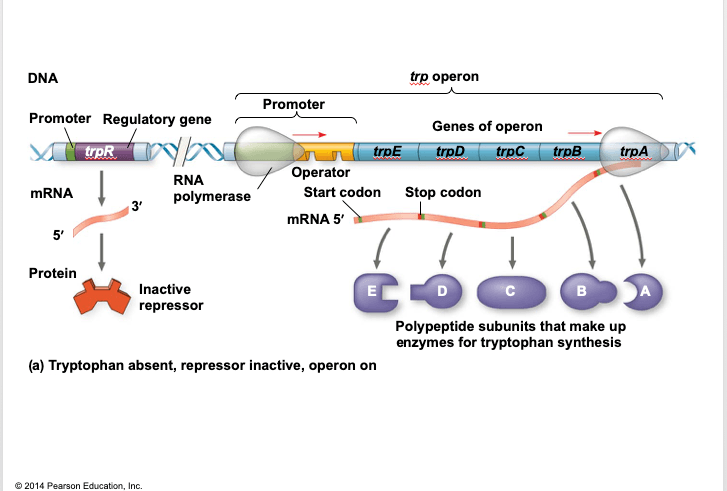
Note what happens if the prokaryote
does not have enough tryptophan.
9
10
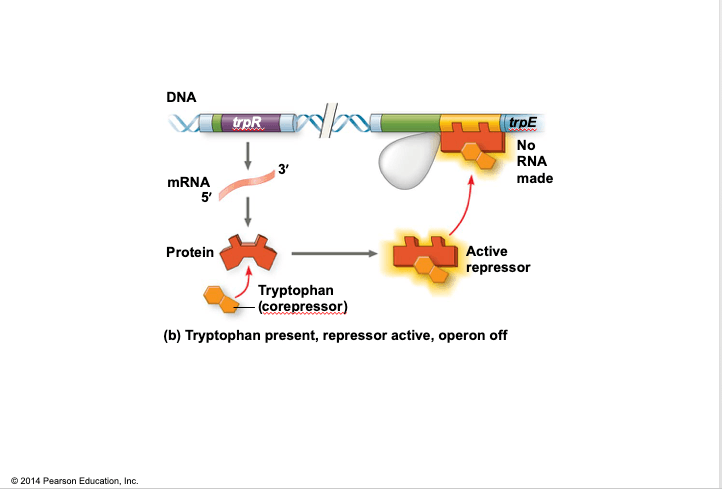
Note what happens when the prokaryote
has enough tryptophan.
11
12
trp operon
No tryptophan - repressor is inactive.
Already have enough tryptophan - repressor is activated with a corepressor.
Since the repressor is always considered to be "on" the trp operon is called a repressible operon.
13
14
15
Adding another layer of complexity.
Note the attenuator system.
16
17
18
Next up
lac operon in prokaryotes.
Note that this operon is usually "off" and needs an inducer to inactivate the repressor.
This makes lac operon an inducible operon.
19
First up
Lactose is absent.
20

21
Next up
Lactose is present.
22

23
24
25
26
Prokaryotic Gene Regulation "trends"
Inducible enzymes are usually involved in catabolic pathways and their synthesis is induced by a chemical signal; trp operon.
Repressible enzymes are usually involved in anabolic pathways and their synthesis is repressed by high levels of the end product; lac operon.
Although lac operon can be both inducible and repressible.
27
Prokaryotic Gene Regulation "trends"
Regulation of both trp and lac operons involves the negative control of genes since the operons are switched off by the active form of the repressor.
28
Prokaryotic Gene Regulation "trends"
Some operons are subject to possible control by using a stimulatory protein; catabolite activator protein (CAP) which activates transcription.
When preferred glucose is scare, CAP is activated by binding with cyclic AMP (cAMP).
29
Prokaryotic Gene Regulation "trends"
Activated CAP attaches to the lac operon promoter and increases the binding affinity of RNA polymerase which will cause faster transcription.
When glucose levels increase, CAP detaches from the lac operon promote and transcription rates go back to normal levels.
CAP regulates other catabolic pathways.
30

31

32
Multiple Choice
For the trp operon, if there is tryptophan absent, the repressor is
Active
Inactive
33
Multiple Choice
The trp operon, it does NOT use a corepressor if there is plenty of tryptophan available.
False
True
34
Multiple Choice
For the lac operon, if lactose is absent, the repressor is
Active
Inactive
35
Multiple Choice
For the lac operon, what does the allolactose inducer do if lactose is present?
The allolactose binds with the repressor and inactivates the repressor.
The allolactose binds to the promoter and stops gene expression.
36
Multiple Choice
For the lac operon, if lactose is present, glucose is scarce, and the cAMP levels are high
the lac mRNA is transcribed.
the lac mRNA is not transcribed.
37
Multiple Choice
For the lac operon, if lactose is present, glucose is present, and the cAMP levels are low
the lac mRNA is transcribed.
the lac mRNA is not transcribed.
38
Now for Eukaryotes
the more "complicated" cells.
39
Differential gene expression
Remember differentiation?
That's when different cells in an Eukaryote are "assigned" different roles; ex. skin v. liver cells.
40
41

42

43
Know mechanisms
Regulating chromatin structure or heterochromatin (methylation) v. euchromatin (histone acetylation or phosphorylation of the methylated histone).
We discussed this earlier in Unit 5 during our introduction to epigenetics.
44

45
46
47
48
Adding another layer of complexity
Control elements are segments of non-coding DNA that can serve as binding sites for transcription factors, which regulate transcription.
Proximal control elements are near the promoter while distal control elements are near the enhancer.
49

50
How do these control elements and
transcription factors work?
51

52

53
54
Transcription factories
Locations where multiple euchromatin areas are exposed.
https://jcs.biologists.org/content/124/21/3676
55

56
Alternative RNA splicing
Editing which exons to keep and in what order.
57

58
59
60
61
DNA Degradation, Protein Processing, &
Protein Degradation can also add
to the variety of proteins that are produced.
62
Ah, the variety.
RNAs
We are living in an RNA World Hypothesis.
63
64
65
A "short list" of different RNA
https://en.wikipedia.org/wiki/List_of_RNAs
https://www.futurelearn.com/info/courses/translational-research/0/steps/14201
The list keeps growing.
66
67
Multiple mechanisms
And we keep adding to the list:
RNA interference or RNAi
microRNAs or miRNAs
small interfering RNAs or siRNAs
long noncoding RNAs or lncRNAs
68
69
70
71
72
73
Review
We discussed prokaryotic gene regulation of expression by comparing the trp and lac operons.
We then discussed multiple, multiple, multiple mechanisms that eukaryotes use to differentiate gene expression.
74
Review
Epigenetics, heterochromatin, euchromatin, methylation, acetylation, histones,...
Control elements, spliceosomes, transcription factories, alternative RNA splicing,...
Lots of different RNA mechanisms and the RNA World Hypothesis.
APB Unit 6.3 - Gene Expression and Regulation #GoBioRams
Chapter 18
Show answer
Auto Play
Slide 1 / 74
SLIDE
Similar Resources on Wayground

66 questions
Animal Science-Dairy Judging Review Lesson
Presentation
•
10th - 12th Grade
67 questions
C2.1 Chemical Signalling (IB Biology)
Presentation
•
12th Grade
66 questions
Speciation
Presentation
•
12th Grade
68 questions
Chemistry Unit 3 Lesson 1: Heat vs. Temperature
Presentation
•
10th - 12th Grade
66 questions
Biomes on Earth Lesson
Presentation
•
9th - 12th Grade
72 questions
11.6 Combined Spectral Analysis
Presentation
•
12th Grade
69 questions
Muscular System Terms
Presentation
•
11th - 12th Grade
71 questions
Upper Limb
Presentation
•
11th - 12th Grade
Popular Resources on Wayground
21 questions
Continents and Oceans

Quiz
•
6th Grade
20 questions
Parts of Speech
Quiz
•
5th Grade
16 questions
Subject & Predicate
Quiz
•
5th Grade
25 questions
Multiplication Facts
Quiz
•
5th Grade
12 questions
Map Skills
Quiz
•
3rd Grade
22 questions
Continents and Oceans
Quiz
•
5th Grade
15 questions
Rounding Decimals
Quiz
•
5th Grade
20 questions
Brand Labels
Quiz
•
5th - 12th Grade
Discover more resources for Biology
10 questions
Exploring the 4 Major Macromolecules and Their Functions

Interactive video
•
9th - 12th Grade
20 questions
Cell Transport
Quiz
•
9th - 12th Grade
16 questions
AP Biology: Unit 2 Review (CED)
Quiz
•
9th - 12th Grade
16 questions
AP Biology: Unit 1 Review (CED)
Quiz
•
9th - 12th Grade
20 questions
Ecological Succession Review
Quiz
•
9th - 12th Grade
30 questions
Quiz Week 6 Review (10/2/26)
Quiz
•
9th - 12th Grade
40 questions
Unit 3 Cell Growth and Differentiation
Quiz
•
10th - 12th Grade
25 questions
3.2 Protein Synthesis Practice
Quiz
•
9th - 12th Grade