Search Header Logo
  1. Resource Library
  2. Science
  3. Life Science
  4. 2.1.5 Life Science S1
2.1.5 Life Science S1

2.1.5 Life Science S1

Assessment

Presentation

Science

9th - 12th Grade

Medium

CCSS.3.MD.A.2, CCSS.4.MD.A.1, NGSS.5-PS1-2

+3

Standards-aligned

Created by

Amanda Krupp

Used 4+ times

FREE Resource

17 Slides • 27 Questions

1

2.1.5 Life Science S1

- Identify appropriate tools and SI units for collecting, recording, and analyzing both quantitative and qualitative data.

- Record precise and approximate measurements.

- Use scientific notation for very small and very large numbers.

Slide image

2

Why use the Metric System?

  • Most countries use it

  • Scientists need a universal way to communicate data

Slide image

3

Slide image

4

Slide image

5

Slide image

6

Multiple Choice

There are _______ grams in 1 kilogram

1

1

2

10

3

100

4

1000

7

Slide image

8

Multiple Choice

Besides liters, what is another way you can measure volume?


Volume = length x width x height

1

cm3

2

m

3

g

4

L

9

Slide image

Graduated Cylinder

10

Multiple Choice

What tool do you use to measure the volume of a liquid?

1

ruler

2

triple beam balance

3

eye dropper

4

graduated cylinder

11

Multiple Choice

Question image
The volume of a glass of orange juice would be measured in __?__.
1
liters  (L)
2
cubic meters  (m3)
3
milliliters  (mL)
4
kilograms  (kg)

12

Slide image

13

Multiple Choice

Units used to measure Mass of an object

1

Centimeters

2

Milliliters

3

Grams

4

Volume

14

Multiple Choice

Question image

What would you use to measure the mass of this?

1

Grams

2

Kilograms

15

Multiple Choice

Question image

What would you use to measure the mass of this?

1

Grams

2

Kilograms

16

Multiple Choice

Which of the following would you most likely measure in kilograms?

1

mass of a paperclip

2

length of a horseshoe

3

length of a longhorn cow

4

mass of a longhorn cow

17

Multiple Choice

Tool used to measure MASS
1
Metric Ruler
2
Triple Beam Balance
3
Graduated Cylinder
4
Thermometer

18

Slide image

19

Multiple Choice

What is the basic unit for length

1

meter

2

centemeters

3

yards

4

kilograms

20

Multiple Choice

Question image
To measure the length of a Kleenex box you would use __?__.
1
kilometers (km)
2
meters (m)
3
dekameters (dam)
4
centimeters (cm)

21

Slide image

22

Slide image

23

Multiple Choice

Question image

The SI unit for temperature is __?__.

1

degree fahrenheit (° F)

2

degree celsius (° C)

3

kelvin (K)

4

degree centigrade (°C)

24

Multiple Choice

The amount of space taken up by an object
1
Mass
2
Volume
3
Density
4
Weight

25

Multiple Choice

Which unit is not used in the metric system?

1

meter

2

gram

3

pound

4

liter

26

Multiple Choice

We use the _____________ when we want to magnify smaller objects.
1
triple beam balance
2
hand lens
3
thermometer
4
graduated cylider

27

Slide image


28

Slide image

29

Slide image

30

Slide image

31

Multiple Choice

The rule of scientific notation is to write all exponents with a base of ____.
1
50
2
5
3
100
4
10

32

Multiple Choice

Write 0.000972 in scientific notation.
1
9.72 x 10⁻⁴
2
9.72 x 10⁻³
3
972 x 10-4
4
9.72 x 10⁴

33

Multiple Choice

How do you write

8.317 x 10⁶

in standard form?

1

8,371

2

83, 170, 000

3

837, 100

4

8, 317, 000

34

Multiple Choice

How would you write 0.0005 in scientific notation?

1

50 x 105

2

5 x 10⁴

3

5 x 10³

4

.5 x 103

35

Multiple Choice

How would you write 479,000 in Scientific Notation?

1

479 x 103

2

47.9 x 10⁴

3

0.479 x 10⁶

4

4.79 x 10⁵

36

Slide image

Accuracy = How close to "true" or desired value

Precision = How close measurements are to each other

37

Multiple Choice

This refers to

how close a group of measurements are to each other

1

estimate

2

accuracy

3

precision

4

mean

38

Multiple Choice

How close a measurement is to the true value is called..

1

Accuracy

2

Precision

3

Significant

4

Estimate

39

Multiple Choice

It is a measure of how close measurements come to each other when they are made in the same way

1

Accuracy

2

Precision

3

Error

4

Extrapolation

40

Multiple Choice

Question image

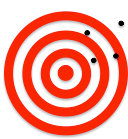
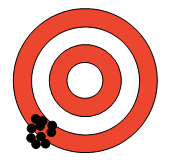
Describe the accuracy and precision of the image

1

Accurate and Precise

2

Accurate and not precise

3

Not Accurate and Precise

4

Not accurate and not precise

41

Multiple Choice

Which is the more precise measurement?

1

4 mL

2

4.3 mL

3

4.30 mL

4

4.300 mL

42

Multiple Choice

Which group of measurements is more precise?

1

28.5, 28.4, 28.5

2

25.8, 25.0 24.1

3

32.1, 35.0, 25.0

4

20.0, 25.0, 30.0

43

Multiple Choice

Question image

This bullseye demonstrates...

1

High Accuracy & High Precision

2

High Accuracy & Low Precision

3

Low Accuracy & High Precision

4

Low Accuracy & Low Precision

44

Slide image

Accuracy = How close to "true" or desired value

Precision = How close measurements are to each other

2.1.5 Life Science S1

- Identify appropriate tools and SI units for collecting, recording, and analyzing both quantitative and qualitative data.

- Record precise and approximate measurements.

- Use scientific notation for very small and very large numbers.

Slide image

Show answer

Auto Play

Slide 1 / 44

SLIDE