
Lesson #2 Analyzing Information in Science
Presentation
•
Science
•
9th - 12th Grade
•
Medium
+8
Standards-aligned
MARY RETCHKO
Used 7+ times
FREE Resource
1 Slide • 41 Questions
1
Analyzing Information in Science
Drawing conclusions is a skill that is often tested.
When you draw a conclusion, you must first use all the available facts to analyze the information.
You do this so you can make a reasonable judgment.
Remember, if some of the facts don't fit, then the conclusion is probably wrong.
2
Multiple Choice
3
Multiple Choice
4
Multiple Choice
Which of the following conclusions could be drawn from the data?
5
Multiple Choice
6
Multiple Choice
7
Multiple Choice
8
Multiple Choice
9
Multiple Choice
10
Multiple Choice
They used their results to make the graph below.
Which month had an average daily temperature of around 41 degrees?
11
Multiple Choice
Two students were watching the clouds and listening to the wind. They could also smell rain in the air. What skill were these students using?
recording data
asking questions
performing an experiment
observing
12
Multiple Choice
13
Multiple Choice
14
Multiple Choice
15
Multiple Choice
Using one or more of your senses to gather information refers to
classifying
observing
inferring
predicting
16
Multiple Choice
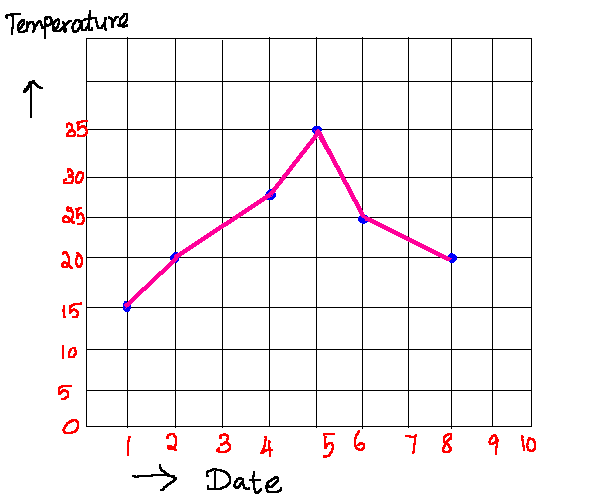
From Tuesday to Wednesday there is ....
17
Multiple Choice
18
Multiple Choice
19
Multiple Choice
What is an explanation you make putting together what you already knew with what you observed?
inference
observation
hypothesis
prediction
20
Multiple Choice
21
Multiple Choice
22
Multiple Choice
23
Multiple Choice
Kyleigh observes and sketches the phases of the moon during a five-week period. Her drawings are shown here. Which statement best describes Kyleigh's investigation?
It involves modeling.
It involves experimentation.
It involves repeated observations.
It involves both experimentation and repeated observations.
24
Multiple Choice
25
Multiple Choice
26
Multiple Choice
27
Multiple Choice
_____________________________ is the study of the natural world and involves evaluating evidence.
Investigation
Information
Science
Inference
28
Multiple Choice
29
Multiple Choice
30
Multiple Choice
You want to make a graph for an experiment you did about plant growth over a two week period of time. What type of graph would you use?
bar graph
line graph
pictograph
pie chart
31
Multiple Choice
Two students were watching the clouds and listening to the wind. They could also smell rain in the air. What skill were these students using?
Recording data
Asking questions
Performing an experiment
Observing
32
Multiple Choice
33
Multiple Choice
34
Multiple Choice
Using one or more of your senses to gather information refers to .....................
classifying
observing
inferring
predicting
35
Multiple Choice
36
Multiple Choice
What is an explanation you make putting together what you already knew with your investigation?
Inference
Observation
Hypothesis
Prediction
37
Multiple Choice
An observation dealing with numbers or amounts
quantitative observation
qualitative observation
38
Multiple Choice
explaining or interpreting observations
analyzing
observing
inferring
classifying
39
Multiple Choice
grouping together items that are alike in some way
analyzing
classifying
observing
inferring
40
Multiple Choice
making a statement or claim about what will happen in the future
experimenting
inferring
analyzing
predicting
41
Multiple Choice
Making an explanation based on your prior knowledge and what you observe
inferring
predicting
guessing
analyzing
42
Multiple Choice
evaluating observations and data in order to draw a conclusion
analyzing
classifying
predicting
inferring
Analyzing Information in Science
Drawing conclusions is a skill that is often tested.
When you draw a conclusion, you must first use all the available facts to analyze the information.
You do this so you can make a reasonable judgment.
Remember, if some of the facts don't fit, then the conclusion is probably wrong.
Show answer
Auto Play
Slide 1 / 42
SLIDE

Similar Resources on Wayground
35 questions
Nuclear fission vs fusion
Presentation
•
9th - 12th Grade
35 questions
Seismic Waves
Presentation
•
9th - 12th Grade
38 questions
Unit 4- Lesson 4: Elections
Presentation
•
9th - 12th Grade
38 questions
Proving Triangles are Congruent
Presentation
•
9th - 12th Grade
38 questions
Definite and Indefinite Articles
Presentation
•
9th - 12th Grade
35 questions
Spanish Subject Pronouns and Estar
Presentation
•
9th - 12th Grade
38 questions
Chemical Reactions - Types of Reactions
Presentation
•
9th - 12th Grade
35 questions
Regulating the Cell Cycle + Cancer (part 3)
Presentation
•
9th - 12th Grade
Popular Resources on Wayground
10 questions
5.P.1.3 Distance/Time Graphs
Quiz
•
5th Grade
10 questions
Fire Drill
Quiz
•
2nd - 5th Grade
20 questions
Equivalent Fractions
Quiz
•
3rd Grade
15 questions
Hargrett House Quiz: Community & Service
Quiz
•
5th Grade
20 questions
Main Idea and Details
Quiz
•
5th Grade
20 questions
Context Clues
Quiz
•
6th Grade
20 questions
Inferences
Quiz
•
4th Grade
15 questions
Equivalent Fractions
Quiz
•
4th Grade
Discover more resources for Science
10 questions
Exploring the Layers of the Earth
Interactive video
•
6th - 10th Grade
25 questions
Naming Ionic and Covalent Compounds
Quiz
•
9th Grade
20 questions
Balancing Chemical Equations
Quiz
•
9th Grade
35 questions
DNA Structure and Replication
Quiz
•
10th Grade
20 questions
Non-Mendelian Genetics
Quiz
•
9th Grade
10 questions
Exploring the Dynamics of Ocean Currents
Interactive video
•
6th - 10th Grade
20 questions
The Cell Cycle and Mitosis
Quiz
•
9th Grade
15 questions
Genetics- Punnett Squares
Quiz
•
9th Grade