Search Header Logo
The Nitrogen Cycle and the Phosphorus Cycle

The Nitrogen Cycle and the Phosphorus Cycle

Assessment

Presentation

•

Science, Biology

•

9th - 12th Grade

•

Medium

•
NGSS
MS-LS2-3, MS-LS2-4, MS-LS2-1

+5

Standards-aligned

Created by

David Blankenship

Used 6+ times

FREE Resource

27 Slides • 40 Questions

1

The Nitrogen Cycle and the Phosphorus Cycle

Slide image

2

Slide image

3

Slide image

4

Slide image

5

Slide image

6

Slide image

7

Slide image

8

Slide image

9

Slide image

10

Fill in the Blank

Type the correct answer in the box. Spell all words correctly.


How is molecular nitrogen (N2) utilized by plants and animals?


Before it can be utilized by plants and animals, molecular nitrogen (N2) must be converted by microbes that use N2 as a replacement for _________________.

11

Slide image

12

Slide image

13

Slide image

14

Slide image

15

Slide image

16

Slide image

17

Multiple Choice

Plants and animals need nitrogen to make __________.
1
Protein
2
Carbohydrates
3
Lipids
4
Minerals

18

Multiple Choice

What process occurs when dead plant and animal matter decomposes and nitrogen is released back into the atmosphere?

1

Assimilation

2

Fixation

3

Ammonification

4

Denitrification

19

Multiple Choice

What is the process of combining nitrogen gas with other elements to make nitrogen into usable compounds?

1

nitrogen composition

2

nitrogen fixation

3

ammonia

4

denitrification

20

Multiple Choice

How is nitrogen "fixed" into a usable form for plants?

1

Through action of bacteria only

2

Through lightning only

3

Through action of bacteria and lightning

4

Through photosynthesis

21

Multiple Choice

Question image

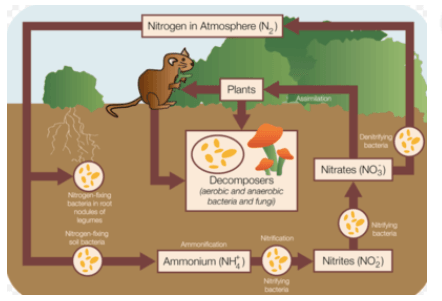
A correct path that nitrogen could take would be

1

air -> animals -> plants -> bacteria

2

animals -> air -> bacteria -> plants

3

bacteria -> air -> plants -> animals

4

air -> bacteria -> plants -> animals

22

Multiple Choice

What is the formula for atmospheric nitrogen?

1

N

2

N2

3

NH3

4

NO3

23

Multiple Choice

How do animals get the nitrogen they need?

1

From the air they breathe

2

From the water they drink

3

From the food they eat

4

From the sun

24

Multiple Choice

What converts nitrogen gas into a usable form for plants and animals?

1

bacteria

2

rain

3

fungi

4

car exhaust

25

Multiple Choice

Nitrification happens in the ______
1
Air 
2
Soil 
3
Ground Water 
4
Plants 

26

Multiple Choice

The process in which Nitrogen circulates and is recycled is called ____________
1
The nitrogen cycle
2
The water cycle
3
The carbon cycle
4
Nitrogen Fixation 

27

Multiple Choice

What happens when organisms die and decay? 
1
Their bodies are lifted up
2
Their nitrogen returns to the soil
3
they keep their nitrogen
4
They stay on earth forever

28

Multiple Choice

After plants and animals contain nitrogen, what puts it back into atmosphere and soil?
1
decomposition
2
precipitation
3
condensation
4
bacteria

29

Multiple Choice

Plants and animals cannot use nitrogen directly from the air.
1
True
2
False

30

Multiple Choice

Organisms that need nitrogen to survive
1
only plants
2
only animals
3
only bacteria
4
all living organisms

31

Multiple Choice

Question image
Organisms that break down dead plants & animals and release nitrogen back into atmosphere...
1
bacteria
2
plants
3
animals
4
producers

32

Multiple Choice

Question image
How much of the atmosphere is composed of nitrogen gas?
1
87%
2
38%
3
78%
4
21%

33

Multiple Choice

Question image
How much of the atmosphere is composed of nitrogen gas?
1
87%
2
38%
3
78%
4
21%

34

Slide image

35

Slide image

36

Slide image

37

Slide image

38

Slide image

39

Slide image

40

Multiple Choice

Question image

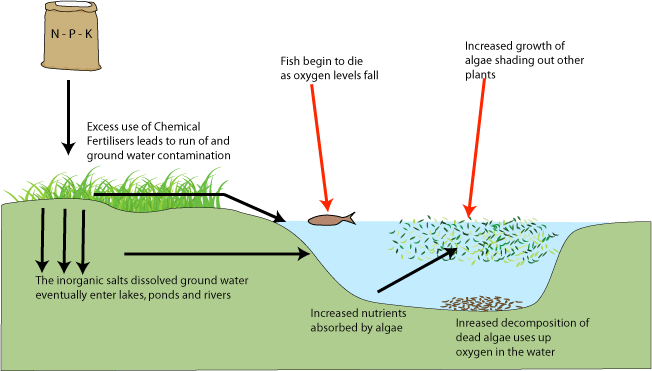
In general, algal blooms occur when

1

toxins accumulate in shellfish.

2

nutrients decrease in the water.

3

nutrients increase in the water.

41

Multiple Choice

An algal bloom is the rapid growth of a population of

1

fungi

2

protozoans

3

algae

42

Multiple Choice

Too much phosphorus in waterways (rivers, lakes) can lead to___________.

1

eutrophication

2

Nothing

3

Death

4

diseases

43

Multiple Choice

Which of the following statements is true of the phosphorus cycle?
1
Phosphorus enters the atmosphere as phosphates.
2
The phosphorus cycle utilizes the processes of erosion, and weathering.
3
Phosphates are used in carbohydrate and glucose storage.
4
The phosphorus cycle utilizes bacteria to breakdown phosphates and make them available for plants.

44

Multiple Choice

_____ brings phosphorous into our waterways. .
1
precipitation
2
runoff
3
transpiration
4
condensation

45

Multiple Choice

True or false: Phosphorous can enter the atmosphere

1

True

2

False

46

Multiple Choice

What is the phosphorus' symbol on the periodic table?

1

P

2

pH

3

Ph

4

H

47

Multiple Choice

Which nutrient is not cycled through the atmosphere and stays only on ground level?
1
carbon
2
nitrogen
3
phosphorus
4
water

48

Multiple Choice

This is released by the weathering of rocks.
1
Carbon
2
Oxygen
3
Phosphorus
4
Nitrogen

49

Multiple Choice

What role do decomposers play in the phosphorous cycle?
1
absorb phosphorous 
2
release phosphorous into atmosphere
3
return phosphorous into the soil
4
combustion

50

Multiple Choice

Phosphorous is passed from plants to ____ who eat them
1
plants
2
animals
3
scavengers

51

Multiple Choice

This is NOT a part of the phosphorus cycle.

1

Phosphate is incorporated into sedimentary rocks

2

Phosphate bound to soil

3

Atmospheric phosphate

4

Phosphate is absorbed from the soil by plants

52

Slide image

53

Slide image

54

Slide image

55

Slide image

56

Slide image

57

Slide image

58

Multiple Choice

What nutrients increase the rate of algae growth and reproduction in aquatic ecosystems?

1

nitrates and phosphates

2

sulfates and ammoniates

3

philates and sulfates

4

phosphates and communicates

59

Multiple Choice

What causes eutrophication of a lake?

1

a dramatic drop in phosphate and nitrate levels

2

a dramatic increase in phosphate and nitrate levels

3

increased indicator tests taken at the lake

4

a high fish population in the lake

60

Multiple Choice

Question image

Which statement best explains this image?

1

The west coast is the source of the most nutrients due to colonization and development of land.

2

The midwest is the source of most nutrients due to farming and fertilizer use.

3

The east coast is the source of most nutrients due to flooding of fields.

61

Multiple Choice

Fertilizer, sewage, and animal feces can wash in to water, leading to...

1

thermal pollution

2

eutrophication

3

photosynthesis

4

noise pollution

62

Multiple Choice

Question image

An increase in the amount of nutrients in a lake is known as

1

calcification

2

cellular respiration

3

eutrophication

4

photosynthesis

63

Multiple Choice

The size of dead zones will ________ with more nitrogen run-off.

1

Increase

2

Stay the same

3

Decrease

64

Multiple Choice

The long term effects of a dead zone includes all of the following except for

1

Fisherman may struggle to catch any fish.

2

The crops of farmers stop growing.

3

The health of the fish population declines.

4

There is an increase in the population of decomposers such as bacteria.

65

Multiple Choice

In a dead zone, _________ levels are really low such that living organisms are not able survive.

1

nitrogen

2

oxygen

3

fertilizer

4

carbon dioxide

66

Multiple Choice

True or False: Fertilizers used for growing crops always stay within the boundaries of the farm.

1

True

2

False

67

Multiple Choice

Which of the following is NOT a source of nitrates and phosphates into a river?

1

Fertilizers

2

Animal waste

3

Wastewater

4

Burning fossil fuels

The Nitrogen Cycle and the Phosphorus Cycle

Slide image

Show answer

Auto Play

Slide 1 / 67

SLIDE