

U5 RNA & Protein Synthesis Notes

Presentation
•
Biology
•
9th - 12th Grade
•
Medium
Standards-aligned

Christopher Powers
Used 18+ times
FREE Resource
37 Slides • 22 Questions
1


RNA & Protein
Synthesis Notes
2


RIBONUCLEIC ACID
R.N.A. is also a nucleic
acid - it is made out of
linked nucleotides (like
DNA). Recall that
nucleotides are made
of a sugar, phosphate,
and nitrogen base.
3


DNA VS. RNA
RNA and DNA are
very similar, but there
are some differences.
First of all, DNA is
double stranded, and
RNA is single stranded.
This means that RNA is
SMALLER than DNA.
4


RNA contains 4 nitrogen bases: adenine, guanine, cytosine
and URACIL. *Thymine is NOT present in RNA.
Uracil is complementary to adenine in DNA. It
essentially takes the place of thymine.
5


The last major difference between DNA and
RNA is that RNA contains the 5-carbon sugar
ribose (recall that DNA contains deoxyribose).
Ribose has one more oxygen atom than
deoxyribose.
6

RECAP
RNA is single stranded, so it is smaller than
DNA, which means it can leave the nucleus
(while DNA cannot leave the nucleus).
RNA contains the sugar ribose.
RNA has 4 bases: A, G, C, and U. The base
pairing rules are as follows:
C pairs with G
G pairs with
C
A pairs with
U
U pairs with A
NO
thymine
in RNA
7
Multiple Choice

deoxyribose
glucose
fructose
ribose
8
Multiple Choice

single helix
double helix
9
Multiple Choice

What base does RNA have that DNA does not?
uracil
thymine
cytosine
guanine
10


11


3 TYPES OF RNA
RNA’s job is to help DNA make proteins.
Since DNA cannot leave the nucleus, it must
deliver its code to the remainder of the cell - it
relies on 3 molecules:
1)
Messenger RNA (mRNA)
2)
Transfer RNA (tRNA)
3)
Ribosomal RNA (rRNA)
12


MESSENGER RNA
mRNA is complementary to the original strand of DNA.
mRNA is first created in the nucleus and then travels to
the ribosomes out in the cytoplasm.
The job of mRNA is to take the information that is stored
in the DNA and relay it to the ribosomes.
EX: DNA = desktop computer; mRNA = printed
instructions for the road trip
DNA Strand: G GCT T A
mRNA strand: C C GA A U
13
Multiple Select
There are 3 types of RNA. What are they? (Select all that apply)
tRNA
rRNA
mRNA
xRNA
14
Multiple Choice
ribose
deoxyribose
glucose
lactose
15
Multiple Choice
DNA
tRNA
rRNA
proteins
16


CODONS
Individual DNA codes are called “codons”.
Codons consist of groups of 3 nucleotides called triplets.
The codons correspond to specific amino acids that are used to
build the needed protein.
mRNA also has codons, which are complementary to DNA
codons.
Example) DNA codon:
cytosine-cytosine-adenine
(CCA for short)
Each codon codes for one amino acid. This is where we need
RNA’s help.
C
C
A
17

DNA Template Strand:
A C G T T A G C C
mRNA strand:
U
G C A A U C G G
mRNA is always complementary to the template DNA
strand.
How many codons are there?
What does the other DNA strand look like?
18


Though there are only 20 different amino acids, they are
sequenced differently and come in different shapes to
make for thousands of different proteins.
19


20


CODONS
There are 64 possible
codons:
43 = 64
64 codons for 20 amino acids.
Can more than one codon specify the same amino acid?
4 possible bases
(A, T, C or G)
3 bases in a codon
(triplets)
21
Multiple Choice
Choose the sequence of the mRNA strand that would match up with to the following DNA strand:
GTACAT
CATGTA
GAUCUA
CAUGUA
CUTGTU
22
Multiple Choice
How many nucleotides code for 1 amino acid?
1
2
3
4
23
Multiple Choice
How many different amino acids are there?
10
18
20
Thousands
24
Multiple Choice
Three nucleotides come together to form a
enzyme
Codon
DNA
RNA
25

This is the beginning step of PROTEIN
SYNTHESIS… meaning:
Protein= well, protein
synthesis= to make
In this process, DNA codons are transcribed
into mRNA codons. mRNA codons are
specific to different amino acids that are
linked together to make a protein. We will
also use two other kinds of RNA to complete
this process and make our desired protein.
26

PROTEIN SYNTHESIS DETAILS
• A two part process in which DNA is decoded
into corresponding proteins.
• The first process is known as transcription,
where DNA is rewritten in the form of mRNA so
that the information can leave the nucleus.
• The second process is translation, where the
ribosome with the help of tRNA translate the
information to make the protein.
• Occurs in both the nucleus(transcription) and
cytoplasm (translation).
27


28


TRANSCRIPTION
Transcription is the first part of
protein synthesis.
During transcription, mRNA is
created by transcribing the
DNA’s code, or rewriting it into
RNA.
Transcription occurs in the
nucleus.
(That’s where the DNA is!)
This is the step of taking the
instructions from MapQuest and
creating a hard copy to take with
you in the car to use for the trip.
29
Multiple Choice
translation
transcription
translocation
Transylvania
30
Multiple Choice
What is the order for Protein Synthesis?
Transcription -> Translation -> Protein
Translation - > Transcription -> Protein
Protein -> Transcription -> Translation
Translation -> Protein -> Transcription
31
Multiple Choice

at a ribosome
in the nucleus
at a mitochondria
at a lysosome
32


TRANSCRIPTION
During transcription, the
enzyme RNA
polymerase temporarily
unzips DNA and adds
complementary RNA
nucleotides to the
growing mRNA strand.
Anywhere there is a T, it
will now be replaced with
a U.
33


TRANSCRIPTION
Recall that mRNA is the messenger. It copies DNA’s code (or
“message”; “instructions”) and it is now responsible for
delivering this message to the rest of the cell.
Once the mRNA strand is completed, it leaves the nucleus (exits
via nuclear pores) and transcription is complete.
(No protein yet...next stop, the ribosomes!)
34


TRANSLATION
Translation is the final step of protein synthesis - it involves
ALL THREE types of RNA (mRNA, tRNA and rRNA).
• Translation is a process in which the mRNA that was
manufactured during transcription is translated into an
amino acid sequence (proteins).
• occurs in the cytoplasm
and on the ribosomes
35
Multiple Choice
What is the correct order to make a protein?
Protein, DNA, RNA
RNA, DNA, Protein
DNA, RNA, Protein
Protein, RNA, DNA
36


Ribosomal RNA (rRNA)= a major
component of ribosomes; also helps bond
amino acids together to make polypeptides
(proteins)!
The goal of the 3 types of RNA is to work
together to make proteins using the DNA’s
instructions!
37
Multiple Choice
mRNA
tRNA
rRNA
DNA
38


TRANSLATION
Transfer RNA (tRNA)= helps transfer amino acids to the corresponding mRNA
codons (tRNA is always complementary to the mRNA strand)
mRNA codons: U G C A A U C G G
tRNA anticodons: A C G U U A G C C
tRNA bases are referred to as “anti-codons” because they are
complementary to mRNA codons.
mRNA strand (codons) U G C A A U C G G
tRNA strand (anti-codons) A C G U U A G C C
39


TRANSLATION
tRNA transfers amino acids
to the ribosome. The amino
acids are attached to the
tRNA via a specialized
enzyme called tRNA
synthetase.
Analogy: tRNA is a librarian; mRNA
codons are the book codes; amino acids
are the books. tRNA reads the mRNA and
fetches the appropriate amino acid.
40


Example)
If the mRNA codon is
CUU, that would
translate to the amino
acid leucine.
The tRNA molecule that
will deliver leucine to the
ribosome has the
anticodon GAA.
Once the amino acid is delivered, the tRNA releases
itself from the ribosome, and leaves to find another
amino acid to add to the growing polypeptide chain.
ANTICODON
LEUCINE
41
Multiple Choice
What best explains the interaction between tRNA and mRNA during translation?
anticodons on the mRNA line up with complementary codons on the tRNA
anticodons on the tRNA line up with complementary codons on the mRNA
tRNA attach amino acids to the complementary mRNA sequence
mRNA attach amino acids to the complementary tRNA sequence
42
Multiple Choice
What does tRNA "transfer"?
amino acids
nucleic acids
nucleotides
AUG
43


DNA Template Strand: A C G T T A G C C
mRNA strand: U G C A A U C G G
Codons?
1)
UGC
2)
AAU
3)
CGG
Which three amino
acids do these
mRNA codons
code for?
1.
2.
3.
44

45


46


LABEL THE FOLLOWING:
MRNA, TRNA, RIBOSOME, PEPTIDE (PROTEIN) CHAIN,
AMINO ACID
47


START AND STOP SIGNALS
Proteins are made up of a very specific sequence of amino
acids.
DNA contains “start” and “stop” codons so that the cell knows
where to start decoding proteins and where to stop.
The start codon= AUG (codes for the amino acid methionine)
Stop codons = UAA, UAG, UGA
48
Multiple Choice
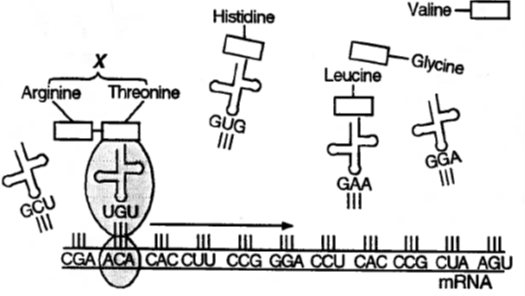
Transcription
Translation
Replication
All the above
49
Multiple Choice
transcription
rRNA
replication
translation
50
Multiple Choice
nucleus
cytoplasm
ribosome
mitochondria
51
Multiple Choice
The main function of tRNA is to
Carry a message that, when translated, forms proteins
Form a portion of ribosomes
String together complementary RNA and DNA strands
Carry amino acids to the ribosomes where they are joined to form proteins
52
Multiple Choice
The main function of mRNA is to
Copy DNA in the nucleus and carries the information to the ribosomes
Bring amino acids from the cytoplasm to the ribosomes
String together complementary RNA and DNA strands
Form a portion of ribosomes
53


PUTTIN’ IT ALL TOGETHER
DNA codes for proteins
Proteins are made during
protein synthesis
Transcription occurs in the
nucleus. The final product
of transcription is an
mRNA strand.
Translation occurs on the
ribosomes in the
cytoplasm. The final
product of translation is a
protein.
54


55


56

Overview
● When a particular protein is needed, the cell must make the
protein through the process of transcription and translation.
● DNA molecules (which contain the code) do not leave the
nucleus of the cell.
● Protein synthesis occurs on ribosomes located outside of the
nucleus.
● Therefore, the code must be carried from the nucleus to the
cytoplasm.
● RNA plays an important role in protein synthesis but it can also
have other functions in the cell.
○ mRNA is essential to the process of transcription, tRNA is
essential to the process of translation, and rRNA makes up
the ribosomes in which translation takes place.
57

Overview
●
Transcription is the process by which a portion of the molecule of
DNA is copied into a complementary strand of RNA. The process of
transcription takes place as follows:
○
An enzyme attaches to the DNA molecule at the gene of interest.
○
The two strands of DNA separate at that location.
○
Complementary RNA nucleotides bond to the nitrogenous bases on
one of the separated DNA strands.
○
The chain of RNA nucleotides forms a single-stranded molecule of
RNA by using the DNA strand as a template.
○
When a stop codon is reached, the RNA strand separates from the
DNA molecule, leaves the nucleus and goes through the nuclear
membrane into the cytoplasm.
○
The two DNA strands rejoin.
58

Overview
●
Translation is the process by which the genetic message, carried by the
mRNA, is used to assemble a protein.
○
The mRNA attaches to a ribosome, which contains proteins and ribosomal
RNA (rRNA). The function of ribosomes is to assemble proteins according
to the genetic message.
○
Each three-base nucleotide sequence on the mRNA is called a codon. Each
codon specifies a particular amino acid that will be used to build the
protein molecule. For example, if the DNA sequence was GAC, then the
RNA sequence becomes CUG (transcription) and the amino acid that is
coded is Leucine (translation).
○
Another type of RNA, transfer RNA (tRNA), brings amino acids to the
ribosome in the order specified by the codon sequence on the mRNA. At
one end of each tRNA is the anticodon, a region that consists of three
nucleotide bases that are complementary to the codon of mRNA. The
other end of the tRNA molecule binds to the specific amino acid that is
determined by the mRNA codon.
59

Overview
● The translation process takes place as follows:
○
The anticodon of the tRNA, with its attached amino acid, pairs
to the codon of the mRNA, which is attached to a ribosome.
○
When a second tRNA with its specific amino acid pairs to the
next codon in sequence, the attached amino acid breaks from
the first tRNA and is bonded to the amino acid of the second
tRNA.
○
The ribosome forms a peptide bond between the amino acids,
and an amino acid chain begins to form.
○
The empty tRNA moves off and picks up another matching
amino acid from the cytoplasm in the cell.
○
This sequence is repeated until the ribosome reaches a stop
codon on the mRNA, which signals the end of protein synthesis.
RNA & Protein
Synthesis Notes
Show answer
Auto Play
Slide 1 / 59
SLIDE
Similar Resources on Wayground

55 questions
Frases útiles en la clase
Presentation
•
9th - 12th Grade
56 questions
iGCSE 0654 - The Circulatory System
Presentation
•
9th - 12th Grade
54 questions
Ecosystem Ecology
Presentation
•
9th Grade - University
53 questions
Biomolecules
Presentation
•
9th - 12th Grade
54 questions
Gilded Age
Presentation
•
9th - 12th Grade
52 questions
3.3 Review for AICE Marine Exam
Presentation
•
9th - 12th Grade
54 questions
Introduction to Marine Biology Guided Notes
Presentation
•
9th - 12th Grade
53 questions
Tennessee Biology EOC
Presentation
•
9th - 12th Grade
Popular Resources on Wayground
10 questions
How much do you know about our Portrait of an Eagle?

Quiz
•
10th Grade
10 questions
Fast Food Slogans
Quiz
•
6th - 8th Grade
21 questions
Continents and Oceans
Quiz
•
6th Grade
20 questions
Parts of Speech
Quiz
•
5th Grade
16 questions
Subject & Predicate
Quiz
•
5th Grade
25 questions
Multiplication Facts
Quiz
•
5th Grade
12 questions
Map Skills
Quiz
•
3rd Grade
22 questions
Continents and Oceans
Quiz
•
5th Grade
Discover more resources for Biology
20 questions
Characteristics of Life
Quiz
•
9th - 10th Grade
10 questions
Exploring the 4 Major Macromolecules and Their Functions

Interactive video
•
9th - 12th Grade
20 questions
Cell organelles and functions
Quiz
•
10th Grade
20 questions
Cell Transport
Quiz
•
9th - 12th Grade
25 questions
photosynthesis and cellular respiration
Quiz
•
9th Grade
20 questions
Macromolecules
Quiz
•
10th Grade
16 questions
Population Ecology
Quiz
•
9th - 12th Grade
20 questions
Cell Organelles
Quiz
•
9th Grade