

The Middle Ages

Presentation
•
Social Studies
•
6th Grade
•
Medium

MARGARET JACKSON
Used 159+ times
FREE Resource
16 Slides • 8 Questions
1
The Middle Ages
Lesson 2: Feudalism and the Rise of Towns

2
Fuedal Order
When Charlemagne’s empire fell, Europe no longer had a powerful central government. Nobles who owned land became more powerful than kings. This led to a new system called feudalism. Under feudalism, nobles ruled and protected the people. In return, the people worked for the nobles. They fought in the noble’s army or farmed the noble’s land. By 1000, the kingdoms of Europe were divided into thousands of areas ruled by nobles. Most of these feudal territories were very small.
Feudalism was based on loyalty and duty. A lord was a high- ranking noble who had power. A vassal was a low-ranking noble who served a lord. The lord rewarded him with land called a fief. Many vassals were knights, or warriors in armor who fought on horseback.
3
Fuedal Order Cont....
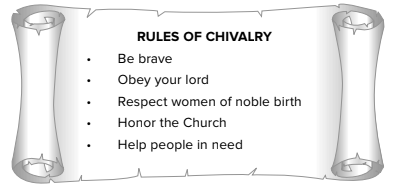
Knights lived according to a code called chivalry. They were expected to be honest and loyal. Knights trained for battle by holding competitions called tournaments. They were expected to fight fairly.
Nobles lived in castles—tall, stone buildings that served as forts and as homes. High stone walls surrounded the castle. Its buildings contained a storage area, stables for the horses, a kitchen, a great hall for eating and receiving guests, bedrooms, and a chapel. When nobles were away at war, their wives or daughters ran the estates.
4
5

6

Medieval Knights Jousting
7
Multiple Choice
a low-ranking noble who served a lord.
lord
vassal
fief
8
Multiple Select
What did people do in exchange for the protection of a noble?
fought in their army
educated their children
farmed their land
9
Open Ended
List one of the rules of behavior that knights followed?
10
The Medieval Manor
The fiefs of the Middle Ages were divided into farming communities called manors. The lord ruled the manor. Peasants worked the land.
There were two groups of peasants—freemen and serfs. Freemen paid the nobles for the right to farm the land. They had legal rights and could move when and where they wished. Most peasants were serfs. Serfs could not leave the manor, own property, or marry without the lord’s permission. However, lords could not sell the serfs.
11
The Medieval Manor Cont...
Lords protected their serfs. In return, serf worked long hours and gave their lord part of their own crops. It was not easy for serfs to gain freedom. They could run away to the towns. If a serf stayed in a town for more than a year without being captured, he or she was considered free. By the end of the Middle Ages, many serfs were allowed to buy their freedom.
New inventions made farming better. The most important was a heavy-wheeled plow with an iron blade. It easily cut through thick clay soil. The horse collar let a horse pull a plow. Horses were faster than oxen, so peasants could plant more crops. Peasants learned to rotate their crops. They planted only two of their three fields at a time. This kept the soil healthy, and more food could be grown.
12

13

14

Medieval Plow
15
Multiple Choice
a peasant who was tied to the land and its owner
serf
fief
lord
16
Open Ended
Why might a serf run away from a manor?
17
Multiple Select
Which inventions or changes helped medieval peasants grow more food.
the plow with an iron blade
the horse collar
the wheel
rake with an iron blade
rotate crops
18
The Growth of Towns and Cities
When the Roman Empire fell, almost all trade in Western Europe
stopped. By 1100, feudalism had made Europe safer. Trade began
again. As trade increased, towns grew. Many cities became
wealthy. Venice and other Italian cities began trading with the
Byzantine Empire. Soon Italian cities became the centers of trade
in the Mediterranean.
Towns in Flanders were the centers of trade for northern
Europe. Flanders is a region in Belgium today. Merchants from all
over western Europe met there to trade their goods for fine wool.
19
The Growth of Towns and Cities Cont...
Towns were usually built on land owned by nobles. They tried to control town business. Townspeople wanted to make their own laws. They forced nobles to give them basic rights. Over time, medieval towns set up their own governments.
Trade encouraged people to make things. Soon these craftspeople organized guilds, or business groups. Each craft had its own guild. Guilds set standards of quality for products, they set prices. and decided who could join a trade.
Medieval cities could be unpleasant and even dangerous places to live. The streets were narrow, dirty and smelly. Yet a city was also a place where people could earn a living.
20

Narrow streets in Medieval cities
21

Each Medieval Guild had its own symbol
22

23
Open Ended
How did the lives of freemen and serfs differ?
24
Multiple Choice
a group of merchants or craftspeople
general store
trade group
guild
The Middle Ages
Lesson 2: Feudalism and the Rise of Towns
Show answer
Auto Play
Slide 1 / 24
SLIDE
Similar Resources on Wayground

16 questions
Exploring the Impact: Human-Environment Interaction
Presentation
•
6th Grade
15 questions
East & Central Africa - History
Presentation
•
6th Grade
22 questions
The Social Structure of Ancient Egypt
Presentation
•
6th Grade
22 questions
Mesopotamia: The Rise of Babylonia and Assyria
Presentation
•
6th Grade
19 questions
Boston Tea Party
Presentation
•
6th Grade
19 questions
Neolithic Era
Presentation
•
6th Grade
17 questions
Ancient Egypt - Daily Life
Presentation
•
6th Grade
19 questions
Canada
Presentation
•
6th Grade
Popular Resources on Wayground
10 questions
How much do you know about our Portrait of an Eagle?

Quiz
•
10th Grade
10 questions
Fast Food Slogans
Quiz
•
6th - 8th Grade
21 questions
Continents and Oceans
Quiz
•
6th Grade
20 questions
Parts of Speech
Quiz
•
5th Grade
16 questions
Subject & Predicate
Quiz
•
5th Grade
25 questions
Multiplication Facts
Quiz
•
5th Grade
12 questions
Map Skills
Quiz
•
3rd Grade
22 questions
Continents and Oceans
Quiz
•
5th Grade
Discover more resources for Social Studies
10 questions
Exploring the Age of Exploration: Key Events and Figures

Interactive video
•
6th - 10th Grade
13 questions
13 Colonies Map Quiz
Quiz
•
6th - 8th Grade
12 questions
7 Continents and 5 Major Oceans
Quiz
•
6th Grade
10 questions
Pillars of Free Enterprise
Quiz
•
6th - 8th Grade
26 questions
QA 1 Review
Quiz
•
6th - 8th Grade
8 questions
Geography of Mesopotamia
Presentation
•
6th Grade
10 questions
Exploring the 13 Colonies Regions
Interactive video
•
6th - 10th Grade
20 questions
Latitude and Longitude Practice
Quiz
•
6th Grade