

Winds: Local and Global

Presentation
•
Science
•
6th Grade
•
Practice Problem
•
Medium
Standards-aligned

Belinda Robinson-phillips
Used 235+ times
FREE Resource
10 Slides • 12 Questions
1
Winds: Local and Global
2
WHY AIR MOVES
• What causes wind?
• What is the Coriolis effect?
• What are the major global wind systems on Earth?
3
What causes wind?
The wind is moving air caused by differences in air pressure.
Air moves from areas of high pressure to areas of
low pressure. The greater the pressure difference, the
faster the air moves, and the stronger the wind blows.
4
Multiple Choice
What causes wind?
differences in water
differences in gases
differences in air pressure
differences in oxygen
5
Multiple Choice
The greater the pressure difference, the _______ the air moves.
slower
faster
more natural
more it stop
6
Multiple Choice
The greater the pressure difference, the _________the wind blows.
stronger
weaker
calmer
gentler
7
What Are the Major Global Wind Systems?
Global winds are large-scale wind systems. There are three pairs of major global wind systems, or wind belts: trade winds, westerlies, and polar easterlies.
8
These Are the Major Global Wind Systems
Trade winds are wind belts that blow from 30° latitude almost to the equator. They curve to the west as they blow toward the equator. Westerlies are wind belts that are found between 30° and 60° latitude. The westerlies blow toward the poles from west to east. Most of the United States is located in the belt of westerly winds. These winds can carry moist air over the United States, producing rain and snow.
Polar easterlies are wind belts that extend from the poles to 60° latitude. They form as cold, sinking air moves away from the poles. In the Northern Hemisphere, polar easterlies can carry cold arctic air over the United States. This can produce snow and freezing weather.
9
Multiple Choice
What are the three main global wind belts?
The three main global wind belts are jet stream, mountain and valley breezes
The three main global wind belts are trade winds, westerlies, and polar easterlies.
The three main global wind belts are westerlies, jet stream, and valley breezes.
The tree main global wind belts are horse latitudes, doldrum, and trade wind.
10
Multiple Choice

TAKE A LOOK, Is air rising or sinking in areas of high pressure?
Rising
Sinking
11
Multiple Choice
The earth rotates faster near the _________.
Poles
Equator
12
Why Do Global Winds Curve?
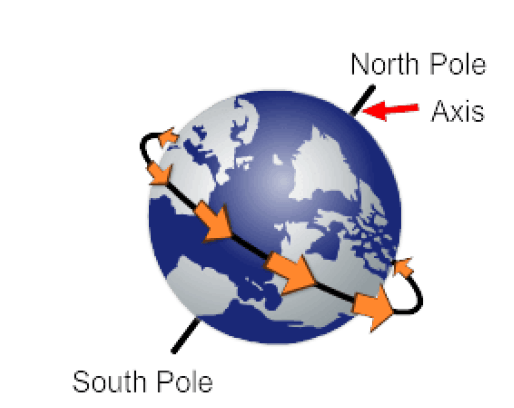
If Earth did not rotate, these winds would blow in straight lines. However, because the Earth does rotate, the winds follow curved paths.
The Earth’s rotation is called the Coriolis effect
As Earth rotates, places near the equator travel faster than places closer to the poles.
This difference in speed causes the Coriolis effect.
Wind moving from the poles to the equator is deflected to the west.
Wind moving from the equator to the poles is deflected east.
13
Multiple Choice
What is the Coriolis effect?
Apparent curving of the wind and ocean currents
The force of air on Earth’s surface
The transfer of thermal energy
The balance of incoming and outgoing energy
14
Multiple Choice
How does Earth’s rotation affect the paths of global winds?
The wind goes in a straight line
The wind goes in a curve line
15
Move to Canvas and complete the Global Wind Chart and Map
It should take 3 to 5 minutes.
16
What Are Local Winds?
The United State is mostly under the westerlies wind which means it blows from west to east. Nevertheless, the wind in our neighborhood does not always blow from the west to the east. Now you know, that global winds are not the only winds that blow.
Local winds are also important. These winds are winds that generally move over short distances and can blow from any direction. Like the other wind systems, local winds are caused by differences in temperature. Many of these temperature differences are caused by geographic features, such as mountains and bodies of water.
17
Multiple Choice
What is the difference between global winds and local winds.
Global winds blow in one direction, but local winds can blow in any direction.
Local winds blow in one direction, but global wind can blow in any direction.
There is no difference because the wind blows the same way.
18
Multiple Choice
Most of the United State, has what type of wind belt?
Trade winds
Westerlies
Polar easterlies
No wind belt
19
MOUNTAIN BREEZES AND VALLEY BREEZES
Earlier we learned about the sea and land breeze combo. Now, we are going to learn about the Mountain and Valley breezes combo. Mountain and valley breezes are other examples of local winds caused by geography. During the day, the sun warms the air on mountain slopes. The warm air rises up the mountain slopes, producing a warm valley breeze. At night, the air on the slopes cools. The cool air moves down the slopes, producing a cool mountain breeze.
20
Multiple Choice
What is most likely to cause local winds?
Convection cells
Polar winds
A shoreline or mountain
Westerlies
21
Multiple Choice
What are mountain breezes and valley breezes?
curving winds
global winds
local winds
jet streams
22
Move to Closing Video in Canvas
Mountain and Valley Breezes-Types of Local Wind
Winds: Local and Global
Show answer
Auto Play
Slide 1 / 22
SLIDE
Similar Resources on Wayground

19 questions
Erosion and Deposition by Water
Presentation
•
6th Grade
17 questions
Water cycle
Presentation
•
6th Grade
17 questions
Food Chain vs Food Web
Presentation
•
6th Grade
17 questions
Phases of the moon
Presentation
•
6th Grade
16 questions
Nervous System
Presentation
•
6th Grade
15 questions
Forces and motion
Presentation
•
6th Grade
19 questions
Elements and Compounds
Presentation
•
6th Grade
15 questions
Speed Calculation Review_2021
Presentation
•
6th Grade
Popular Resources on Wayground
10 questions
How much do you know about our Portrait of an Eagle?

Quiz
•
10th Grade
10 questions
Fast Food Slogans
Quiz
•
6th - 8th Grade
21 questions
Continents and Oceans
Quiz
•
6th Grade
20 questions
Parts of Speech
Quiz
•
5th Grade
16 questions
Subject & Predicate
Quiz
•
5th Grade
25 questions
Multiplication Facts
Quiz
•
5th Grade
12 questions
Map Skills
Quiz
•
3rd Grade
22 questions
Continents and Oceans
Quiz
•
5th Grade
Discover more resources for Science
10 questions
6.6D - Relative Density Review
Quiz
•
6th Grade
20 questions
Claim, Evidence and Reasoning (CER)
Quiz
•
6th - 8th Grade
20 questions
Density
Quiz
•
6th Grade
10 questions
Exploring Chemical and Physical Changes

Interactive video
•
6th - 10th Grade
20 questions
Food Chains & Food Webs
Quiz
•
5th - 7th Grade
18 questions
Interpreting Distance/Time Graphs
Quiz
•
6th Grade
10 questions
Decoding the Periodic Table of Elements
Interactive video
•
6th - 10th Grade
15 questions
Potential and Kinetic Energy
Quiz
•
6th Grade