Search Header Logo
Chem Unit 1 Remediation- Density & Mass-Vol Graphs (LStd1.3,1.4)

Chem Unit 1 Remediation- Density & Mass-Vol Graphs (LStd1.3,1.4)

Assessment

Presentation

Chemistry, Physics, Science

9th - 12th Grade

Easy

NGSS
MS-PS1-2, MS-PS3-1

Standards-aligned

Created by

John Wozniak (NCPS)

Used 8+ times

FREE Resource

25 Slides • 46 Questions

1
Chem - LStd 1.4 Remediation Lesson - Density

media

2

media

3

Multiple Choice

Which of the following is NOT a unit of density?

1

g/cm3

2

m3/g

3

g/ml

4

all are density units

4

Multiple Choice

Which of the following is NOT a unit of density?

1

kg/m3

2

m3/kg

3

kg/L

4

all are density units

5

media

6

media

7

media

8

Multiple Choice

A can of Coke will sink in a bowl of water.  A can of Diet Coke will float in a bowl of water.  What does this tell you about the density of the Diet Coke?
1
it is bigger than 1
2
it is smaller than 1
3
it is equal to 1
4
it is equal to -1

9

media

10

media

11

Multiple Choice

Question image
Put the liquids in order from most dense to least dense?
1
4, 3, 2, 1
2
1, 2, 3, 4
3
3, 4, 2, 1, 
4
4, 3, 1, 2

12

Multiple Choice

the substances that are more dense ____________

1

will sink below the less dense substances

2

will float on the less dense substances

13

Multiple Choice

The substances that are less dense ______________

1

will float on the less dense substances

2

will sink below the less dense substances

14

Multiple Choice

A Balloon containing helium gas floats in the air because

1

helium gas is more dense than air

2

helium gas is less dense than air

15

media

16

Multiple Choice

The formula to calculate DENSITY (g/cm3) is

1

MASS x VOLUME

2

MASS - VOLUME

3

MASS / VOLUME

4

VOLUME/ MASS

17

Multiple Choice

Frank has an eraser. It has a mass of 4g, and a volume of 2cm3. What is its density?
1
8 g/cm3
2
2 g/cm3
3
1/2 g/cm3
4
24 g/cm3

18

media

19

media

20

media

21

Volume of the Blue Rectangular Prism

V = 10cm x 8cm x 9cm = 7200 cm3

media

22

media

23

media

24

Multiple Choice

The volume of irregular objects can be determined by using

1

water displacement method

2

water replacement method

3

water level method

25

Multiple Choice

Which formula can be used to find the volume of a rectangular prism?
1
length x width
2
length x width x height
3
height x length
4
length + width + height

26

Multiple Choice

Question image

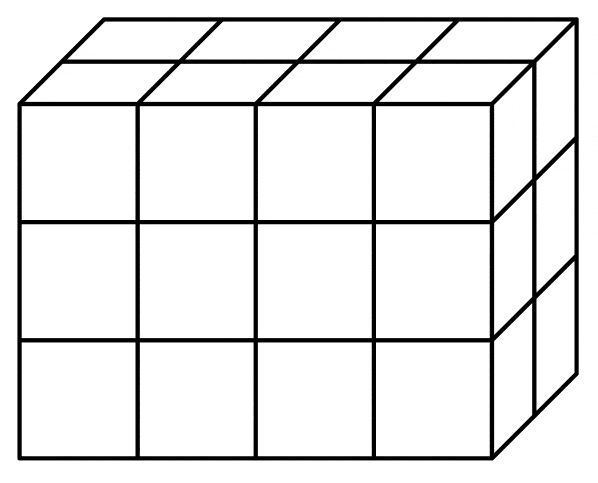
What is the volume of this rectangular prism?

1

26 cubic units

2

24 cubic units

3

24 square units

4

26 square units

27

Multiple Choice

Question image

Find the volume of the figure.

1

63 cm³

2

91 cm³

3

819 cm³

4

409.5 cm³

28

Multiple Choice

Question image

Each side of this ice cube measures 3 inches. What is the volume of the ice cube?

1

9 cubic inches (in3)

2

27 cubic inches (in3)

3

18 cubic inches (in3)

4

27 square inches (in2)

5

18 square inches (in2)

29

Multiple Choice

Question image

Each side of this ice cube measures 2 cm. What is the volume of the ice cube?

1

6 cm3

2

8 cm3

3

4 cm3

4

8 cm2

5

4 cm2

30

Multiple Choice

Steven finds the volume of a graduated cylinder with a penny in it. The volume was 43 mL. If the volume before the penny was added was 38 mL. Then what is the volume of the PENNY (=the displacement)?

1

43 mL

2

81 mL

3

38 mL

4

5 mL

31

Multiple Choice

Steven finds the volume of a graduated cylinder with a rock in it. The volume was 68 mL. If the volume before the rock was added was 41 mL. Then what is the volume displacement?

1

109 mL

2

68 mL

3

41 mL

4

27 mL

32

media

33

Multiple Choice

To calculate DENSITY, we must

1

take the amount of MASS in the object and DIVIDE it by the amount of VOLUME occupied by the object

2

take the amount of MASS in the object and MULTIPLY it by the amount of VOLUME occupied by the object

3

take the amount of MASS in the object and SUBTRACT it from the amount of VOLUME occupied by the object

4

take the amount of VOLUME occupied by the object and DIVIDE it by the amount of MASS in the object

34

Multiple Choice

Jack has a rock. The rock has a mass of 10 g and a volume of 2 cm3. What is the DENSITY of the rock?

1

5 mL

2

5 g/cm3

3

20 g/cm3

4

0.2 g/cm3

35

Multiple Choice

Jill also has a rock. Her rock has a mass of 2 g and a volume of 10 cm3. What is the DENSITY of the rock?

1

5 mL

2

5 g/cm3

3

20 g/cm3

4

0.2 g/cm3

36

Multiple Choice

Question image

Each side of this silver cube measures 2 cm. It has a mass of 84 g. What is the DENSITY of the silver cube?

1

42 g/cm3

2

10.5 g/cm3

3

21 g/cm3

4

8 square inches (in2)

37

media

38

media

39

0.5 g/cm3 x 800 cm3 = 400 g*cm3/cm3 = 400 g

media

40

Multiple Choice

When we solve the Density equation to find the Mass we see that MASS =

1

DENSITY x VOLUME

2

DENSITY / VOLUME

3

MASS / VOLUME

4

VOLUME / DENSITY

41

Multiple Choice

Jill has a rock. Her rock has a density of 2 g/cm3 and a volume of 10 cm3. What is the MASS of the rock?

1

20 g

2

20 g/cm3

3

5 g

4

0.2 g/cm3

5

0.2 g

42

Multiple Choice

Jack also has a rock. His rock has a density of 20 g/cm3 and a volume of 4 cm3. What is the MASS of the rock?

1

80 g

2

80 g/cm3

3

5 g

4

5 g/cm3

5

0.2 g

43

Multiple Choice

Question image

Each side of this silver cube measures 3 cm. It has a density of 10.5 g/cm3. What is the MASS of the silver cube?

1

31.5 g

2

94.5 g

3

283.5 g

4

0.29 g

5

0.028 g

44

media

45

media

46

(325 g) / (9.0 g/cm3) = 36.1 g/(g/cm3) = 36.1 g*(cm3/g) = 36.1 cm3

media

47

Multiple Choice

When we solve the Density equation to find the Volume we see that VOLUME =

1

DENSITY x MASS

2

DENSITY / MASS

3

MASS / VOLUME

4

MASS / DENSITY

48

Multiple Choice

Jill has a rock. Her rock has a density of 2 g/cm3 and a mass of 100 g. What is the VOLUME of the rock?

1

50 cm3

2

50 g/cm3

3

200 cm3

4

0.02 g/cm3

5

0.02 cm3

49

Multiple Choice

Jack also has a rock. His rock has a density of 10 g/cm3 and a mass of 20 g. What is the VOLUME of the rock?

1

200 cm3

2

2 g/cm3

3

2 cm3

4

0.5 g/cm3

5

0.5 cm3

50

Multiple Choice

Question image

This silver cube has a density of 10.5 g/cm3 and a mass of 210 g What is the VOLUME of the silver cube?

1

10.5 cm3

2

20 cm3

3

210 cm3

4

220.5 cm3

5

2205 cm3

51

media

52

media

53

media

54

Using a Mass Volume Graph to calculate the Density

"Making a Density Graph" video


Watch this short video

(copy the link and paste it into a new tab):

https://youtu.be/oVJPywo40Ps


55

Multiple Choice

Question image

For a Mass-vs-Volume graph, the slope of the line represents the _______________ of the substance.

1

volume

2

density

3

mass

4

length

56

Multiple Choice

Question image

Using this Mass-vs-Volume graph for Tin, calculate/find the density of Tin

1

10.0

2

7.3

3

4.8

4

3.0

57

Multiple Choice

Question image

Using this Mass-vs-Volume graph of Tin, what is the mass of a 1.20 cm3 sample?

1

0.20 g

2

1.20 g

3

8.75 g

4

10 g

58

Multiple Choice

Question image

Using this Mass-vs-Volume graph of Tin, what is the volume of a 5 g sample?

1

0.20 cm3

2

0.70 cm3

3

1.20 cm3

4

1.60 cm3

59

Multiple Choice

Question image

On a Mass-vs-Volume graph, the slope of the line represents the _______ of the substance

1

Density

2

Length

3

Mass

4

Volume

60

Multiple Choice

Question image

Using this Mass-vs-Volume graph, calculate/find the density of the substance

1

5.0 g/cm3

2

50.0 g/cm3

3

0.2 g/cm3

4

3.0 g/cm3

61

Multiple Choice

Question image

Using this Mass-vs-Volume graph, what is the volume of a 150 g sample?

1

10.0 cm3

2

20.0 cm3

3

30.0 cm3

4

40.0 cm3

62

Multiple Choice

Question image

Using this Mass-vs-Volume graph, what is the MASS of a 20.0 cm3 sample?

1

5 g

2

10 g

3

40 g

4

50 g

5

100 g

63

Multiple Choice

Question image

This is a Mass-vs-Volume graph of substances A, B, C, and D.


The slope of the line for Substance C represents the _______________ of Substance C.

1

volume

2

density

3

mass

4

length

64

Multiple Choice

Question image

Using this Mass-vs-Volume graph for Substances A, B, C, and D... Which substance has the highest density?

1

D

2

C

3

B

4

A

65

Multiple Choice

Question image

Using this Mass-vs-Volume graph for Substances A, B, C, and D... Which substance has the lowest density?

1

D

2

C

3

B

4

A

66

Multiple Choice

Question image

If you have EQUAL VOLUME samples of 4 different substances, which sample would have the largest MASS?

1

The sample with the HIGHEST DENSITY

2

The sample with the LOWEST DENSITY

67

Multiple Choice

Question image

Using this Mass-vs-Volume graph for Substances A, B, C, and D... If you have 10 cm3 samples of each substance, which sample would have the largest MASS?

1

D

2

C

3

B

4

A

68

Multiple Choice

Question image

If you have EQUAL MASS samples of 4 different substances, which sample would have the largest VOLUME?

1

The sample with the HIGHEST DENSITY

2

The sample with the LOWEST DENSITY

69

Multiple Choice

Question image

Using this Mass-vs-Volume graph for Substances A, B, C, and D... If you have 25g samples of each substance, which sample would have the largest VOLUME?

1

D

2

C

3

B

4

A

70

Multiple Choice

What is the MASS of a 10 cm3 sample of lead if lead has a density of 11.3 g/cm3?

1

0.88 g

2

1.13 g

3

113 g

4

1130 g

71

Multiple Choice

What is the VOLUME of a 10 g sample of lead if lead has a density of 11.3 g/cm3?

1

0.88 cm3

2

1.13 cm3

3

113 cm3

4

1130 cm3

Chem - LStd 1.4 Remediation Lesson - Density

media

Show answer

Auto Play

Slide 1 / 71

SLIDE