

Phylum Mollusca Notes

Presentation
•
Biology, Science
•
10th - 12th Grade
•
Practice Problem
•
Medium
Standards-aligned

Teresa Schlueter
Used 57+ times
FREE Resource
38 Slides • 32 Questions
1

2
Mollusk or mollusc means soft body
Mollusks are soft-bodied animals that usually have an internal or external shell.

3
Mollusks include snails, slugs, clams, squids, and octopi.
Many Mollusks share similar developmental stages.
4
Multiple Choice
What is the Latin meaning of the word Mollusca?
Soft-bodied
Stomach foot
Head-footed
Two-shelled
5
Multiple Choice
In a mollusk the shell can be
internal and external
only internal
only external
internal, external or absent
6
1.Body has two parts: head-foot and visceral mass
2.Mantle that secrets a calcareous shell that covers the visceral mass
3.Mantle cavity functions in excretion, gas exchange, elimination of digestive wastes, and release of reproductive products
7
4.Bilateral symmetry
5.All Molluscs have a soft body, and most Molluscs have an internal or external shell.


8
6. Protostome characteristics
spiral and determinate cleavage
mouth forms from blastopore
7. Eucoelom reduced to cavities surrounding the heart, nephridia, and gonads

9
8. Open circulatory system in all but one class (Cephalopoda)
9. Radula usually present and used in scraping food

10
Multiple Choice
11
Multiple Choice
12
Multiple Choice
True or false : All mollusks except those in the class Cephalopoda have an open circulatory system.
true
false
13
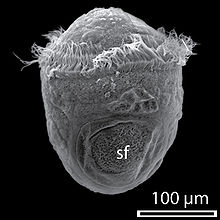
Many aquatic Mollusks have a free-swimming larval stage called a trochophore.
The trochophore larva is also characteristic of annelids, indicating that these two groups may be closely related.

14
Multiple Choice
15
Multiple Select
How are Mollusks similar to Annelids? (select all that apply)
Bilaterally symmetrical
True Coelomate
Segmented
Trochophore Larva
16
Mollusks have eucoelom (true coeloms) surrounded by mesoderm tissue
They have complex, interrelated organ systems that function together to maintain the body as a whole
they are more complex than flatworms and roundworms
17
Multiple Choice
Which of the following is the correct description of the body cavity of Mollusks?
They are protostome acoelomates
They are protostome coelomates
They are deuterostome coelomates
They are protostome pseudocoelomates
18
The body plan of most Mollusks has four parts:
Head - foot – contains mouth, nervous and sensory structures, foot used for attachment and locomotion
Mantle – attached to visceral mass and overlies the visceral mass
Shell – used for protection
Visceral mass – contains organs for digestion, circulation, reproduction, and excretion
19
Multiple Choice
Which of the following would contain the vital organs of a mollusk?
Visceral mass
Mantle
Head
Foot
20
The muscular foot takes many forms
flat structures for crawling
spade-shaped structures for burrowing
tentacles for capturing prey


21
Feeding
Mollusks can be herbivores, carnivores, filter feeders, detritivores, or parasites.
Snails and slugs feed using a flexible, tongue-shaped structure known as a radula.

22
Hundreds of tiny teeth are attached to the radula.
The radula is used to scrape algae off rocks or to eat the soft tissues of plants.


23
Clams, oysters, and scallops use gills.
Food is carried by water, which enters the incurrent siphon.


24
A siphon is a tube-like structure through which water enters and leaves the body.
The water flows over the gills while the food and oxygen are pulled out of it. and leaves by the excurrent siphon.

25
Multiple Choice
26
Multiple Select
The muscular foot of a mollusks can take many forms, each with different function. Select all the forms the foot can take with their correct function.
tentacles for grabbing and capturing prey
ridged for gathering particles
broad and flat for crawling
spade-shaped for digging and burrowing
round and thick for smashing
27
Multiple Choice
28
Multiple Choice
How do Bivalves eat?
Filter feeders
Radula
Tentacles
Beak
29
Multiple Choice
30
•Aquatic Mollusks breathe using gills inside their mantle cavity.
•As water passes through the mantle cavity, oxygen in the water moves into blood flowing through the gills.

31
•At the same time, carbon dioxide moves in the opposite direction.
•Land snails and slugs respire (breath) using a mantle cavity that has a large surface area lined with blood vessels.

32
Some Mollusks have open circulatory systems (slow moving mollusks);
other Mollusks have closed circulatory systems (fast moving mollusks).

33
A closed circulatory system can transport blood through an animal’s body more quickly than an open circulatory system.
In an open circulatory system, blood is pumped through incomplete vessels by a simple heart.
34
Multiple Choice
35
Multiple Choice
36
Two-shelled Mollusks have a simple nervous system.
3 sets of ganglia
2 sets of nerve cords.

The complexity of the nervous system and the ability to respond to environmental conditions varies among Mollusks.
37
Well-developed brains in these animals allows them to remember things for long periods.

Octopi and their relatives have the most highly developed nervous system of all invertebrates.
38
Snails secrete mucus along the base of the foot, and then move over surfaces using a rippling motion of the foot.
Octopus draws water into the mantle cavity and then forces the water out through a siphon.
Water leaving the body propels the octopus in the opposite direction.
39
Some Mollusks reproduce sexually by external fertilization.
In other Mollusks, fertilization takes place inside the body of the female.
Some Mollusks are hermaphrodites and usually fertilize eggs from another individual.
40
Multiple Choice
Mollusks are the first phylum that have all of the following well-developed systems except?
Digestive
Excretory
Circulatory
Nervous
41
Class: Gastropoda (gastro = stomach, poda = foot)
Gastropods are shell-less or single-shelled Mollusks that move by using a muscular foot located on the ventral side.


42
Many gastropods have a single shell that protects their bodies.
When threatened, they can pull completely into their shells

Gastropods include:
pond snails, land slugs, sea butterflies, sea hares
43

Torsion
only occurs in Gastropods
twisting of the body 180 O during development
44
Multiple Choice
Gastropods can twists the body round so that the anus, reproductive organs, mantle cavity and gills all point forward. What it is called?
Fusion
Torsion
Excretion
Respiration
45
Multiple Choice
46
Multiple Choice
47
Class: Bivalvia (bi = two, valve = shell)
Bivalves have two shells that are held together by one or two powerful muscles called adductor muscles.


48
Common bivalves include:
Clams, oysters, mussels, scallops


49
Multiple Choice
How are pearls formed?
All bivalves form them as part of their lives!
Irritant gets between shell & mantle and is covered with nacre
Pearls are result of retained digestive wastes
Extension of the shell formed for extra protection
50
Multiple Choice
51
Multiple Choice
52
Multiple Choice
53
Class: Cephalopoda (cephalo = head, poda = foot)
Cephalopods are typically soft-bodied Mollusks in which the head is attached to a single foot.
foot is divided into tentacles or arms.

54
Cephalopods have eight or more tentacles equipped with sucking disks that grab and hold prey.
Most modern cephalopods have only small internal shells or no shells at all.

55
The only present-day cephalopods with external shells are nautiluses.


56
Specialized cells called Chromatophores that allow them to camouflage themselves in their environment are present in the mantle of cephalopods.


57
Cephalopods have complex sense organs that help them detect and respond to external stimuli.
Cephalopods distinguish shapes by sight using complex eyes and texture by touch.

58
Only Class with direct development

Cephalopods include:
Squid, Octopi, Cuttlefish, and Nautilus

59
Multiple Choice

60
Multiple Choice
61
Multiple Choice
62
Multiple Choice
63
Multiple Choice
64

65

66

67

68
Multiple Select
Name the THREE groups of Mollusks.
Gastropods
Arthropods
Cephalpods
Bivalves
69
Multiple Choice
70
Multiple Choice
Show answer
Auto Play
Slide 1 / 70
SLIDE
Similar Resources on Wayground

61 questions
cells 2022
Presentation
•
9th Grade - University
67 questions
Blood Vessels and Blood Pressure
Presentation
•
9th - 12th Grade
65 questions
Biomolecules
Presentation
•
11th Grade
64 questions
Proportional Parts in Triangles
Presentation
•
9th - 12th Grade
65 questions
Biology EOC part 1: Molecular and Cellular bio.
Presentation
•
9th - 12th Grade
69 questions
Parts and Function of a Cell
Presentation
•
11th Grade
65 questions
AP Gene Expression from Gene to Protein
Presentation
•
9th - 12th Grade
65 questions
AP Biology FRQ Friday Tips and Tricks
Presentation
•
9th - 12th Grade
Popular Resources on Wayground
10 questions
Safety Day 2026 – Student Review

Quiz
•
9th Grade
21 questions
Continents and Oceans
Quiz
•
6th Grade
20 questions
Parts of Speech
Quiz
•
5th Grade
16 questions
Subject & Predicate
Quiz
•
5th Grade
25 questions
Multiplication Facts
Quiz
•
5th Grade
12 questions
Map Skills
Quiz
•
3rd Grade
22 questions
Continents and Oceans
Quiz
•
5th Grade
15 questions
Rounding Decimals
Quiz
•
5th Grade
Discover more resources for Biology
20 questions
Cell organelles and functions
Quiz
•
10th Grade
20 questions
Cell Transport
Quiz
•
9th - 12th Grade
8 questions
DNA vs. RNA
Presentation
•
9th - 12th Grade
20 questions
Macromolecules
Quiz
•
10th Grade
20 questions
Characteristics of Life
Quiz
•
9th - 10th Grade
15 questions
Photosynthesis and Cellular Respiration
Quiz
•
10th Grade
16 questions
Epithelial tissues
Quiz
•
11th - 12th Grade
15 questions
DNA Structure and Replication
Quiz
•
9th - 12th Grade