
The Shakespearean Sonnet
Presentation
•
English
•
9th - 12th Grade
•
Practice Problem
•
Easy
+4
Standards-aligned
Shannon Frantz
Used 50+ times
FREE Resource
18 Slides • 13 Questions
1
The Shakespearean Sonnet
Be sure to review all information presented in the slides and complete all of the questions to earn credit for this assignment.
2
Navigate to and watch the video below.
Be sure to focus on the Shakespearean Sonnet characteristics.
https://www.youtube.com/watch?v=_cd60K0uiDY
3
Multiple Choice
How many lines does a sonnet have?
four
two
fourteen
sixteen
4
Multiple Choice
Another name for a Shakespearean sonnet is a(n)...
Italian Sonnet
English Sonnet
Petrarchan Sonnet
Love Sonnet
5
The Shakespearean Sonnet Format
Made up of 14 lines
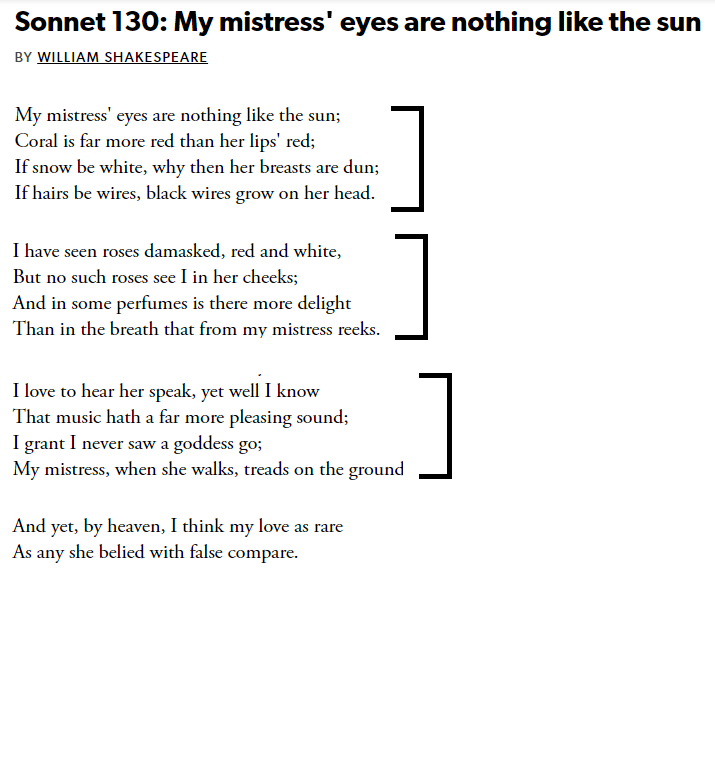
Has a total of 4 verses: 3 quatrains (3 verses that are 4 lines each) followed by 1 couplet (1 verse that is 2 lines)
6
Look at the verses of Sonnet 130.
How would you label the annotated verses? (Record your response on the next slide.)
7
Fill in the Blank
What would you label the annotated verses from the previous slide a COUPLET or a QUATRAIN?
8
Multiple Choice
How many lines make up a couplet?
three
four
one
two
9
Navigate to and watch the video below.
Be sure to focus on iambic pentameter.
https://www.youtube.com/watch?v=I5lsuyUNu_4
10
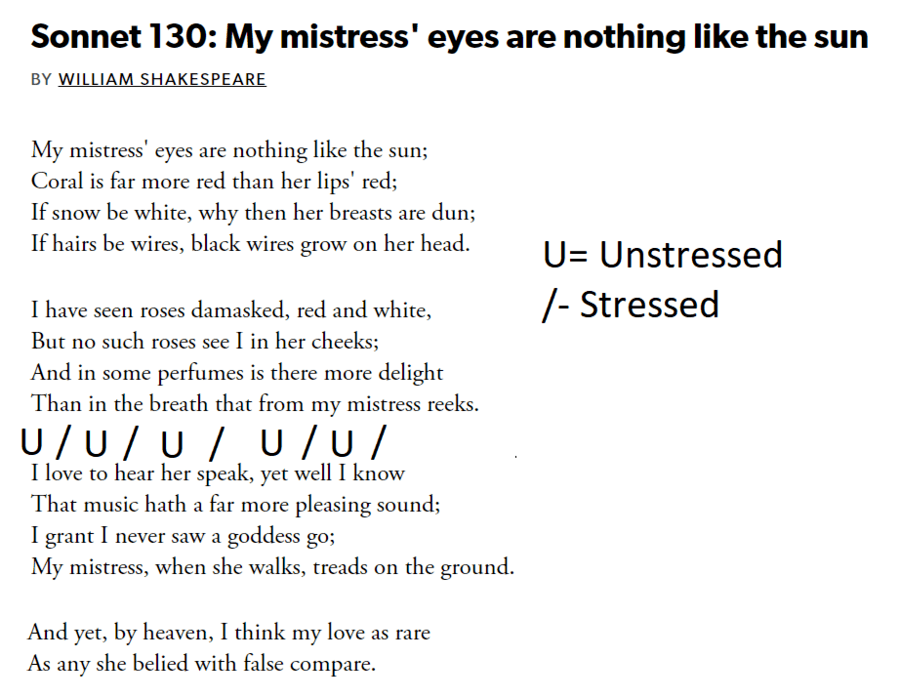
Shakespearean Sonnets are written in Iambic Pentameter.
Meter is the the rhythm of the poem, like the beat to music. Sonnets use a specific format: iambic pentameter.
Each line is made up of 5 iambs (hint: penta=5).
An iamb is two syllables, where the first is unstressed and the second is stressed (emphasized - think how it comes out more forcefully from your mouth).
That means each line of a sonnet is 10 syllables, if you clap them out.
11
Look at the structure of Sonnet 130.
Which comes first in iambic pentameter: the stressed or unstressed syllable? (Record your response on the next slide.)
12
Fill in the Blank
What comes first in iambic pentameter: the STRESSED or UNSTRESSED syllable?
13
Multiple Choice
How many syllables make up an IAMB?
10
5
2
1
14
Navigate to and watch the video below.
Be sure to focus on how to label rhyme scheme.
https://www.youtube.com/watch?v=68sZEkw4k2M
15
Shakespearean Sonnet - Rhyme
A rhyme scheme - Looks at the sequence and arrangement of sounds at the end of each line of poetry. It is usually represented by using letters to demonstrate which lines rhyme with which.
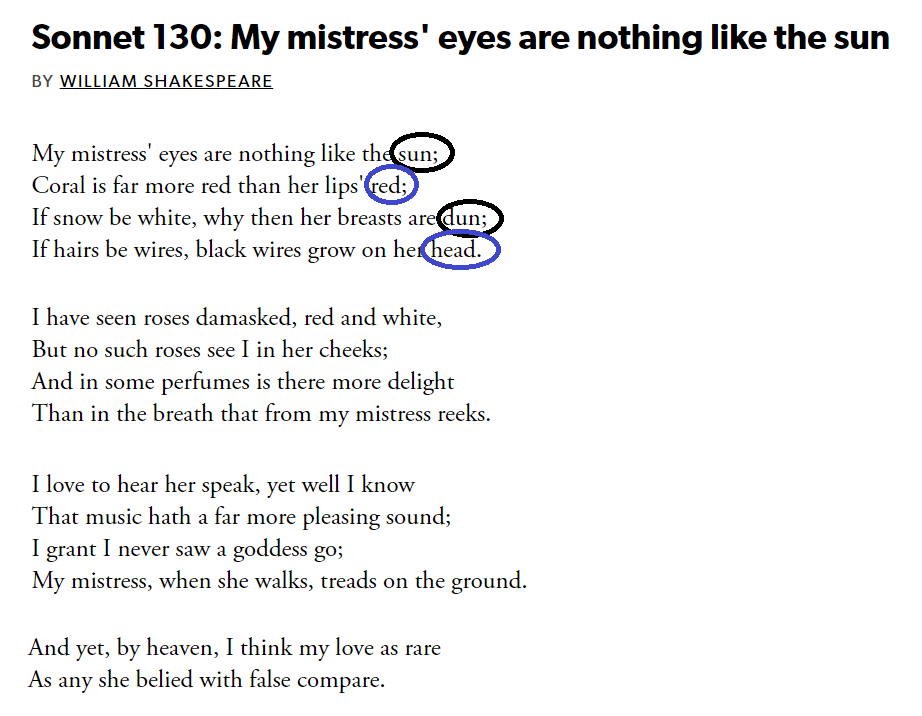
Shakespearean Sonnets have a particular rhyme scheme: ABAB, CDCD, EFEF, GG
16
Look at the format of Sonnet 130.
How would you label the rhyme scheme for the first verse? (Record your response on the next slide.)
17
Multiple Choice
The rhyme scheme of the first verse would be...
AABB
ABAB
BABA
GG
18
Shakespearean Sonnet - Additional Structures
Shakespearean Sonnets are typically about love.
Each sonnet includes a volta, or turning point.
.The lines leading up to the volta introduces a problem or a question.
The lines after the volta provides a solution or answer.
19
Read Sonnet 130.
What is the speaker's problem with his mistress? (Record your response on the next slide.)
20
Open Ended
What is the problem that the speaker has with his mistress?
21
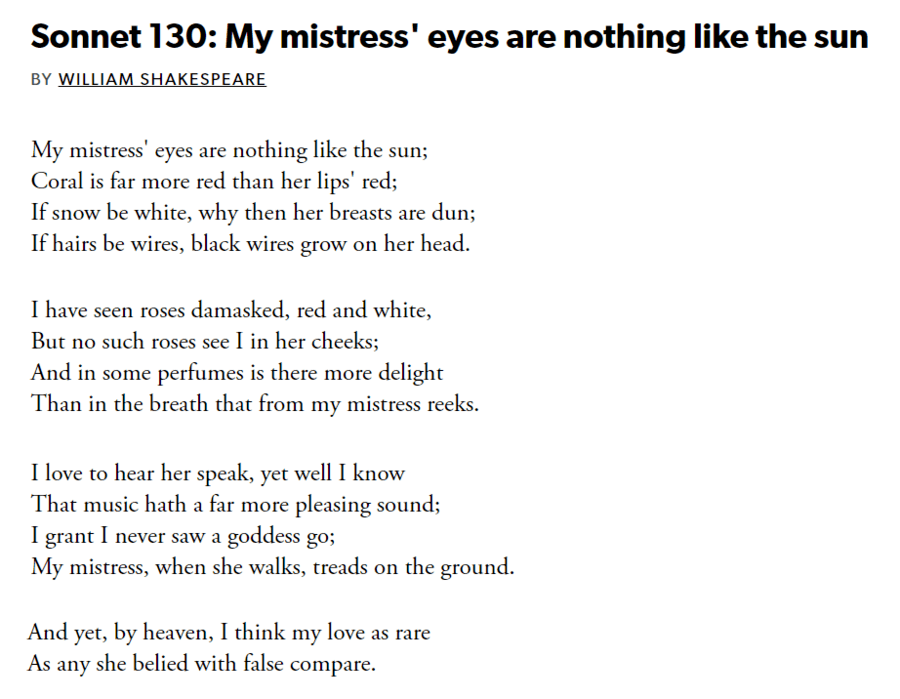
Re-Read Sonnet 130.
What does the speaker reveal in the couplet? (Record your response on the next slide.)
22
Open Ended
In the couplet, what does the speaker reveal about his mistress?
23
Re-Read Sonnet 130.
What is structure is missing in this poem? (Record your response on the next slide.)
24
Multiple Choice
The following structure is missing from Sonnet 130:
Problem
Solution
Volta
25
What do these lines mean?
"And in some perfumes is there more delight/Than in the breath that from my mistress reeks."
26
Open Ended
"And in some perfumes is there more delight/Than in the breath that from my mistress reeks." In my own words, these lines mean:
27
What do these lines mean?
"And yet, by heaven, I think my love as rare/As any she belied with false compare."
28
Open Ended
"And yet, by heaven, I think my love as rare/As any she belied with false compare." In my own words, these lines mean:
29
Why write something so structured?
Humans like rhythm and rhyme - our brains are hardwired to enjoy poetry and music.
Sonnets give repetition and variety - these qualities make people comfortable, but keeps interest.
Sonnets give boundaries/rules - structure is also something our brains like.
30
Navigate to and watch the video below.
Be sure to focus on how The Sonnet Man's summary of Sonnet 130.
https://www.youtube.com/watch?v=h1tg_WBUY28&t=246s
31
Open Ended
Sonnet 130 is a bit insulting to the mistress. What would YOU say to or about someone that you love?
The Shakespearean Sonnet
Be sure to review all information presented in the slides and complete all of the questions to earn credit for this assignment.
Show answer
Auto Play
Slide 1 / 31
SLIDE

Similar Resources on Wayground
21 questions
Oro A1 Entrance Test
Lesson
•
KG
20 questions
Prepositional Phrases
Lesson
•
9th - 12th Grade
23 questions
Elements of Fairy Tales
Lesson
•
9th - 12th Grade
27 questions
Poetry & Maya Angelou
Lesson
•
9th - 12th Grade
25 questions
Sentences, Fragments, and Run-Ons
Lesson
•
9th - 12th Grade
23 questions
Ethos. Pathos. Logos. Period 2
Lesson
•
9th - 12th Grade
23 questions
Passive Voice
Lesson
•
9th - 12th Grade
21 questions
making a claim
Lesson
•
9th - 12th Grade
Popular Resources on Wayground
10 questions
5.P.1.3 Distance/Time Graphs
Quiz
•
5th Grade
10 questions
Fire Drill
Quiz
•
2nd - 5th Grade
20 questions
Equivalent Fractions
Quiz
•
3rd Grade
15 questions
Hargrett House Quiz: Community & Service
Quiz
•
5th Grade
20 questions
Main Idea and Details
Quiz
•
5th Grade
20 questions
Context Clues
Quiz
•
6th Grade
20 questions
Inferences
Quiz
•
4th Grade
15 questions
Equivalent Fractions
Quiz
•
4th Grade
Discover more resources for English
18 questions
Informative or Argumentative essay
Quiz
•
5th Grade - University
20 questions
Figurative Language Review
Quiz
•
10th Grade
20 questions
Grammar
Quiz
•
9th - 12th Grade
21 questions
College Trivia!
Quiz
•
11th - 12th Grade
18 questions
Figurative Language Review
Quiz
•
9th Grade
30 questions
ACT Grammar Prep 1
Quiz
•
9th - 12th Grade
10 questions
Test Taking Strategies for State Reading Assessments
Interactive video
•
6th - 10th Grade
10 questions
Mastering the Comma: Essential Punctuation Skills
Interactive video
•
6th - 10th Grade