Search Header Logo
Q3: WEEK 1-2  (DESCRIBING MOTION)

Q3: WEEK 1-2 (DESCRIBING MOTION)

Assessment

Presentation

Physics

7th Grade

Medium

Created by

Florence Domingo

Used 10+ times

FREE Resource

28 Slides • 20 Questions

1

WEEK 1

Describing motion

Slide image

2

WEEK 1 OBJECTIVES

After this lesson, you should be able to:

  • Differentiate quantities in terms of magnitude and direction.


  • Describe the motion of an object in terms of distance or displacement, speed or velocity, and acceleration.


  •   Create and interpret visual representation of the motion of objects such as tape charts and motion graphs.


3

DEFINITION OF TERMS:

(please take note of the ff.terms)

  • Physical quantity (noun)- A property that is measured [e.g. mass, length, time, temperature]. 


4

DEFINITION OF TERMS

  • MAGNITUDE (noun) - refers to the numerical value of a measurement.

  • Unit (noun)- Any standard used for making comparisons in measurements [e.g. kg, meter, seconds, Celsius)

Slide image

5

SCALAR VS. VECTOR

The various quantities (Length, Mass, Time, Distance, Speed etc.) that we can observe in nature have the characteristics of being a scalar quantity or vector quantity. 

6

SCALAR VS. VECTOR

  • A SCALAR QUANTITY is a quantity that can be completely described

     by a MAGNITUDE ONLY. Quantities such as

    length (meter), mass(kilogram), time (second), temperature (Celsius),

    distance (meter) Speed ( meter/second) are scalar quantities. They tell you

     the magnitude or value of the quantity they measure but not the direction. 

Slide image

7

SCALAR VS. VECTOR

  • A VECTOR QUANTITY is a quantity that tells us both the magnitude (numerical value and unit) and direction (North, East, South, West). 

Slide image

8

Slide image

9

SCALAR VS. VECTOR

  • Click the play button on the right and jot down important details.

10

Multiple Choice

A quantity that has both magnitude and direction is called a scalar quantity.
1
True
2
False

11

Multiple Choice

What is magnitude?
1
The direction that describes a quantity.
2
A numerical value
3
A unit of force

12

Multiple Choice

A deer running 15 meters per second due west.Vector or scalar?

1

Scalar

2

Vector

13

Multiple Choice

Wind blowing at 20 mph.Vector or scalar?

1

Scalar

2

Vector

14

Describing motion by distance and displacement (How far?)

There are terms we use in Physics (Science that deals with the properties and interaction of space, time, matter, and energy) that appear to be similar. Did you notice the terms Distance and displacement on Scalar and Vector lesson? They appear to be similar right? They both measure distance. But they have different meaning. 

15

DISTANCE VS. DISPLACEMENT

  • DISTANCE is a scalar quantity(MAGNITUDE ONLY). It measures the length travelled by a moving object or body. Its unit can be meter, kilometer, miles etc. DISPLACEMENT on the other hand is a vector quantity (MAGNITUDE AND DIRECTION) and its unit can also be meter, kilometer, miles etc. 

Slide image

16

DISTANCE VS. DISPLACEMENT

  • If the cube moves from point A to B by 10 centimeter and moves 2 cm to point C, then the cube’s total distance is 12 cm while its displacement is 12 cm to the right. If the cube moves from point C to D by 6 cm then the cube’s total distance is 18cm while its displacement is

    6cm to the left. 

Slide image

17

DISTANCE VS. DISPLACEMENT

  • Notice that distance only includes the magnitude, and it does not

    provide the direction and the total of all lengths are simply added regardless of the direction. Displacement on the other hand includes the magnitude and direction and the total depends on the direction. If the cube moves back to its original position the displacement will be 0. 

Slide image

18

DISTANCE VS. DISPLACEMENT

  • Click the play button of the video on the right and take note of the important information.

19

Multiple Choice

Question image

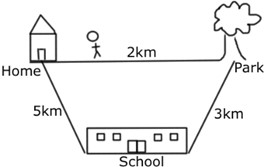
Jerry walked from home to school, then from the school to the park. What is his total distance?

1

2 km

2

5 km

3

8 km

4

10 km

20

Multiple Choice

Bill runs 400 meters to Andy's house, turns around, and runs 400 meters back home. What is Bill's distance?

1

0 meters

2

400 meters

3

800 meters

4

1600 meters

21

Multiple Choice

Jermaine runs exactly 2 laps around a 400 meter track. What is the displacement?

1

800

2

400

3

0

4

200

22

Describing motion by how fast an object covers a distance or displacement

-Motion is defined as change in position. But how do we say that an object is in motion?


-To say that there is a change in position, we must look at a reference point. A REFERENCE POINT or FRAME OF REFERENCE is something that is not moving upon which we can tell whether an object moves. 

23

REFERENCE POINT

  • In Figure 1, the ball is positioned on top of the table, while in figure 2 the same ball is under the table. Therefore, we can say that the ball had been in motion and that, there is a change in position by referring to the table which is not moving as a frame of reference. We can say that there is no motion if it is the table that moves and the ball remains on top of it as in figure 1. 

Slide image

24

REFERENCE POINT

  • Click the play button of the video on the right and take note of important details.

25

Describing motion

Now that you know the fundamentals of motion

let us proceed to the 3 ways of describing motion: SPEED, VELOCITY AND ACCELERATION. 

26

SPEED, VELOCITY AND ACCELERATION

  • Click the play button of the video on the right and take note of the important information.

27

Multiple Choice

Which of the following is a measurement of velocity?
1
16 m east
2
25 m/s2
3
55 m/h south
4
60 km/h

28

Multiple Choice

Question image

Reese can run 10 meters in 5 seconds. What is her speed?

1

5 meters/sec

2

2 meters/sec

3

5 miles/hour

4

2 miles/hour

29

Multiple Choice

What is velocity?
1
the quickness of an object
2
the location of an object
3
acceleration
4
speed in a specific direction

30

Multiple Choice

What is speed?

1

It is how far you go

2

It is the distance traveled over a period of time

3

It is how fast you accelerate

4

It is the change in the postilion of a object

31

SPEED, VELOCITY AND ACCELERATION

  • Click the play button of the video on the right and take note of the important information.

32

Multiple Choice

Question image
A box sliding down an inclined plane attains a velocity of 27 m/s in 3 seconds from rest.  Find the acceleration.
1
30 m/s
2
24 m/s2
3
9 m/s2
4
81 km/hr

33

VISUAL REPRESENTATION OF MOTION

Visual representation of motion is another way of describing the motion of an object thru graphs. It is a quick way to describe the motion of an object.

34

Slide image

35

MOTION GRAPHS

  • Please click the play button of the video at the right side of this slide.

36

Slide image

37

Slide image

38

Multiple Choice

Question image

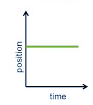
Describe the motion of the object in the graph

1

Moving with constant speed

2

Speeding up

3

Not moving

39

Multiple Choice

Question image
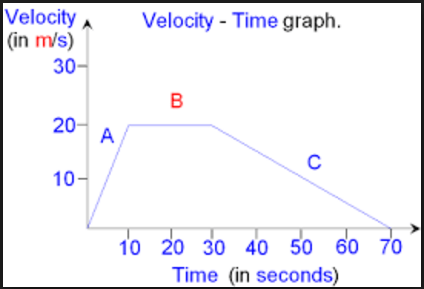
This is a velocity-time graph.  What is the object doing in segment B?
1
Positive acceleration
2
Negative acceleration
3
Constant Velocity
4
Not moving

40

Multiple Choice

Question image

This is a velocity-time graph. What is the object doing in segment A?

1

Speeding up

2

Slowing down

3

Constant Velocity

4

Not moving

41

Fill in the Blank

Question image

LEARNING TASK 1: Which among the quantities from the choices is an example of speed?

42

Fill in the Blank

Question image

LEARNING TASK 1: Which among the quantities from the choices is an example of velocity?

43

Fill in the Blank

Question image

LEARNING TASK 1: Which among the quantities from the choices is an example of acceleration?

44

Fill in the Blank

Question image

LEARNING TASK 1: Which among the quantities from the choices is an example of distance?

45

Fill in the Blank

Question image

LEARNING TASK 1: Which among the quantities from the choices is an example of displacement?

46

LEARNING TASK 2

  • DIRECTION: Solve the following problems. Follow the 3 steps in solving motion problems. SHOW YOUR SOLUTION. (5 points each problem.) 

  • Write your answer on a sheet of paper then upload the picture to the Google Form.

Slide image

47

LEARNING TASK 3

  • DIRECTION: Complete the graph below by plotting the data of time and distance on the table then PROVIDE AN INTERPRETATION OF THE RESULTING GRAPH. (10 pts)

  • Write your answer on a sheet of paper then upload the picture to the Google Form.

Slide image

48

LEARNING TASK 4

  • DIRECTION:  Draw a road sign on a bond paper then explain how it helps prevent road accidents by relating it to the concepts of speed, velocity, and acceleration. Upload the picture to the Google Form.(10 pts)

Slide image

WEEK 1

Describing motion

Slide image

Show answer

Auto Play

Slide 1 / 48

SLIDE