

Gas Laws - Dalton's Partial Pressure

Presentation
•
Chemistry
•
9th - 12th Grade
•
Medium
Standards-aligned

Michaela Bratsch
Used 95+ times
FREE Resource
7 Slides • 10 Questions
1

2

3

4
5
6

7

8
Multiple Choice
Dalton's law equation is used to find what?
the density of a pure gas
the total pressure of a pure gas
the total pressure of a gas mixture
the volume of a gas mixture
9
Multiple Choice
What does gas pressure depend on?
size of the container and type of gas
number of particles and average kinetic energy
size of container and average mass
the type of gas in the container
10
Multiple Choice
What variables must be kept constant in Dalton's law?
the number of moles
liters and volume
temperature and volume
temperature only
11
Multiple Choice
In a mixture of gases, each gas contributes to the total pressure. The individual contribution of each gas is known as the _________________.
partial volume
partial pressure
molar mass
mole ratio
12
Multiple Choice
A tank of gas contains 50 kPa of helium, 50 kPa of argon, and 100 kPa of neon. What is the total pressure of the gas mixture?
100 kPa
50 kPa
200 L
200 kPa
13
Multiple Choice
A container holds a mixture of two different gases. The oxygen in a container exerts 80 mmHg of pressure on the inside of the container. The total pressure inside the container is 120 mmHg. What is the pressure of the other gas in the container?
200 mmHg
80 mmHg
40 mmHg
120 mmHg
14
Multiple Choice
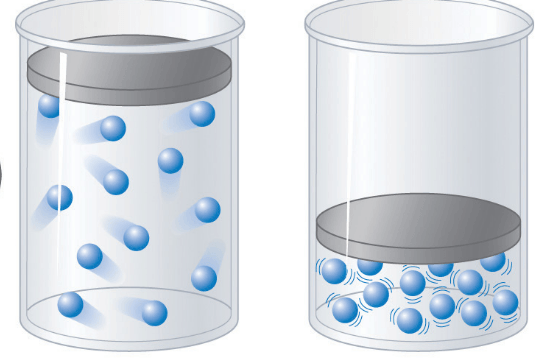
Which container will have a lower pressure?
left
right
they both have the same pressure
I don't know
15
Multiple Choice
A mixture of hydrogen, nitrogen, and water vapor has a total pressure of 864 mmHg. The partial pressure of hydrogen is 220 mmHg and that of nitrogen is 410 mmHg. What is the partial pressure of water vapor?
234 mmHg
1.37 mmHg
2.64 mmHg
1, 494 mmHg
16
Multiple Choice
Three gases, Ar, N2 and H2 are mixed in a 500L container. Ar has a pressure of 255 torr, N2 has a pressure of 228torr and H2 has pressure of 752torr. What is the total pressure in the container?
483torr
270torr
1235torr
17
Multiple Choice
Dalton's Law states...
that at a constant temperature the volume of a confined ideal gas varies inversely with its pressure.
that the total pressure exerted by the mixture of non-reactive gases is equal to the sum of the partial pressures of individual gases
how gases tend to expand when heated
that the density of an ideal gas at constant pressure varies inversely with the absolute temperature of the gas.
Show answer
Auto Play
Slide 1 / 17
SLIDE
Similar Resources on Wayground

13 questions
Solving Logarithmic Equations
Presentation
•
9th - 12th Grade
11 questions
P-T Diagram Group Practice
Presentation
•
9th - 12th Grade
14 questions
Acid Naming & Formula Writing
Presentation
•
10th - 11th Grade
12 questions
Writing Linear Equations From Two Points
Presentation
•
9th - 12th Grade
12 questions
Resumes Pre-knowledge
Presentation
•
9th - 12th Grade
12 questions
3A Gramática : -ER and -IR regular verbs
Presentation
•
KG - 12th Grade
11 questions
Quadrilaterals
Presentation
•
9th - 12th Grade
11 questions
Factoring: Quadratic Trinomial when a=1
Presentation
•
9th - 12th Grade
Popular Resources on Wayground
10 questions
How much do you know about our Portrait of an Eagle?

Quiz
•
10th Grade
10 questions
Fast Food Slogans
Quiz
•
6th - 8th Grade
21 questions
Continents and Oceans
Quiz
•
6th Grade
20 questions
Parts of Speech
Quiz
•
5th Grade
16 questions
Subject & Predicate
Quiz
•
5th Grade
25 questions
Multiplication Facts
Quiz
•
5th Grade
12 questions
Map Skills
Quiz
•
3rd Grade
22 questions
Continents and Oceans
Quiz
•
5th Grade
Discover more resources for Chemistry
20 questions
Metric Conversions
Quiz
•
11th Grade
20 questions
electron configurations and orbital notation
Quiz
•
9th - 12th Grade
26 questions
Atomic Structure, Isotopes and Ions
Quiz
•
10th Grade
20 questions
Periodic Trends
Quiz
•
10th Grade
5 questions
Atomic Theory Intro Video

Interactive video
•
10th Grade
20 questions
COUNTING ATOMS
Quiz
•
10th Grade
20 questions
Practice: E-Con, Orbital Notation, Noble Gas Notation
Quiz
•
10th Grade
11 questions
Balancing Chemical Equations
Presentation
•
9th Grade