Search Header Logo
Marine Science Ch 6

Marine Science Ch 6

Assessment

Presentation

Science

9th Grade

Medium

Created by

Nikkole Wowaka

Used 4+ times

FREE Resource

47 Slides • 63 Questions

1

Marine Science Ch 6
Slide image

2

Slide image

3

Multiple Choice

What do we call a chemical substance made up of 2 or more different types atoms bonded together?
1
formula
2
atom
3
subscript
4
compound

4

Multiple Choice

What are the basic building blocks for all matter?

1

atoms

2

elements

3

compounds

4

chemicals

5

Slide image

6

Multiple Select

Organic molecules that make up living things are all made from which 3 elements?

1

hydrogen

2

nitrogen

3

oxygen

4

carbon

5

calcium

7

Slide image

8

Multiple Choice

carbohydrates are used for

1

growth

2

energy

3

structure

4

insulation

5

DNA and RNA

9

Slide image

10

Multiple Choice

This is one job proteins do NOT have in the body
1
storing genetic information
2
structure
3
speed up chemical reactions
4
transport things through cell membrane

11

Multiple Choice

What is a protein:

1

A polymer composed of many sugars.

2

A polymer composed of many amino acids.

3

A polymer composed of fatty acids.

4

A polymer composed of nucleotides.

12

Slide image

13

Multiple Choice

Lipids are composed of which atoms?

1

Hydrogen, Oxygen, Nitrogen

2

Hydrogen, Oxygen, Carbon

3

Oxygen, Nitrogen, Carbon

4

Oxygen, Nitrogen, Hydrogen

14

Multiple Choice

An example of a nucleic acid is

1

amino acid

2

DNA

3

sugar

4

wax

15

Slide image

16

Multiple Choice

What is the function of nucleic acids?

1

store energy (long-term)

2

store energy (short-term)

3

build skin, hair, nails, muscles

4

store genetic information

17

Multiple Choice

Question image

Which of the following elements does a Nucleic Acid have that a Carbohydrate and Lipid do not?

1

Carbon

2

Oxygen

3

Hydrogen

4

Nitrogen

18

Slide image

19

Fill in the Blank

what is released as a by product of photosynthesis

20

Slide image

21

Slide image

22

Multiple Choice

an organism that gets its carbohydrates by consuming other organisms is called a(n)

1

autotroph

2

heterotroph

23

Slide image

24

Multiple Choice

In which way are photosynthesis and cellular respiration different?
1
Cellular respiration stores ATP, while photosynthesis releases ATP.
2
Cellular respiration produces oxygen, while photosynthesis uses oxygen.
3
Photosynthesis releases energy, while cellular respiration stores energy.
4
Photosynthesis uses carbon dioxide, while cellular respiration produces carbon dioxide.

25

Multiple Choice

Question image

What two products does a plant make during photosynthesis?

1

Water and Glucose

2

Oxygen and Glucose

3

Oxygen and Water

4

CO2 and Glucose

26

Slide image

27

Multiple Choice

autotrophs/primary producers that produce most of the worlds oxygen are mostly found it

1

tropical forests

2

aquatic ecosystems

3

temperate forests

4

wetlands

28

Slide image

29

Multiple Choice

phosphates and nitrates are

1

organic molecules

2

inorganic molecules

30

Slide image

31

Multiple Select

all living organisms are divided into which 2 groups based on cellular structure?

1

eukaryotes

2

prokaryotes

3

animals

4

plants

32

Slide image

33

Multiple Choice

Humans are

1

prokaryotic

2

eukaryotic

34

Slide image

35

Multiple Choice

prokaryotes don't have a nucleus

1

true

2

false

36

Slide image

“Illustration of a prokaryotic cell having a plasma membrane inside a cell wall. Inside the cell wall there are photosynthetic membrane folds containing chlorophyll. The cell contains cytoplasm, scattered ribosomes, cytoskeletals and a ringlike molecule of DNA.”

37

Multiple Choice

eukaryotes are ONLY multicellular

1

true

2

false

38

Slide image

39

Multiple Select

Eukaryotes can be separated into which 2 groups

1

animal cells

2

bacterial cells

3

marine organism cells

4

plant cells

5

reptilian cells

40

Slide image

Typical cells of animals and algae and plants, and some of the structures they contain. Shared structures include Golgi apparatus, cell membrane, cytoskeleton, nucleus, ribosomes, endoplasmic reticulum, citoplasm and mitochondria. Algae and plant cells also include cell walls chlorplasts and vacuoules.

41

Multiple Choice

What does DNA stand for?

1

Deoxyribonucleic acid

2

Denitrogenous acid

3

Deribonucleic acid

4

Diribonucleic acid

42

Slide image

43

Multiple Choice

The sugar in DNA is ?
1
sucrose
2
glucose
3
deoxyribose
4
fructose

44

Multiple Choice

Which of the following monomers are repeatedly joined together to form a strand of DNA?

1

amino acids

2

nucleotides

3

fatty acids

4

polysaccharides

45

Slide image

46

Multiple Choice

the smallest level of organization is

1

atom

2

cell

3

organelle

47

Slide image

48

Multiple Choice

a group of cells functioning as a unit

1

cell

2

molecule

3

organ

4

tissue

5

organ system

49

Slide image

50

Multiple Choice

which includes more things in it

1

ecosystem

2

community

51

Slide image

52

Multiple Choice

movement of substances in water

1

osmosis

2

diffusion

53

Slide image

Two beakers showing a crystal of salt dissolving in water. The ions in the first beaker start out concentrated in one part of the solution. but eventually spread out because of their random movement (illustrated in the second beaker).

54

Multiple Choice

A student noticed that placing wilted lettuce in a bowl of cool water caused the lettuce to become more crisp and firm. What is the best explanation for his observation?
1
Water moved into the lettuce cells by active transport.
2
Water moved into the lettuce cells by osmosis.
3
Salt moved into the lettuce cells by diffusion.
4
Water moved out of the lettuce cells by osmosis.

55

Multiple Choice

Question image
Where is there a high concentration of water?
1
in the flower
2
cannot be determined by picture.
3
in the vase
4
in the leaves

56

Slide image

57

Multiple Choice

Question image
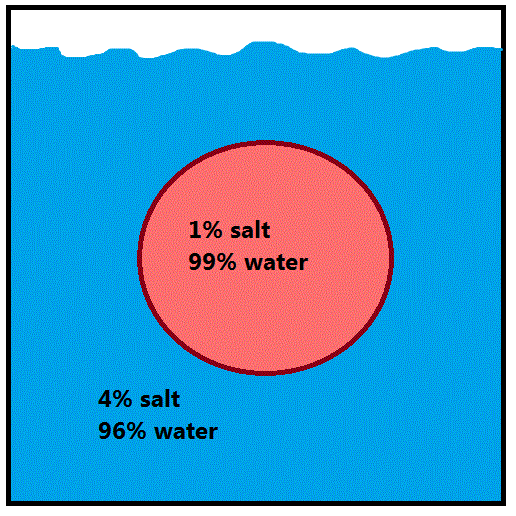
The cell is 99% water. The surrounding is salty. Where will the water go?
1
Into the cell
2
Out of the cell
3
Equally in & out 

58

Slide image

59

Multiple Choice

Body fluid change with the salinity around an organism, as seen in mollusks and worms is known as an:

1

Anadromous

2

Osmoconformer

3

Brackish

4

Osmoregulator

60

Multiple Choice

The ability to keep the concentration of an animal’s body fluids more or less constant is known as an:

1

Osmoconformer

2

Brackish

3

Osmoregulator

4

Salt wedge

61

Slide image

62

Multiple Choice

which can tolerate a larger range of salinities?

1

osmoconformers

2

osmoregulators

63

Slide image

Illustration of the regulation of salt and water balance comparing marine fish and freshwater fish. The marine fish drinks seawater and it excretes as little urine as possible to conserve water. Some salts pass through the gut without being absorbed. Salts that are absorbed are excreted, mostly through the gills but also in the urine. Freshwater fish do not drink and they produce large amounts of dilute urine. Salts are absorbed by the gills to replace those lost in the urine.

64

Multiple Choice

which fish urinates more?

1

freshwater

2

saltwater

65

Slide image

66

Multiple Choice

what are humans?

1

endotherm

2

ectotherm

67

Multiple Choice

what are fish?

1

endotherm

2

ectotherm

68

Slide image

69

Multiple Choice

what are fish?

1

poikilotherm

2

homeotherm

70

Multiple Choice

what are humans?

1

poikilotherm

2

homeotherm

71

Slide image


72

Multiple Choice

if you are a poikilotherm you also have to be an ectotherm

1

true

2

false

73

Slide image

74

Multiple Choice

How does the DNA of the offspring formed from asexual reproduction compare to the parent?

1

none of the DNA is transferred to the offspring

2

half of the DNA is transferred to the offspring

3

the DNA of the offspring is identical to the DNA of the parent

4

none of these are correct

75

Slide image

76

Multiple Choice

Which of these is NOT an advantage of asexual reproduction.

1

Enables organisms to reproduce without a mate

2

Requires less time and energy

3

Results in little genetic variation

4

Enables organisms to produce large amounts of offspring

5

Enables plants to spread and colonize an area in a short period of time

77

Multiple Choice

Occurs when an animal offspring grows from a piece of its parent.

1

fission

2

budding

3

mitotic cell division

4

regeneration

5

vegetative

78

Multiple Choice

Question image

What type of reproduction is happening in this hydra?

1

binary fission

2

parthenogenesis

3

fragmentation/regeneration

4

vegetative propagation

79

Multiple Choice

Which of the following is an example of binary fission?

1

An unfertilized egg develops into a worker or drone in a bee hive.

2

A starfish is cut into two pieces. Each piece forms into a whole starfish.

3

A seed from an apple germinates.

4

A bacterial cell undergoes mitosis.

80

Multiple Choice

During asexual reproduction in a certain organism, a new organism begins to form on the adult's body. Eventually, when the new organism is large enough, it breaks off from the adult and lives separately. This type of reproduction is known as

1

parthenogenesis.

2

binary fission.

3

budding.

4

regeneration/fragmentation.

81

Slide image

82

Multiple Choice

___________ reproduction has the advantage of increasing genetic variation.

1

Sexual

2

Asexual

3

Fission

4

Budding

83

Slide image

84

Multiple Choice

Sexual reproduction results in

1

Genetically unique offspring

2

Genetically identical offspring

85

Multiple Choice

Spawning that causes eggs and sperm to be released in the water column is called

1

local spawning

2

broadcast spawning

3

internal spawning

4

Column spawning

86

Slide image

87

Multiple Choice

Do sharks do external or internal fertilization?

1

external

2

internal

88

Multiple Choice

Most sponges are hermaphrodites.  What does this mean?
1
sponges can produce their own food
2
sponges can produce both eggs and sperm
3
sponges cannot reproduce
4
sponges can swim around

89

Slide image

90

Multiple Choice

gradual change in the genetic makeup of a population over time

1

natural selection

2

mutation

3

selective breeding

4

evolution

91

Slide image

92

Multiple Choice

Which term refers to the process by which individuals that are better suited to the environment survive and reproduce therefore passing down their genes to their offspring?

1

Evolution

2

Variation

3

Adaptation

4

Natural Selection

93

Slide image

94

Multiple Choice

Which scientist visited the Galapagos Islands and came up with the theory of natural selection?

1

Theodor Schwann

2

Gregor Mendel

3

Charles Darwin

4

Rudolf Virchow

95

Slide image

96

Multiple Choice

the gene pool changes as a result from pressures from

1

random events

2

natural disasters

3

the environment

4

mutations

97

Slide image

98

Multiple Choice

Question image

Who first proposed binomial nomenclature as a way of classifying organisms?

1

Carolus Linnaeus

2

Aristotle

3

Charles Darwin

4

Louis Pasteur

99

Multiple Choice

___ shows the relationship between species
1
Classification
2
Visible similarity
3
Family history
4
Biology

100

Slide image

101

Multiple Choice

Question image

What is the correct order of taxonomy?

1

Kingdom, pylum, class, species, genus, family, class

2

Species, genus, family, order, class, phylum, kingdom

3

Kingdom, phylum, class, order, family, genus, species

4

species, phylum, order, class, kingdom, family, genus

102

Slide image

103

Multiple Choice

Binomial nomenclature is the ____________ system for naming organisms.

1

Numerical

2

Symbolical

3

two word

4

alphabetical

104

Slide image

105

Multiple Choice

Question image

What is the common ancestor of Letters A, B, C, D, E?

1

1

2

2

3

3

4

4

106

Slide image

107

Multiple Choice

Question image

Phylogeny is usually represented by a tree diagram called a _________ - _____

1

Genetic Line

2

Phylogenetic Tree

3

Photographic Queue

4

Future Babies

108

Multiple Choice

Question image

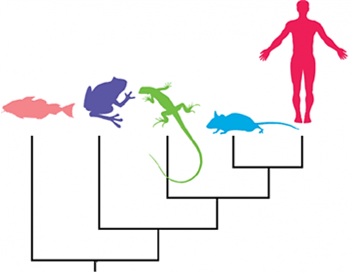
According to this phylogenetic tree, which creature is the least related out of all pictured?

1

Fish

2

Frog

3

Salamander

4

Human

109

Slide image

Illustration of the major groups of living things, including prokaryotes and eukaryotes. Eukaryotes include Kingdom Animalia, Kingdom Fungai, Kingdom Plantae, and Protista. Prokaryotes include Domain Bacteria, Domain Archae and Domain Eukarya.

110

Multiple Choice

The written set of choices leading to an organism's name is a(n)

1

Cladogram

2

Instructions

3

Dichotomous key

4

Binomial nomenclature

Marine Science Ch 6

Slide image

Show answer

Auto Play

Slide 1 / 110

SLIDE