
Plate Tectonics Review
Presentation
•
Science
•
8th Grade
•
Medium
+2
Standards-aligned
Tyanna Bailey
Used 9+ times
FREE Resource
10 Slides • 34 Questions
1
Plate Tectonics Review
By : Ms. Bailey*
2
Multiple Choice
Who came up with the theory of Pangaea?
Werner
Wegener
Newton
Darwin
3
Multiple Choice
This was the supercontinent that existed 500 million years ago
Gondwala
Pandora
Pangaea
Panama
4
5
Multiple Choice
What type of boundary is shown?
convergent
divergent
transform
6
Multiple Choice
What type of boundary is shown
convergent
divergent
transform
7
Multiple Choice
What type of plate boundary is shown?
convergent
divergent
transform
8
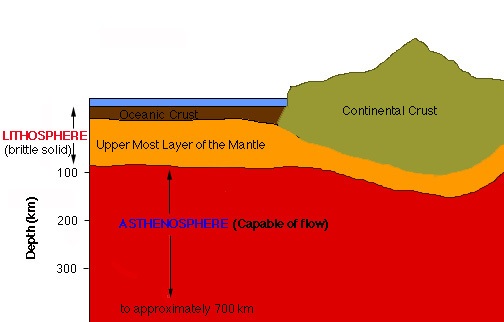
The lithosphere is broken into Tectonic Plates
The lithosphere is made from the crust and the uppermost part of the mantle
The lithosphere is rigid, brittle rock
These plates float on the asthenosphere
9
10
How do the plates ACTUALLY MOVE?
Convection currents in the asthenosphere drive the movement of lithospheric plates
11
12
How does a convection cell occur?
Hot magma in the asthenosphere begins to rise, similar to the way hot air rises.
As it rises to the top of the asthenosphere, it cools and becomes more dense.
This cooler, dense magma then sinks again. As it sinks, it gets warmer, until the process begins again
This movement of magma is what drives the plates to move.
13
Multiple Choice
When two plates converge and subduction happens, it tends to form
earthquakes
volcanoes
mountains
rift valleys
14
Multiple Choice
An earthquake occurs at a:
convergent boundary
divergent boundary
transform boundary
15
Multiple Choice
Tectonic plates are made of the:
lithosphere
asthenosphere
mesosphere
crust
16
Multiple Choice
This causes plate tectonics
conduction in the mantle
radiation from the Sun
convection in the outer core
convection in the mantle
17
Multiple Choice
At this type of boundary, plates collide with each other
convergent
divergent
transform
18
Multiple Choice
At this type of boundary, plates slide past each other
convergent
divergent
transform
19
20
Multiple Choice
The San Andreas Fault, where strong earthquakes occur, is an example of a
convergent boundary
divergent boundary
transform boundary
21
Multiple Choice
When one layer of crust (usually oceanic) sinks back into the mantle because of differences in density, it is called:
subtraction
density
volcanoes
subduction
22
Multiple Choice
At this type of boundary, plates move away from each other
convergent
divergent
transform
23
Multiple Choice
This tectonic plate slips past each other nor creating or destroying land formations: _____________
Divergent boundary
Transform boundary
Convergent boundary
Mid-Ocean boundary
24
Multiple Choice
This tectonic plate boundary creates mountain ranges: ____________________
Divergent boundary
Convergent boundary
Transform boundary
Mid-oceanic boundary
25
Multiple Choice
This plate boundary moves land apart, creating an ocean trench or a valley on land : ________________________
Divergent boundary
Transform boundary
Convergent boundary
Mid-Ocean voundary
26
Multiple Choice
Oceans plates sink back into the mantle at _______________ zones, keeping the crust the same size.
Mid-ocean ridges
Ocean trenches
Subduction
Transforming
27
Multiple Choice
We live closer to the _________________ mid- ocean ridge.
Atlantic
Pacific
North American
Californian
28
29
Multiple Choice
Other evidence include __________________ that plate tectonics does occurr in the crust of the Earth.
Rock formation, weather, fossils
Mountain formation, fossils, climate
Land features, fossils, climate
Valleys, Ocean trenches, climate
30
Multiple Choice
The evidence is in ______________________, where coastlines and mountain ranges appear to fit together like a puzzle all over the world
Continental drift
Plate Tectonics
The Rock Cycle
Divergent boundaries
31
Multiple Choice
Plate Tectonics supports the idea that all continents were once fused together called _____________ .
The rock cycle
Supercontinent
The crust
Pangea
32
Multiple Choice
The rock cycle is driven in part by _________________.
The Earth's mantle
The Earth's core
The Earth's tectonic plates
The Earth's rock cycle
33
Multiple Choice
The Andes Mountains formed when the Nazca plate and the South American plate:
converged
diverged
transformed
34
Multiple Choice
The San Andreas Fault, where strong earthquakes occur, is an example of a
convergent boundary
divergent boundary
transform boundary
35
Multiple Choice
What type of boundary is shown
convergent
divergent
transform
36
Multiple Choice
What type of boundary is shown?
convergent
divergent
transform
37
38
Multiple Choice
39
Multiple Choice
Which is the fastest type of seismic wave?
p-waves
s-waves
surface waves
40
Multiple Choice
The instrument used to record earthquakes is a(n)________.
Richter magnitude
Modified Mercalli
Seismograph
Seismogram
41
Multiple Choice
42
Multiple Choice
The epicenter of an earthquake is the point on Earth's surface directly below the focus.
False
True
43
Multiple Choice
44
Multiple Choice
_________ is another word for an earthquake's strength.
Intensity
Frequency
Magnitude
Pressure
Plate Tectonics Review
By : Ms. Bailey*
Show answer
Auto Play
Slide 1 / 44
SLIDE

Similar Resources on Wayground
39 questions
Newton's First Law
Presentation
•
8th Grade
41 questions
Earth/Space Review 3-Sun+moon+Earth
Presentation
•
8th Grade
35 questions
Newton's Laws of Motion
Presentation
•
8th Grade
38 questions
History of Technology
Presentation
•
8th Grade
40 questions
EID 1.5 Ecological Succession
Presentation
•
8th Grade
38 questions
Science 7 Year End Review - Unit B
Presentation
•
7th Grade
40 questions
12/1 - Newton's 2nd Law of Motion
Presentation
•
8th Grade
35 questions
Life Science Review for Benchmark
Presentation
•
8th Grade
Popular Resources on Wayground
10 questions
Oak Hills High School Policy and Success Quiz
Passage
•
9th Grade
11 questions
Hallway & Bathroom Expectations
Quiz
•
6th - 8th Grade
15 questions
School Bus Safety Questions
Quiz
•
6th Grade
25 questions
AJHS Scavenger Hunt
Quiz
•
6th Grade
20 questions
Lab Safety Quiz
Quiz
•
6th Grade
22 questions
would you rather
Quiz
•
3rd - 11th Grade
29 questions
Laboratory Safety Rules
Quiz
•
6th Grade
21 questions
Continents and Oceans
Quiz
•
6th Grade
Discover more resources for Science
20 questions
Lab Safety review
Quiz
•
8th Grade
20 questions
Lab Safety
Quiz
•
5th - 8th Grade
10 questions
Lab Safety Essentials
Interactive video
•
6th - 10th Grade
15 questions
Lab Safety
Presentation
•
6th - 8th Grade
20 questions
Semester 1: Unit 1: Characteristics of Life
Quiz
•
6th - 8th Grade
24 questions
Flinn Lab Safety Quiz
Quiz
•
5th - 12th Grade
18 questions
Atoms
Quiz
•
8th Grade
20 questions
Properties of Water
Presentation
•
6th - 8th Grade