

Active and Passive Voice

Presentation
•
English
•
8th - 12th Grade
•
Practice Problem
•
Hard

CHETNA CHANGLANI
Used 43+ times
FREE Resource
19 Slides • 0 Questions
1
Active and Passive Voice

2
What is Active Voice?
A sentence in the active voice is structured traditionally:
subject + verb + object.
3

4
Example
Beth stubbed her toe.
In each of these sentences, the subject does the action of the verb, and the object of the sentence receives that action.
Beth, the subject, does the stubbing. Her toe receives the stubbing (and hurts a lot).
5
What Is Passive Voice?
A sentence is in the passive voice when the word that is the recipient of the action is the subject of the sentence.
The opposite of the active voice is the passive voice.
object + verb + subject
6

7
Example
The toe was stubbed by Beth.
Now, the nouns receiving the actions are the subjects of these sentences.
Instead of thinking about Beth, now we’re focusing on her toe.
8

9

10
Passive Voice
Note that in each sentence, there is a form of to be + a past participle.
That’s a dead giveaway that the sentence is in passive voice.
If the subject of a sentence is being acted upon by an outside force, the sentence is in passive voice.
11

12
When to Use Active Voice
It’s bold. “Beth stubbed her toe” is more clear, direct, and interesting than “The toe was stubbed by Beth.” Get straight to the point and engage your readers with active voice.
It’s precise. “Country music is sometimes hated” conveys less information than “People sometimes hate country music.” You could expand it to say “Country music is sometimes hated by people,” but that makes the sentence more clunky. Just use active voice.
It’s succinct. Sentences in active voice are often shorter than their passive-voice counterparts. Cut the fluff and tighten your prose with active voice.
13
When to Use Passive Voice
1. When you don’t know who did the action.The plate didn’t fall on its own—it was dropped on the floor.
But who dropped the plate? No one knows.
2. When the person who did the action isn’t important.In this experiment, the eggs were placed in vinegar overnight.
The experiment with the eggs is the important bit; mentioning the person who did it would be distracting.
3. When you want your readers to focus on the object of the action.All the fruit in the pantry is covered in mold.
The focus in this sentence is on the fruit, not the mold. (Although if you were standing in that pantry, your focus would probably be on the mold.)
14
How to change an active voice sentence to a passive voice sentence

15
How to change an active voice sentence to a passive voice sentence
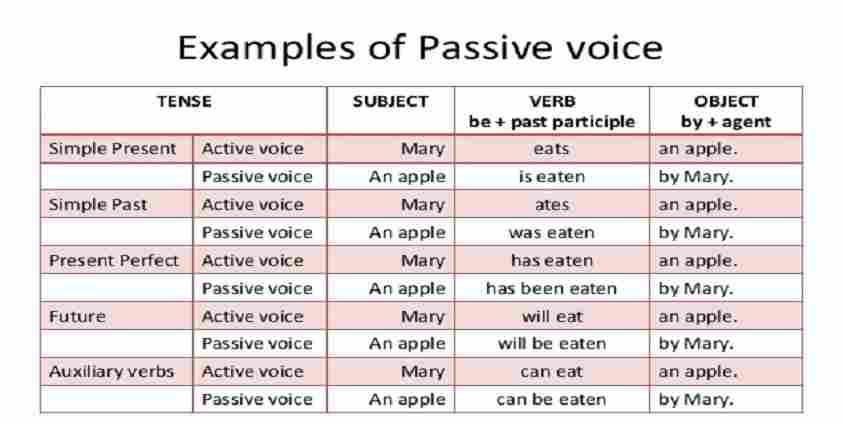
Make the object of the active sentence into the subject of the passive sentence.
Use the verb “to be” in the same tense as the main verb of the active sentence.
Use the past participle of the main verb of the active sentence.
16
Examples
Active Voice ------------------------------------------- Passive Voice
I eat an apple. ---------------------------- An apple is eaten by me.
He bought a car. ------------------------- A car was bought by him.
17

18
19

Active and Passive Voice
Show answer
Auto Play
Slide 1 / 19
SLIDE
Similar Resources on Wayground

15 questions
Pronouns
Presentation
•
8th - 12th Grade
12 questions
Noun clauses
Presentation
•
9th - 12th Grade
13 questions
Commas and Dialogue and Nonessential Elements
Presentation
•
9th - 12th Grade
17 questions
Rhetoric
Presentation
•
9th - 12th Grade
17 questions
Literary Elements: Author's Tone
Presentation
•
7th - 12th Grade
14 questions
Allusion
Presentation
•
9th - 12th Grade
15 questions
MLA Citations
Presentation
•
9th - 12th Grade
12 questions
Text Structure 1
Presentation
•
9th - 12th Grade
Popular Resources on Wayground
10 questions
How much do you know about our Portrait of an Eagle?

Quiz
•
10th Grade
10 questions
Fast Food Slogans
Quiz
•
6th - 8th Grade
21 questions
Continents and Oceans
Quiz
•
6th Grade
20 questions
Parts of Speech
Quiz
•
5th Grade
16 questions
Subject & Predicate
Quiz
•
5th Grade
25 questions
Multiplication Facts
Quiz
•
5th Grade
12 questions
Map Skills
Quiz
•
3rd Grade
22 questions
Continents and Oceans
Quiz
•
5th Grade
Discover more resources for English
25 questions
Making Inferences
Quiz
•
6th - 8th Grade
20 questions
Figurative Language Review
Quiz
•
8th Grade
30 questions
Central Idea practice Grade 7-8
Quiz
•
6th - 8th Grade
15 questions
Simple, compound, and complex sentences
Quiz
•
9th Grade
16 questions
Ethos, Pathos, Logos Practice
Quiz
•
9th Grade
12 questions
Final Figurative Language Review
Presentation
•
6th - 8th Grade
20 questions
Sentences, Fragments, and Run-ons
Quiz
•
8th Grade
20 questions
TEXTUAL EVIDENCE & INFERENCES
Quiz
•
6th - 8th Grade