

What Are the Planets in Our Solar System?

Presentation
•
Science
•
4th Grade
•
Easy
Standards-aligned

S P
Used 15+ times
FREE Resource
65 Slides • 2 Questions
1
What Are the Planets in Our Solar System?

2
3
A solar system is made up of a star and the planets and other bodies that revolve around
it.

4
The sun is the star at the center of our solar system.

5
Distances in the solar system are measured using the astronomical unit, or AU. One AU is the distance between Earth and the sun—about 150 million km.

6
Earth = 1 AU
(1 AU =150 million km.)
Neptune = 30 x 1 AU
(150 million km. x 30)
Neptune is 30 times as far from the sun as Earth.

7
8
Our solar system has eight planets—Mercury,
Venus, Earth, Mars, Jupiter, Saturn, Uranus, and
Neptune.

9
A planet is a large round body that
revolves around a star in a clear orbit.

10
PLANET - a celestial body moving in an elliptical orbit around a star.
Definition from Oxford Languages
11
What makes a planet a planet?
It must orbit a star (in our cosmic neighborhood, the Sun).
It must be big enough to have enough gravity to force it into a spherical shape.
It must be big enough that its gravity cleared away any other objects of a similar size near its orbit around the Sun.

12
13

14

15
16
Dwarf planets, such as Pluto, are
nearly round bodies whose orbits cross
those of other bodies.
Photo by: NASA

17
p.329
Planets are large solar system bodies.
Dwarf planets are smaller than planets and their orbits are not clear of other objects.

18
19

20

21

22

23
24
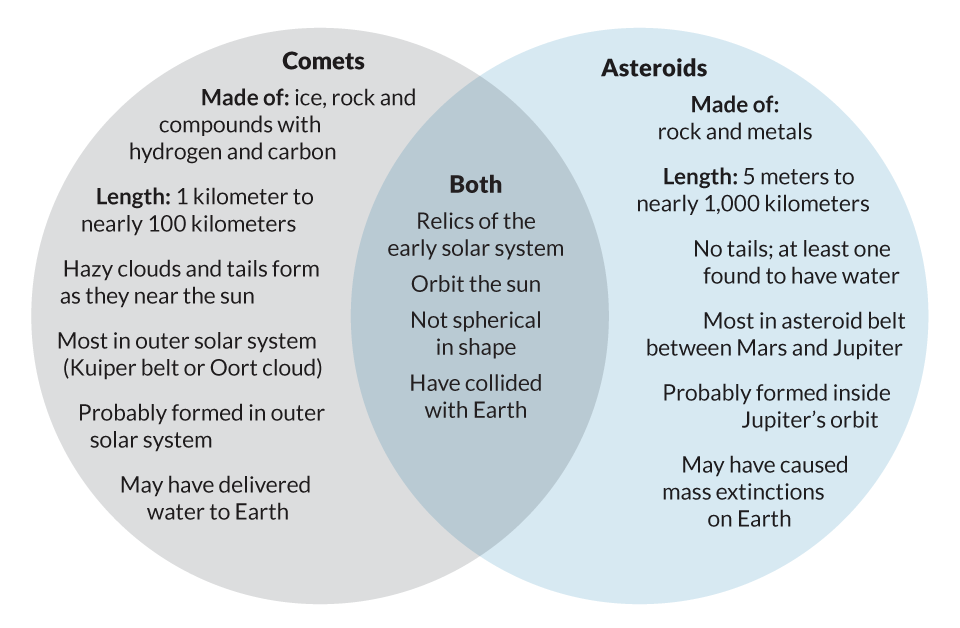
When comets get near the sun, they develop glowing tails that can sometimes be seen from Earth.

25

26

27

28

29
30

31

32

33

34
35
36
37

38

39

40

41

42

43

44

45
Solve -------
142,984 - 4, 879 = ? km. ; 88,846 - 3,032 = ? miles
Jupiter's diameter is 138,105 km. (85, 814 miles) bigger than Mercury's

46
47

48

49
Open Ended
50

51

52
53
The life zone is the region of space where the temperature range allows life to thrive.

54
Life Zone
Scientists think it is because Earth is the only planet within the solar system’s life
zone.
Earth sits near the center of the life zone.
Our solar system’s life zone
begins just outside Venus’s orbit
and ends before the orbit of Mars.

55
Our solar system’s life zone
begins just outside Venus’s orbit
and ends before the orbit of Mars.

56
57
Earth's Atmosphere
Earth’s atmosphere traps solar energy to keep Earth’s temperature comfortable.
It contains the gases that most living things
need.
It also protects living things from harmful solar radiation.

58
Earth's Oceans
Earth’s oceans help
maintain the temperature.
The oceans store and distribute heat from the sun. Ocean currents carry heat away from the equator and toward
the poles.

59
Earth's Oceans
Without the oceans to store and distribute heat from the sun,
some places on Earth would be extremely cold or extremely hot.

60
The temperature range of Earth
is ideal for many living things.

61
Open Ended
62

63

64
Sum It Up Answers
1. moons
2. gas giants (Uranus & Neptune are particularly considered also as ice giants)
3. rings
4. temperatures
5. Outer Planets (Jovian Planets)

65
Sum It Up Answers
6. hard
7. moons
8. rings
9. diameters
10. Inner Planets (Terrestrial Planets)
66
Brain Check Answers
Neptune - H.
Mercury - C.
Mars - E.
Saturn - D.
Earth - F.

67
Brain Check Answers
Uranus - B.
Jupiter - A.
Venus - G.
What Are the Planets in Our Solar System?
Show answer
Auto Play
Slide 1 / 67
SLIDE


