Search Header Logo
11.1 The Dissolution Process

11.1 The Dissolution Process

Assessment

Presentation

Chemistry

University

Medium

Created by

Luis Bello

Used 3+ times

FREE Resource

19 Slides • 10 Questions

1

11.1 The Dissolution Process

by Luis Bello

​luis.bello@tulsacc.edu

2

​Previous Class

​Phase Transitions

Phase Diagrams

media

3

Multiple Choice

**An ice cube feels cold when we hold it. Which of the following best explains why?

1

Heat moves from our hands into the ice cube.

2

Cold moves from our hands into the ice cube.

3

Heat moves from the ice cube into our hands.

4

Cold moves from the ice cube into our hands.

4

Multiple Choice

Question image

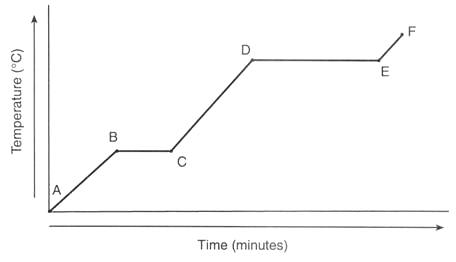
What line segment represents only the solid state? (Diagram F)

1

A-B

2

B-C

3

C-D

4

D-E

5

Multiple Choice

Question image

Between which points is the temperature of the substance remaining constant? (Diagram F)

1

A-B only.

2

A-B, C-D, E-F

3

B-C only.

4

B-C, D-E

6

Multiple Choice

True or false: melting and freezing occur at the same temperature!

1

True

2

False

3

I don't know

7

Multiple Choice

Question image

A substance's heating curve is shown in the graph. What is its boiling point? (Diagram B)

1

100 C

2

60 C

3

80 C

4

20 C

8

Multiple Choice

Question image

Is the substance gaining or losing energy? (Diagram D)

1

Gaining

2

Losing

9

Multiple Choice

Question image

What will occur when the substance changes from 1 atm to 30 at a constant temperature of -15oC? (Diagram A)

1

condensation

2

deposition

3

melting

4

sublimation

10

Multiple Choice

Question image

What is point A? (Diagram C)

1

triple point

2

critical point

3

equilibrium point

4

normal melting point

11

Multiple Choice

Question image

What is the normal boiling point of this substance? (Diagram C)

1

150 °C

2

100 °C

3

-50 °C

4

0 °C

12

Multiple Choice

Question image

What is the normal melting point of this substance? (Diagram C)

1

150 °C

2

100 °C

3

-50 °C

4

0 °C

13

14

15

media

16

media

17

media

18

media

19

media

20

11.2 Electrolytes

By the end of this section, you will be able to:

  • Define and give examples of electrolytes

  • Distinguish between the physical and chemical changes that accompany dissolution of ionic and covalent electrolytes

  • Relate electrolyte strength to solute-solvent attractive forces

21

media

22

media

23

media

Solutions of Gases in Liquids

24

Henry’s law

For many gaseous solutes, the relation between solubility, Cg, and partial pressure, Pg, is a proportional one:

Cg=kPg

where k is a proportionality constant that depends on the identities of the gaseous solute and solvent, and on the solution temperature. This is a mathematical statement of Henry’s law: The quantity of an ideal gas that dissolves in a definite volume of liquid is directly proportional to the pressure of the gas.

25

Application of Henry’s Law

At 20 °C, the concentration of dissolved oxygen in water exposed to gaseous oxygen at a partial pressure of 101.3 kPa is 1.38 × 10⁻³ mol L−1. Use Henry’s law to determine the solubility of oxygen when its partial pressure is 20.7 kPa, the approximate pressure of oxygen in earth’s atmosphere.

26

​Solution

media

27

Solutions of Liquids in Liquids

media

Some liquids may be mixed in any proportions to yield solutions; in other words, they have infinite mutual solubility and are said to be miscible.

Ethanol, sulfuric acid, and ethylene glycol (popular for use as antifreeze, pictured in Figure 11.13) are examples of liquids that are completely miscible with water.

28

Two liquids that do not mix to an appreciable extent are called immiscible

media

Separate layers are formed when immiscible liquids are poured into the same container. Gasoline, oil, benzene, carbon tetrachloride, some paints, and many other nonpolar liquids are immiscible with water.

29

Solutions of Solids in Liquids

The dependence of solubility on temperature for a number of solids in water is shown by the solubility curves in Figure 11.16. Reviewing these data indicates a general trend of increasing solubility with temperature, although there are exceptions, as illustrated by the ionic compound cerium sulfate.

media

11.1 The Dissolution Process

by Luis Bello

​luis.bello@tulsacc.edu

Show answer

Auto Play

Slide 1 / 29

SLIDE