Search Header Logo
Introduction to Solutions

Introduction to Solutions

Assessment

Presentation

Science

8th - 12th Grade

Medium

NGSS
MS-PS1-2, MS-PS1-4, MS-PS3-4

Standards-aligned

Created by

B Taylor

Used 28+ times

FREE Resource

11 Slides • 31 Questions

1

Introduction to Solutions

Ms Taylor

2

​Mixtures  

  • A mixture contains two or more substances that are not chemically combined.

  • Can be:

  • Homogenous- A substance is homogeneous if its composition is identical wherever you sample it - it has uniform composition and properties throughout. Homogeneous is Latin for the same kind. ex, sea water

  • Heterogeneous - A mixture that does not have uniform composition and properties throughout.

3

Homogenous Mixture

  • Solution - a Homogenous mixture, usually of a solid and a liquid where the solid settles out, eg saltwater. The parts making up a solution keep their individual properties but the particles are not clearly seen or distinguished. It can be made from liquid in liquid;gas in gas; gas in liquid etc.

  • ​Consists of two parts:

Solute - What is dissolved in a solution eg, the salt in saltwater. Usually in smaller amount.

Solvent - Liquid in which something is dissolved, eg the water in saltwater. The larger part of the solution.

4

Multiple Choice

What is a substance that is dissolved in another substance? 

1

solution

2

solute

3

solvent

4

compound

5

Multiple Choice

What is a solvent?

1

The substance that does the dissolving in a solution.

2

The substance that is being dissolved in a solution.

3

The mixing of different substances.

4

The process in which neutral molecules lose or gain electrons

6

Multiple Choice

Question image

Which substance is SOLUBLE in water?

1

sand

2

oil

3

salt (sodium chloride)

4

sulfur

7

Multiple Choice

Question image

Which substance is INSOLUBLE in water?

1

salt (sodium chloride)

2

sugar (sucrose)

3

oil

4

copper sulfate

8

Multiple Choice

salt water is a 

1

compound

2

element

3

heterogeneous mixture

4

solution

9

​Solubility

Solubility is how much solute dissolves in a certain amount of solvent at a certain temperature.

  • An Insoluble substance cannot be dissolved in the solvent.

  • Dissolve- "Like dissolves like'- polar solute dissolves in polar solvent and non-polar solute dissolve in non-polar solvent.(with reference to a solid) become or cause to become incorporated into a liquid so as to form a solution (solid particles are no longer visible).

Concentration - The amount of substance in a specified space. The more solute in the solvent, more concentrated. A small amount of solute in solvent makes a DILUTE solution.

10

Multiple Choice

When a Koolaid mix in water is dark in color and very sweet it is a __________ solution.

1

concentrated 

2

Diluted

11

Multiple Choice

What does it mean to dilute a solution?

1

lower the concentration of solute per solvent

2

increase the concentration of solute per solvent

12

​Factors that affect solubility

There are three factors that affect the solubility of a sulute. These are:

  • Temperature

  • Surface Area

  • Agitation/stirring

13

1. ​Temperature

  • The solubility of a given solute in a given solvent typically depends on temperature.

  • As the temperature of a solution is increased, the average kinetic energy of the molecules that make up the solution also increases.

  • This increase in kinetic energy allows the solvent molecules to more effectively break apart the solute molecules that are held together by intermolecular attractions.

  • Therefore, at higher temperatures, more of a solute is dissolved in the same amount of solvent.​ (ex. sugar dissolves easier in room temperature water than cold water)

14

​Saturated and Unsaturated Solutions

​An unsaturated solution is one that still has the ability to dissolve more solute particles.

​A saturated solution is one that has dissolved the maximum amount of solutes possible at that temperature. A saturated solution will have few solute particles undissolved as that is the indication that it cannot dissolve any more solute

A super-saturated solution is one which has dissolved as much solute as possible at a higher temperature after it had already been saturated. These will form crystals when cooled.

15

​2. Surface area

Surface Area - the outside part or uppermost layer of something (often used when describing its texture, form, or extent).

  • The SMALLER the particles, the GREATER the surface area that is exposed to the solvent.

  • Crushing the solute increases the amount of contact it has with the solvent. The particles of the crushed solute mix with the solvent more quickly and so dissolves faster.

  • ​Hence, clumps of sugar will take longer to dissolve than finer particles

16

​3. Agitation/stirring

Agitation - the action of briskly stirring or disturbing something, especially a liquid.

Mixing by stirring or shaking causes the solute particles to separate from one another and spread out more quickly among the solvent particles as it helps to increase the surface area exposed to solvent particles.

17

Multiple Choice

Question image

How does a solution become supersaturated?

1

dissolve lots of solute in it.

2

dissolve a little solute in it. 

3

dissolve more solute than you should be able to. 

4

dissolve a solvent in it. 

18

Multiple Choice

When a certain amount of solvent cannot hold any more solute it is called a ________ solution.

1

Diluted

2

Saturated

19

Multiple Choice

When materials combine to form a mixture, they

1

A. keep their original properties.

2

B. react to form a new substance with new properties.

3

C. combine in a specific ratio.

4

D. always change their physical state.

20

Multiple Choice

When a solvent contains as much of the solute as it can hold, the solution is said to be

1

supersaturated

2

diluted

3

saturated

4

unsaturated

21

Multiple Choice

Stirring the solution increases or decreases the solubility?

1

increases

2

decreases

22

Multiple Choice

Solution where more solute can still be dissolved at the given temperature. 

1

Saturated

2

Unsaturated

3

Supersaturated

4

Homogeneous solution

23

Multiple Choice

Question image

Which factor is shown in the picture?

1

temperature

2

particle size

3

stirring

4

use of spoon

24

Multiple Choice

Why do sugar particles dissolve faster in hot water?

1

water particles move slow

2

water particles move fast

3

water particles settle down

4

water particles stay on top

25

Multiple Choice

What combination would dissolve a solid solute the fastest?

1

high temperature, no stirring

2

no heat, no stirring

3

sugar cube, no heat

4

high temperature, stirring

26

Multiple Choice

Question image

The beaker on the left is _______________ and the beaker on the right is _______________

1

Concentrated, dilute

2

Dilute, concentrated

3

Soluble, insoluble

4

Insoluble, soluble

27

Multiple Choice

Which of the following does not affect solubility of solutes?

1

Tempearture

2

Color

3

Size particles

4

Kind of solute

28

Multiple Choice

Which of the following statements is true about how using smaller salt crystals would affect the rate of making a salt solution in water?

1

Smaller crystals increase the surface area and slow down dissolving.

2

Smaller crystals decrease the surface area and speed up dissolving.

3

Smaller crystals increase the surface area and speed up dissolving.

4

Smaller crystals decrease the surface area and slow down dissolving.

29

Multiple Choice

Which will dissolve faster crushed table salt or crystal of table salt?

1

crushed table salt

2

crystal of table salt

30

Multiple Choice

The concentration of a mixture can be increased in which of the following ways?

1

Heating the mixture

2

Adding more water “solvent”

3

Adding more powder “solute”

4

Stirring the mixture

31

Multiple Choice

Which of the following actions will NOT

increase the rate of dissolution

(dissolving) for solids?

1

Stirring the solution

2

Decreasing the temperature

3

Increasing the surface area of the

solute

4

Increasing the temperature

32

Multiple Choice

Which of the following actions will NOT

increase the rate of dissolution

(dissolving) for solids?

1

Stirring the solution

2

Decreasing the temperature

3

Increasing the surface area of the

solute

4

Increasing the temperature

33

media
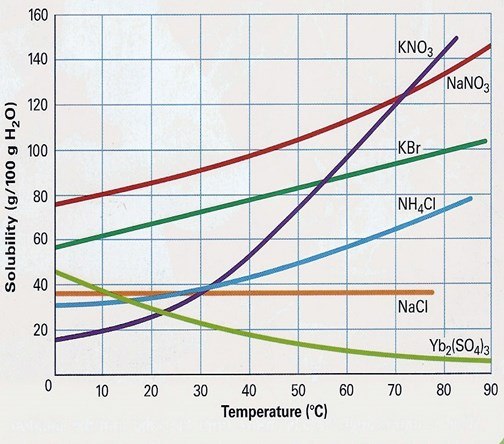
  • These are used to map the state of solubility of a substance AT A GIVEN TEMPERATURE. ​

  • IF the amount of solute in the solution at a STATED temperature falls:

  1. on the line- it is saturated at that temperature

  2. Under the line-unsaturated at that temperature

  3. Above the line-supersaturated​ at that temperature

Solubility Charts

34

media
  • Usually the graphs shows solubility Curves for more than one substance.

  • Select the curve that matches the substance you need and ignore the others.

Note points to the left of graph!!​

Reading Solubility Graphs

35

Multiple Choice

Question image
How many grams of SOcan dissolve at 50 ⁰C?
1
5 g
2
10 g
3
20 g
4
39 g

36

Multiple Choice

Question image
What is the minimum temperature needed to dissolve at least 10 g of KClO3?
1
25 ⁰C
2
10 ⁰C
3
5 ⁰C
4
100 ⁰C

37

Multiple Choice

Question image
Which solute does not increase in solubility as temperature rises?
1
NH3
2
NaNO3
3
KNO3
4
NaCl

38

Multiple Choice

Question image

How many grams of SO2 can dissolve at 50 ⁰C in 100 g of water?

1

5 g

2

10 g

3

20 g

4

39 g

39

Multiple Choice

Question image

At 80'C, KBr's solubility is:

1

100

2

90

3

80

4

0

40

Multiple Choice

Question image

How much NaBr solute can be dissolved at 70 degrees?

1

110

2

120

3

130

4

140

41

Multiple Choice

Question image

When 40 grams of NaCl is dissolved in 100 grams of water at 90 ºC, the solution can be correctly described as:

1

supersaturated

2

saturated

3

unsaturated

42

Multiple Choice

Question image

What is the solubility of NaNO3 at 20 C in 100 g of water?

1

90 g

2

80 g

3

40 g

4

160 g

Introduction to Solutions

Ms Taylor

Show answer

Auto Play

Slide 1 / 42

SLIDE