

History of atomic theory

Presentation
•
Chemistry
•
10th - 12th Grade
•
Medium
Standards-aligned

Kristen Vanderveen
Used 40+ times
FREE Resource
15 Slides • 15 Questions
1
Bromfield Honors Chemistry
2

3
4

5
Multiple Choice
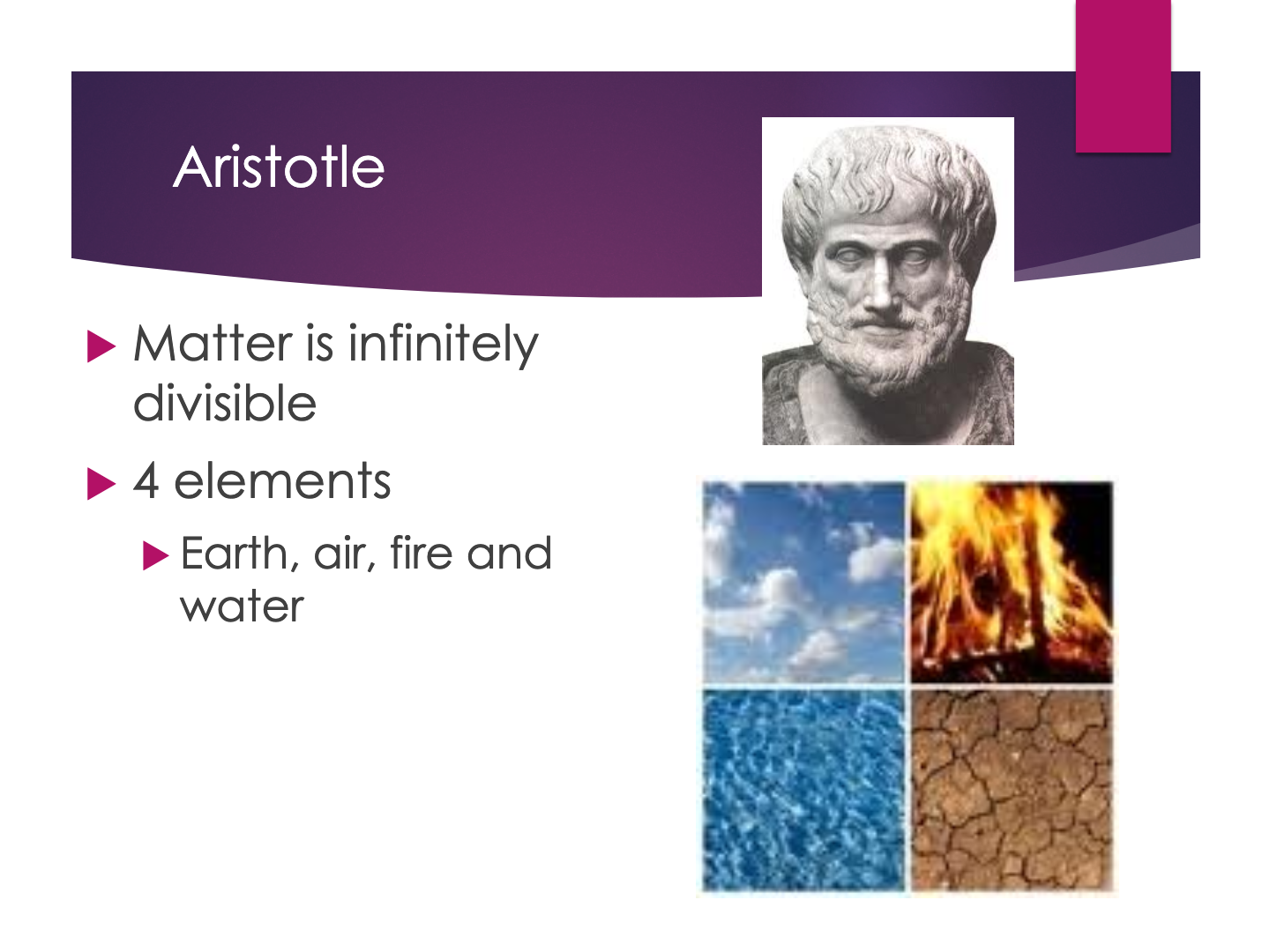
Which scientist is credited with being the first to propose that matter is made of atoms?
Aristotle
Dalton
Boyle
6
"Father of modern chemistry"
Some major accomplishments:
*Introduced a quantitative experimental approach
*Identified hydrogen and oxygen as elements

7
Lavosier is credited with stating the Law of Conservation of Mass

The total mass of the reactants is equal to the total mass of the products.
8
Watch this video about Lavoisier's experiments showing conservation of mass
9
Multiple Choice
12 grams of carbon react with 32 grams of oxygen to form exactly 44 grams of carbon dioxide. This is a good example of Lavoisier's:
Law of Definite Proportions
Atomic Theory
Law of Conservation of Mass
Law of Multiple Proportions
10
Multiple Choice
Scientist credited with developing the Law of Conservation of Mass
Lavoisier
Democritus
Dalton
Proust
11
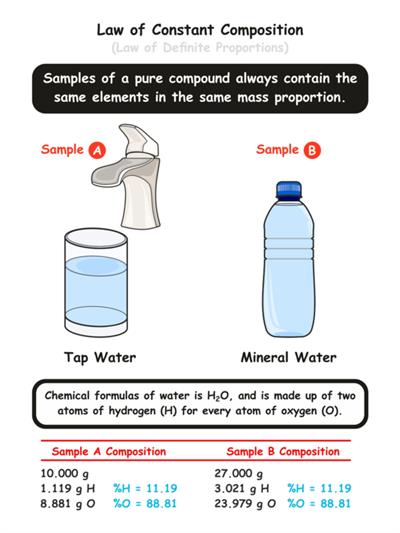
(aka law of definite proportions)
Proposed by Joseph Proust
12

A pure sample of a compound contains the same ratio of elements by mass, regardless of the source or size of the sample
Some text here about the topic of discussion.
Law of definite composition
13

Examples:
14
Multiple Choice
Democritus
15

16

17
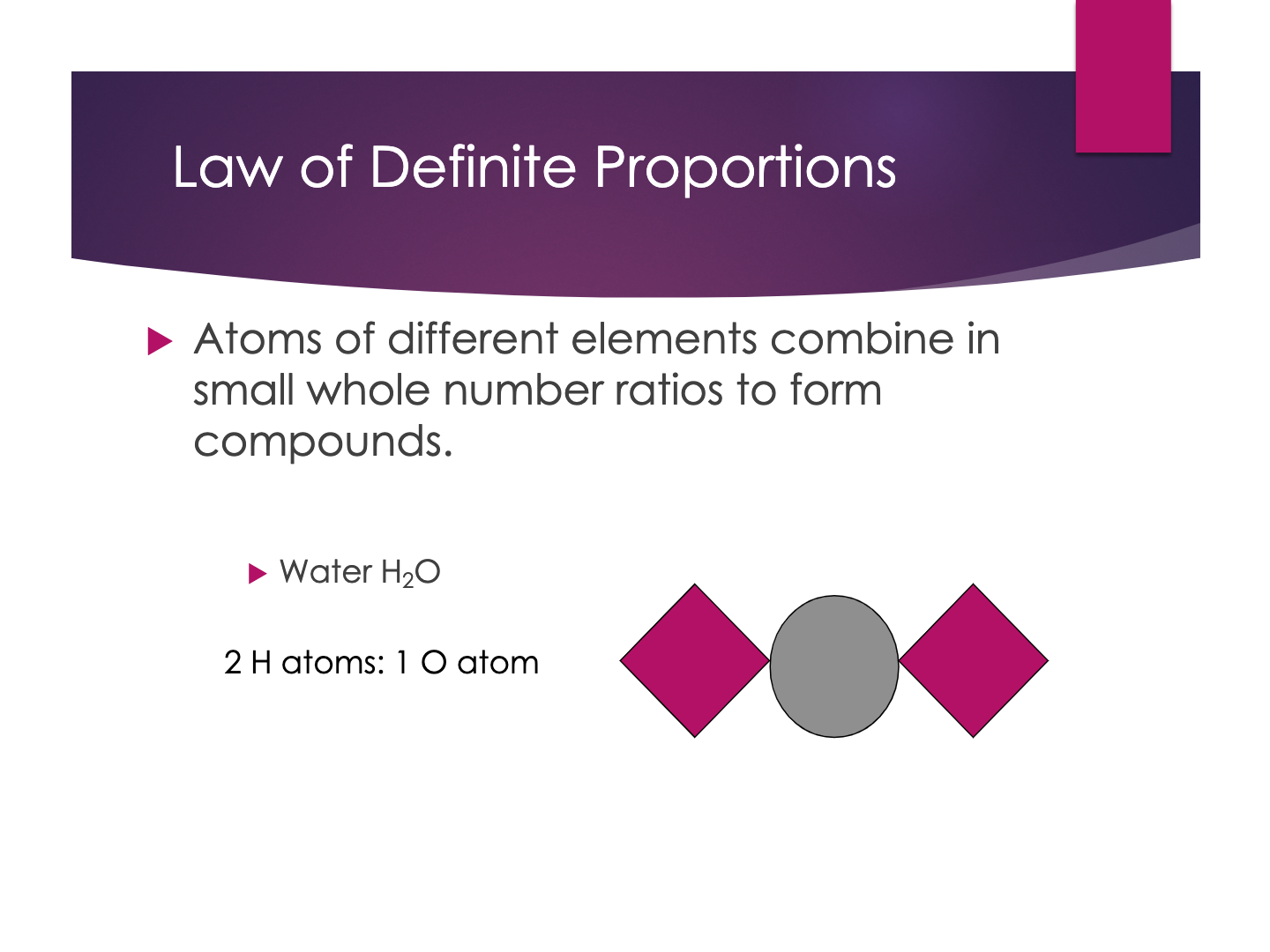
This is how Dalton incorporated Proust's work into his theory
18

This law came out of Dalton's own experiments
19
Multiple Choice
States that, regardless of the amount, a compound is always composed of the same elements in the same proportion by mass
Law of definite proportions
Law of conservation of mass
Law of multiple proportions
Periodic law
20
Multiple Choice
Who is credited with stating the "Law of Definite Proportions" ?
Dalton
Proust
Democritus
Brady
Lavoisier
21
Multiple Choice
Which law states that two different compounds can be made from the same two elements (in different proportions)?
Law of Definite proportions
Law of multiple proportions
Law of conservation of mass
Dalton's Law of Partial Pressures
22
Multiple Select
Which of the following is NOT a part of Dalton's atomic theory?
Atoms are made of protons, neutrons and electrons.
Atoms are always in motion.
Atoms of the same element are identical.
Atoms can't be destroyed...merely re-arranged.
Every element has its own kind of atom.
23
Multiple Choice
The percentage of copper and oxygen in samples of “CuO” obtained by different methods were found to be the same. This illustrates the law of:
definite proportions
conservation of mass
multiple proportions
mass action
24
Multiple Choice
The compounds FeO, Fe2O3, and Fe3O4 all have been identified. These compounds illustrate the law of ____
multiple proportions
definite proportions
mass action
conservation of mass
25
Multiple Choice
Which one of the following statements is NOT part of Dalton's atomic theory?
26
Multiple Choice
Idea that matter cannot be created nor destroyed
Rutherford's Rule
Mendeleev's Mandate
Law of Conservation of Matter
The Periodic Law
Proust's Postulate
27
Multiple Choice
Although all parts of Dalton's atomic theory are important, which one of the statements is crucial to explain the observations summarized by the Law of Definite Proportions?
28
Multiple Choice
29
Multiple Choice
The scientist who first claimed that matter was made of small, hard particles called “atomos.”
Democritis
Dalton
Proust
Einstein
Mendeleev
30

Bromfield Honors Chemistry
Show answer
Auto Play
Slide 1 / 30
SLIDE
Similar Resources on Wayground

21 questions
Limiting Reagents and Percentage Yield
Presentation
•
10th - 12th Grade
24 questions
Atomic Models
Presentation
•
9th - 12th Grade
25 questions
Periodic Table Families and Properties
Presentation
•
9th - 12th Grade
25 questions
2.9 Covalent Bonding
Presentation
•
9th - 12th Grade
21 questions
Elements, Compounds, Mixtures
Presentation
•
9th - 12th Grade
21 questions
Chemical Reactions Intro
Presentation
•
9th - 12th Grade
22 questions
Kinetic Molecular Theory
Presentation
•
10th Grade - University
21 questions
Dilutions and Molarity Calculations
Presentation
•
10th - 12th Grade
Popular Resources on Wayground
10 questions
How much do you know about our Portrait of an Eagle?

Quiz
•
10th Grade
10 questions
Fast Food Slogans
Quiz
•
6th - 8th Grade
21 questions
Continents and Oceans
Quiz
•
6th Grade
20 questions
Parts of Speech
Quiz
•
5th Grade
16 questions
Subject & Predicate
Quiz
•
5th Grade
25 questions
Multiplication Facts
Quiz
•
5th Grade
12 questions
Map Skills
Quiz
•
3rd Grade
22 questions
Continents and Oceans
Quiz
•
5th Grade
Discover more resources for Chemistry
20 questions
Metric Conversions
Quiz
•
11th Grade
20 questions
electron configurations and orbital notation
Quiz
•
9th - 12th Grade
26 questions
Atomic Structure, Isotopes and Ions
Quiz
•
10th Grade
20 questions
Periodic Trends
Quiz
•
10th Grade
5 questions
Atomic Theory Intro Video

Interactive video
•
10th Grade
20 questions
COUNTING ATOMS
Quiz
•
10th Grade
20 questions
Practice: E-Con, Orbital Notation, Noble Gas Notation
Quiz
•
10th Grade
20 questions
Ions
Quiz
•
10th Grade